Lester Diarmuid, McGrane Bronagh, Belton Sarahjane, Duncan Michael J, Chambers Fiona C, O'Brien Wesley
School of Education, Sports Studies and Physical Education, University College Cork, 2 Lucan Place, Western Road, Cork, Ireland.
School of Arts Education and Movement, Dublin City University, Institute of Education, St. Patrick's Campus, Dublin, Ireland.
Sports (Basel). 2017 Oct 2;5(4):77. doi: 10.3390/sports5040077.
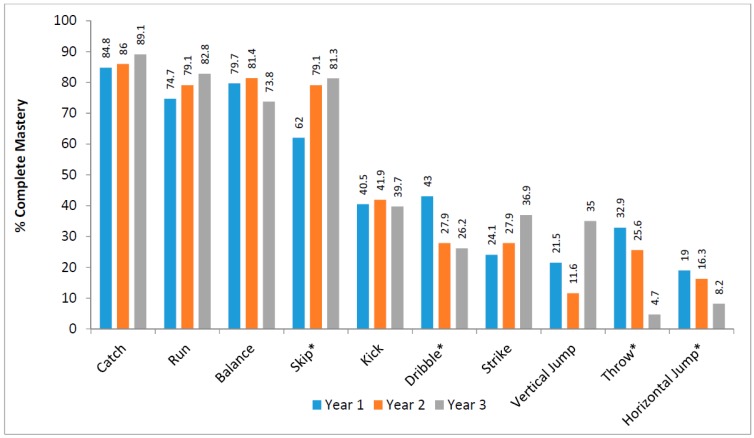
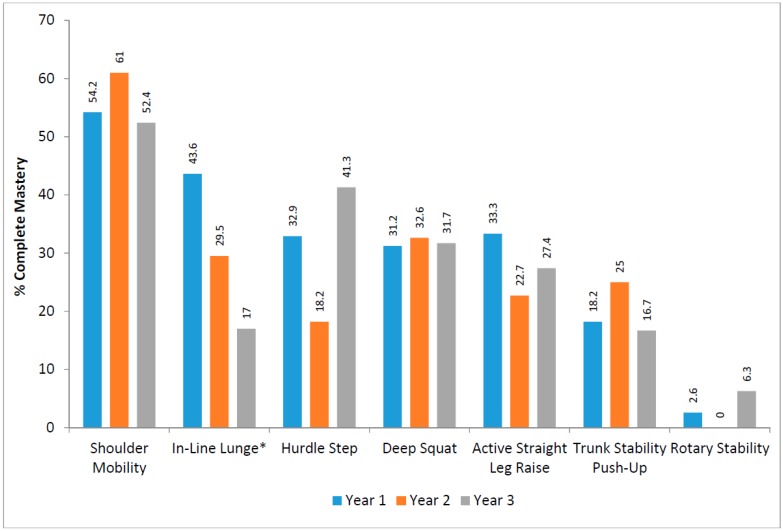
Research has shown that post-primary Irish youth are insufficiently active and fail to reach a level of proficiency across basic movement skills. The purpose of the current research was to gather cross-sectional baseline data on Irish adolescent youth, specifically the prevalence of movement skills and patterns, in order to generate an overall perspective of movement within the first three years (Junior Certificate level) of post-primary education. Data were collected on adolescents (N = 181; mean age: 14.42 ± 0.98 years), attending two, mixed-gender schools. Data collection included 10 fundamental movement skills (FMS) and the seven tests within the Functional Movement Screen (FMS™). The data set was analysed using the Statistical Package for Social Sciences (SPSS) version 20.0 for Windows. Overall, levels of actual mastery within fundamental and functional movement were low. There were statistically significant age-related differences observed, with a progressive decline as age increased in both the object control ( = 0.002) FMS sub-domain, and the in-line lunge ( = 0.048) test of the FMS™. In summary, we found emerging evidence that school year group is significantly associated with mastery of movement skills and patterns. Results from the current study suggest that developing a specifically tailored movement-oriented intervention would be a strategic step towards improving the low levels of adolescent fundamental and functional movement proficiency.
研究表明,爱尔兰小学毕业后的青少年活动量不足,且未能达到基本运动技能的熟练水平。当前研究的目的是收集爱尔兰青少年的横断面基线数据,特别是运动技能和模式的流行情况,以便全面了解小学毕业后前三年(初中证书水平)的运动情况。对就读于两所男女混合学校的青少年(N = 181;平均年龄:14.42 ± 0.98岁)进行了数据收集。数据收集包括10项基本运动技能(FMS)和功能性动作筛查(FMS™)中的七项测试。使用适用于Windows的社会科学统计软件包(SPSS)20.0版对数据集进行了分析。总体而言,基本运动和功能性运动的实际掌握水平较低。观察到存在与年龄相关的统计学显著差异,在FMS™的物体控制( = 0.002)子领域和直线弓步( = 0.048)测试中,随着年龄的增长均呈逐渐下降趋势。总之,我们发现新的证据表明学年组与运动技能和模式的掌握程度显著相关。当前研究的结果表明,制定专门定制的以运动为导向的干预措施将是提高青少年基本运动和功能性运动熟练程度较低水平的战略步骤。