Department of Pharmacology and Cancer Biology, Duke University School of Medicine, Durham, North Carolina 27710.
Albert Eye Research Institute, Duke University, Durham, North Carolina 27710.
eNeuro. 2018 Jun 11;5(3). doi: 10.1523/ENEURO.0144-18.2018. eCollection 2018 May-Jun.
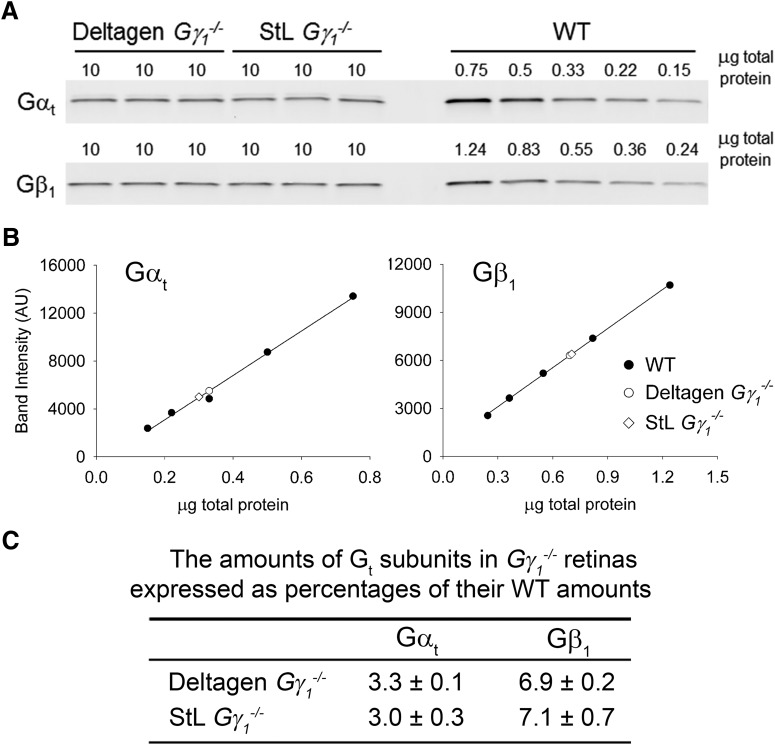
The heterotrimeric G-protein transducin mediates visual signaling in vertebrate photoreceptor cells. Many aspects of the function of transducin were learned from knock-out mice lacking its individual subunits. Of particular interest is the knockout of its rod-specific γ-subunit (Gγ). Two studies using independently generated mice documented that this knockout results in a considerable >60-fold reduction in the light sensitivity of affected rods, but provided different interpretations of how the remaining α-subunit (Gα) mediates phototransduction without its cognate Gβγ-subunit partner. One study found that the light sensitivity reduction matched a corresponding reduction in Gα content in the light-sensing rod outer segments and proposed that Gα activation is supported by remaining Gβ associating with other Gγ subunits naturally expressed in photoreceptors. In contrast, the second study reported the same light sensitivity loss but a much lower, only approximately sixfold, reduction of Gα and proposed that the light responses of these rods do not require Gβγ at all. To resolve this controversy and elucidate the mechanism driving visual signaling in Gγ knock-out rods, we analyzed both mouse lines side by side. We first determined that the outer segments of both mice have identical Gα content, which is reduced ∼65-fold from the wild-type (WT) level. We further demonstrated that the remaining Gβ is present in a complex with endogenous Gγ and Gγ subunits and that these complexes exist in wild-type rods as well. Together, these results argue against the idea that Gα alone supports light responses of Gγ knock-out rods and suggest that Gβγ is not unique in its ability to mediate vertebrate phototransduction.
三聚体 G 蛋白转导素介导脊椎动物光感受器细胞的视觉信号转导。通过敲除缺乏其单个亚基的突变小鼠,我们了解了转导素功能的许多方面。特别有趣的是敲除其 rod 特异性 γ-亚基(Gγ)。两项使用独立生成的小鼠的研究表明,这种敲除导致受影响的 rod 光敏感性显著降低>60 倍,但对剩余的 α-亚基(Gα)如何在没有其同源 Gβγ-亚基伴侣的情况下介导光转导提供了不同的解释。一项研究发现,光敏感性降低与光感受器中天然表达的剩余 Gβ与其他 Gγ 亚基结合所支持的 Gα 激活相匹配。相比之下,第二项研究报告了相同的光敏感性损失,但 Gα 的减少仅约为六倍,并且提出这些 rod 的光反应根本不需要 Gβγ。为了解决这一争议并阐明 Gγ 敲除 rod 中视觉信号转导的机制,我们并排分析了这两种小鼠系。我们首先确定两种小鼠的外段都具有相同的 Gα 含量,其从野生型(WT)水平降低了约 65 倍。我们进一步证明,剩余的 Gβ与内源性 Gγ和 Gγ 亚基形成复合物,这些复合物也存在于野生型 rod 中。这些结果共同反对了 Gα 单独支持 Gγ 敲除 rod 光反应的观点,并表明 Gβγ 并非介导脊椎动物光转导的独特能力。