Hans Popper Laboratory of Molecular Hepatology, Division of Gastroenterology & Hepatology, Internal Medicine III, Medical University of Vienna, Währinger Gürtel 18-20, A-1090 Vienna, Austria.
Int J Mol Sci. 2018 Jun 15;19(6):1777. doi: 10.3390/ijms19061777.
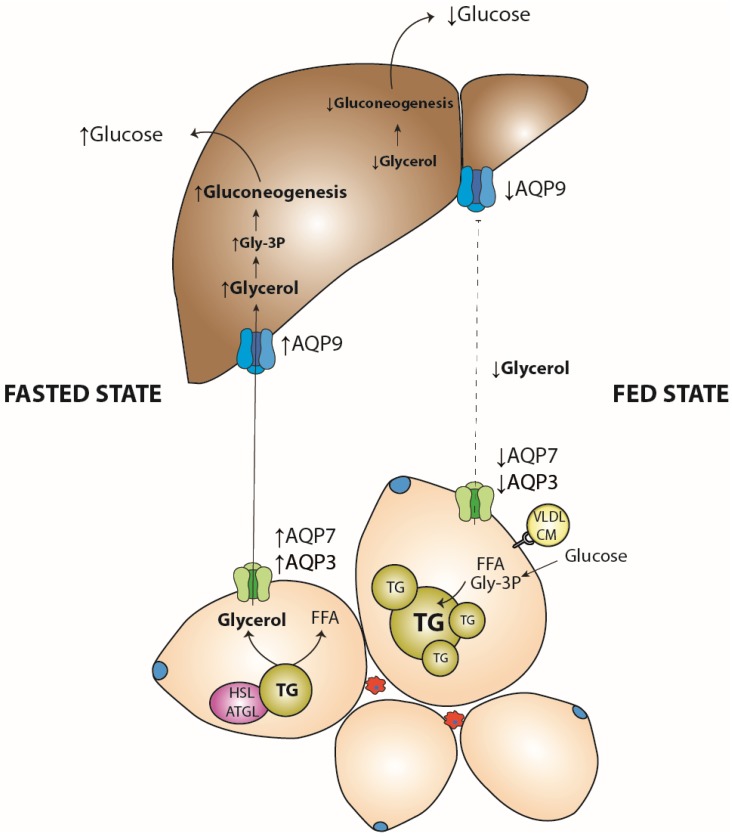
Nuclear receptors, such as the farnesoid X receptor (FXR) and the peroxisome proliferator-activated receptors gamma and alpha (PPAR-γ, -α), are major metabolic regulators in adipose tissue and the liver, where they govern lipid, glucose, and bile acid homeostasis, as well as inflammatory cascades. Glycerol and free fatty acids are the end products of lipid droplet catabolism driven by PPARs. Aquaporins (AQPs), a family of 13 small transmembrane proteins, facilitate the shuttling of water, urea, and/or glycerol. The peculiar role of AQPs in glycerol transport makes them pivotal targets in lipid metabolism, especially considering their tissue-specific regulation by the nuclear receptors PPARγ and PPARα. Here, we review the role of nuclear receptors in the regulation of glycerol shuttling in liver and adipose tissue through the function and expression of AQPs.
核受体,如法尼醇 X 受体 (FXR) 和过氧化物酶体增殖物激活受体 γ 和 α (PPAR-γ、-α),是脂肪组织和肝脏中主要的代谢调节剂,它们调节脂质、葡萄糖和胆汁酸的动态平衡,以及炎症级联反应。甘油和游离脂肪酸是由 PPAR 驱动的脂滴分解代谢的终产物。水通道蛋白 (AQPs) 是由 13 种小跨膜蛋白组成的家族,促进水、尿素和/或甘油的穿梭。AQP 在甘油转运中的特殊作用使它们成为脂质代谢的关键靶点,尤其是考虑到它们被核受体 PPARγ 和 PPARα 的组织特异性调节。在这里,我们通过 AQPs 的功能和表达来综述核受体在调节肝脏和脂肪组织中甘油转运中的作用。