Department of Theoretical and Computational Biophysics, Max Planck Institute for Biophysical Chemistry, Am Fassberg 11, 37077, Göttingen, Germany.
Nat Commun. 2018 Jun 18;9(1):2375. doi: 10.1038/s41467-018-04830-4.
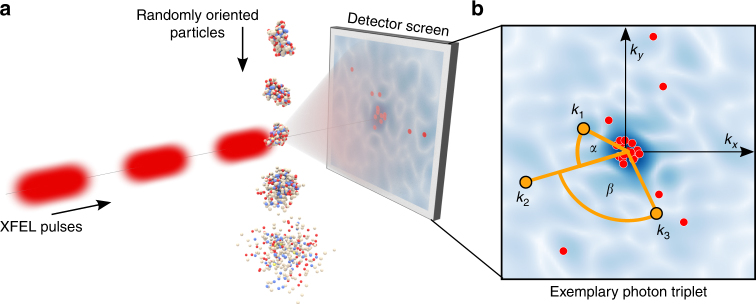
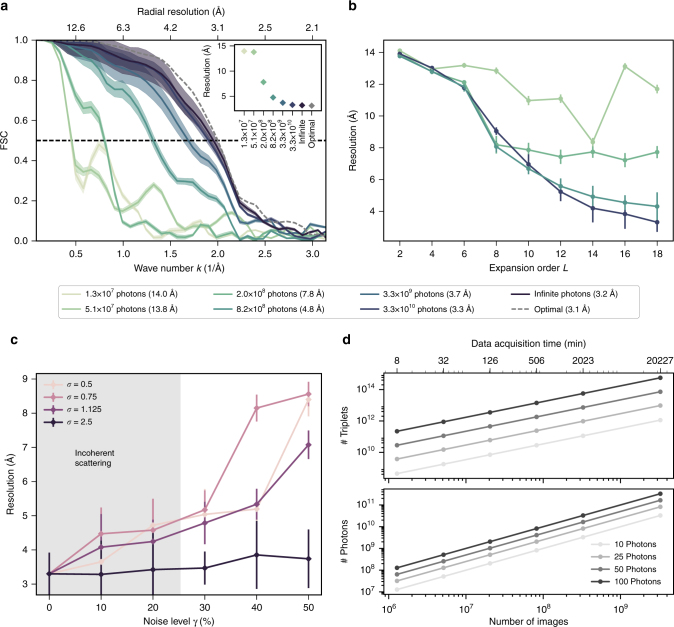
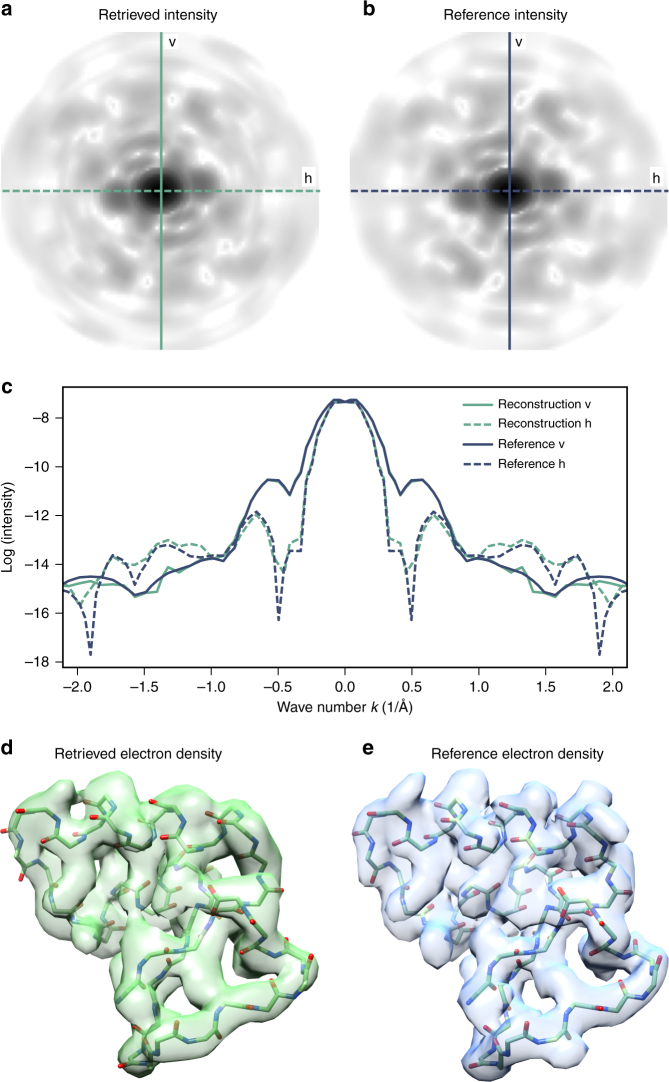
Scattering experiments with femtosecond high-intensity free-electron laser pulses provide a new route to macromolecular structure determination. While currently limited to nano-crystals or virus particles, the ultimate goal is scattering on single biomolecules. The main challenges in these experiments are the extremely low signal-to-noise ratio due to the very low expected photon count per scattering image, often well below 100, as well as the random orientation of the molecule in each shot. Here we present a de novo correlation-based approach and show that three coherently scattered photons per image suffice for structure determination. Using synthetic scattering data of a small protein, we demonstrate near-atomic resolution of 3.3 Å using 3.3 × 10 coherently scattered photons from 3.3 × 10 images, which is within experimental reach. Further, our three-photon correlation approach is robust to additional noise from incoherent scattering; the number of disordered solvent molecules attached to the macromolecular surface should be kept small.
飞秒强激光自由电子脉冲散射实验为确定生物大分子结构提供了新途径。虽然目前仅限于纳米晶体或病毒颗粒,但最终目标是对单个生物分子进行散射。这些实验的主要挑战是由于每个散射图像的预期光子计数非常低,通常远低于 100,因此信号与噪声比极低,以及分子在每次拍摄时的随机取向。在这里,我们提出了一种基于全新关联的方法,并表明每张图像中有三个相干散射光子就足以进行结构确定。使用一个小蛋白的合成散射数据,我们证明了在使用 3.3×10 张图像中的 3.3×10 个相干散射光子的情况下,可以达到近原子分辨率 3.3Å,这在实验范围内是可行的。此外,我们的三光子相关方法对来自非相干散射的额外噪声具有鲁棒性;附着在大分子表面的无序溶剂分子的数量应保持较小。