Departamento de Microbiologia, Universidade Federal de Viçosa, Viçosa, 36570-900, Brazil.
Núcleo de Biomoléculas, Universidade Federal de Viçosa, Viçosa, Brazil.
Sci Rep. 2018 Jun 18;8(1):9273. doi: 10.1038/s41598-018-27423-z.
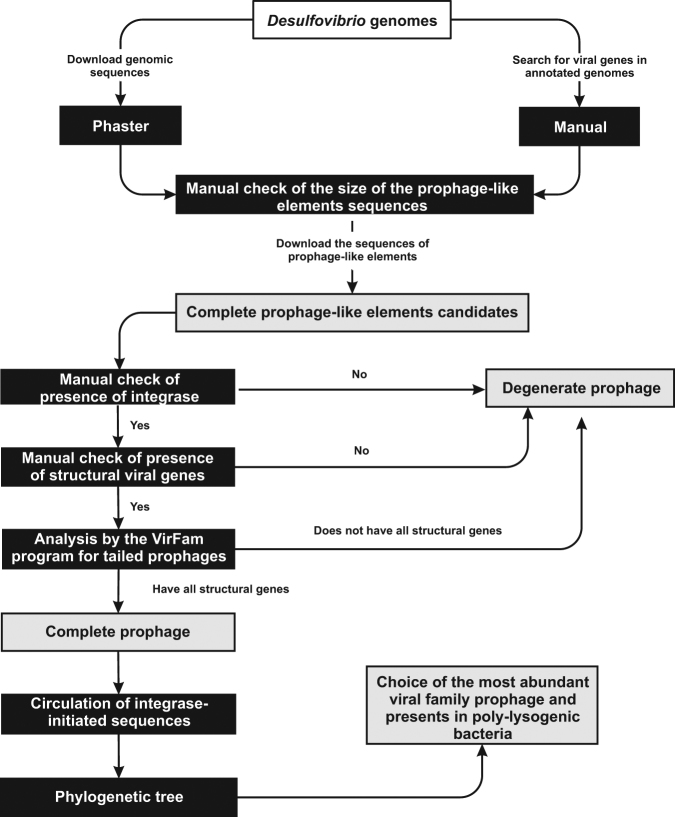
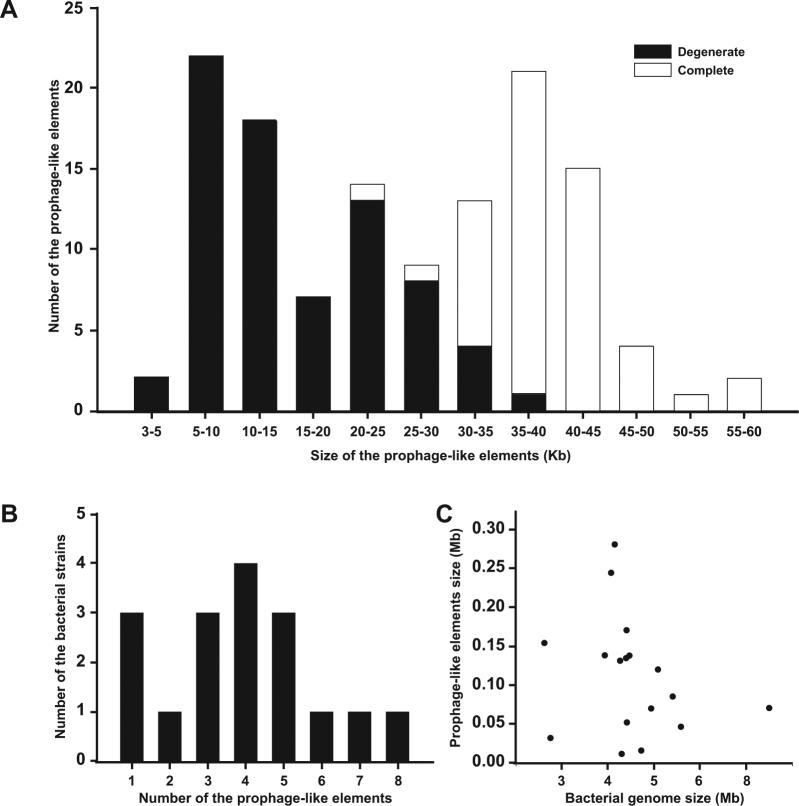
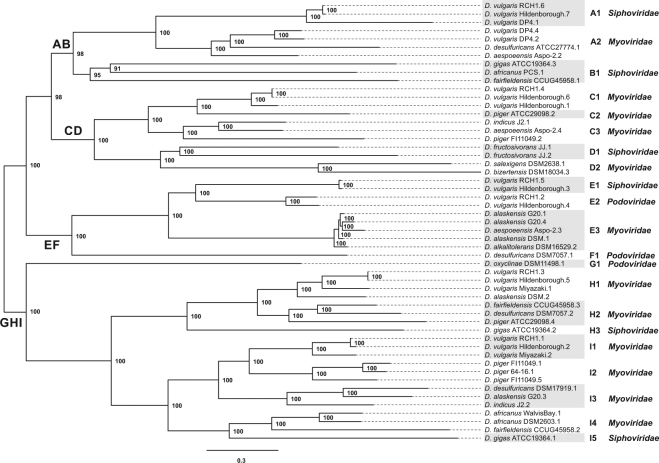
Bacteria of the genus Desulfovibrio belong to the group of Sulphate Reducing Bacteria (SRB). SRB generate significant liabilities in the petroleum industry, mainly due to their ability to microbiologically induce corrosion, biofilm formation and HS production. Bacteriophages are an alternative control method for SRB, whose information for this group of bacteria however, is scarce. The present study developed a workflow for the identification of complete prophages in Desulfovibrio. Poly-lysogenesis was shown to be common in Desulfovibrio. In the 47 genomes analyzed 53 complete prophages were identified. These were classified within the order Caudovirales, with 69.82% belonging to the Myoviridade family. More than half the prophages identified have genes coding for lysozyme or holin. Four of the analyzed bacterial genomes present prophages with identity above 50% in the same strain, whose comparative analysis demonstrated the existence of colinearity between the sequences. Of the 17 closed bacterial genomes analyzed, 6 have the CRISPR-Cas system classified as inactive. The identification of bacterial poly-lysogeny, the proximity between the complete prophages and the possible inactivity of the CRISPR-Cas in closed bacterial genomes analyzed allowed the choice of poly-lysogenic strains with prophages belonging to the Myoviridae family for the isolation of prophages and testing of related strains for subsequent studies.
脱硫弧菌属细菌属于硫酸盐还原菌 (SRB) 群。SRB 在石油工业中会产生重大的责任,主要是因为它们具有微生物诱导腐蚀、生物膜形成和 HS 生成的能力。噬菌体是 SRB 的一种替代控制方法,然而,关于该组细菌的噬菌体信息却很少。本研究开发了一种鉴定脱硫弧菌中完整噬菌体的工作流程。聚赖氨酸生成被证明在脱硫弧菌中很常见。在所分析的 47 个基因组中,鉴定出了 53 个完整的噬菌体。这些噬菌体被归类为尾噬菌体目,其中 69.82%属于肌病毒科。在所鉴定的超过一半的噬菌体中,有编码溶菌酶或溶菌素的基因。在分析的四个细菌基因组中,同一菌株中有超过 50%身份相同的噬菌体,对其进行比较分析表明序列之间存在线性关系。在所分析的 17 个封闭细菌基因组中,有 6 个具有被归类为非活性的 CRISPR-Cas 系统。鉴定细菌多聚赖氨酸生成、完整噬菌体与分析的封闭细菌基因组中可能不活跃的 CRISPR-Cas 之间的接近程度,使得选择属于肌病毒科的多聚赖氨酸生成菌株成为可能,用于分离噬菌体并测试相关菌株,以便进行后续研究。