1 Julius Center for Health Sciences and Primary Care, University Medical Center, the Netherlands.
2 Department of Neurobiology, Care Science and Society, Karolinska Institutet, Sweden.
Eur J Prev Cardiol. 2018 Aug;25(12):1326-1340. doi: 10.1177/2047487318780751. Epub 2018 Jun 19.
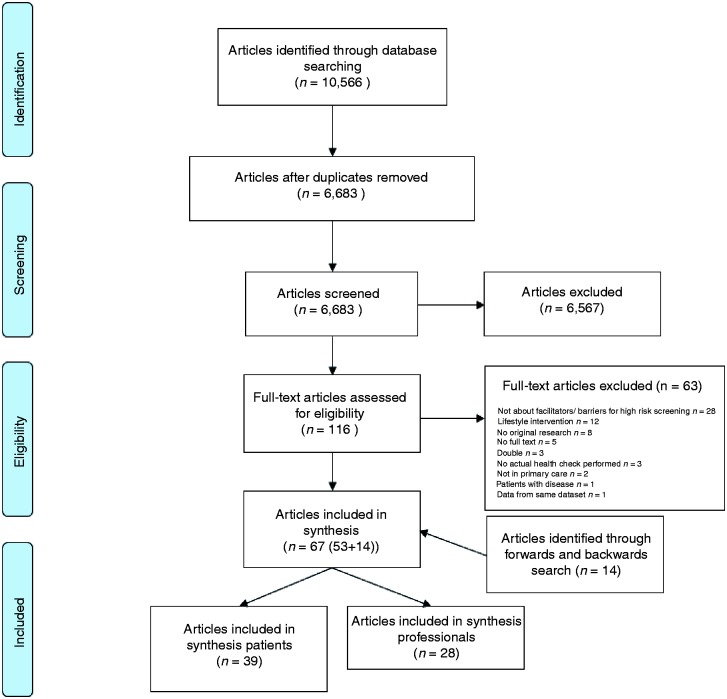
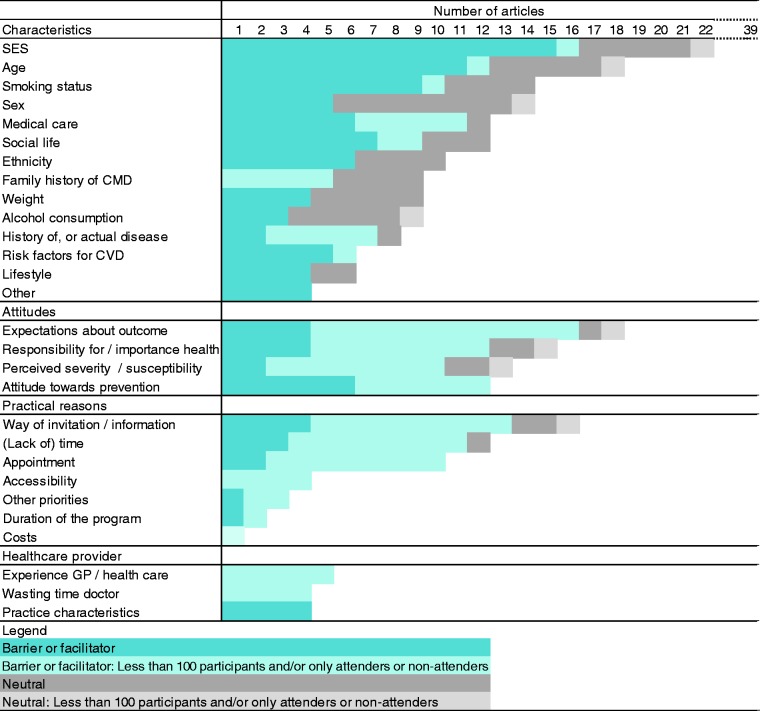
Background Health checks for cardiometabolic diseases could play a role in the identification of persons at high risk for disease. To improve the uptake of these health checks in primary care, we need to know what barriers and facilitators determine participation. Methods We used an iterative search strategy consisting of three steps: (a) identification of key-articles; (b) systematic literature search in PubMed, Medline and Embase based on keywords; (c) screening of titles and abstracts and subsequently full-text screening. We summarised the results into four categories: characteristics, attitudes, practical reasons and healthcare provider-related factors. Results Thirty-nine studies were included. Attitudes such as wanting to know of cardiometabolic disease risk, feeling responsible for, and concerns about one's own health were facilitators for participation. Younger age, smoking, low education and attitudes such as not wanting to be, or being, worried about the outcome, low perceived severity or susceptibility, and negative attitude towards health checks or prevention in general were barriers. Furthermore, practical issues such as information and the ease of access to appointments could influence participation. Conclusion Barriers and facilitators to participation in health checks for cardiometabolic diseases were heterogeneous. Hence, it is not possible to develop a 'one size fits all' approach to maximise the uptake. For optimal implementation we suggest a multifactorial approach adapted to the national context with special attention to people who might be more difficult to reach. Increasing the uptake of health checks could contribute to identifying the people at risk to be able to start preventive interventions.
针对心脏代谢疾病的健康检查可能有助于发现高危人群。为了提高这些健康检查在初级保健中的利用率,我们需要了解哪些障碍和促进因素决定了参与度。
我们使用了一个迭代搜索策略,包括三个步骤:(a)确定关键文章;(b)基于关键词在 PubMed、Medline 和 Embase 中进行系统文献搜索;(c)筛选标题和摘要,然后进行全文筛选。我们将结果总结为四个类别:特征、态度、实际原因和医疗保健提供者相关因素。
共纳入 39 项研究。想要了解心脏代谢疾病风险、感到有责任、关心自己的健康等态度是参与的促进因素。年龄较小、吸烟、教育程度较低、不想担心结果、对健康检查或预防的态度消极、认为严重程度或易感性低等态度是参与的障碍。此外,信息和预约的便利性等实际问题也可能影响参与度。
参与心脏代谢疾病健康检查的障碍和促进因素具有异质性。因此,不可能制定一种“一刀切”的方法来最大限度地提高利用率。为了实现最佳实施效果,我们建议采取一种多因素方法,并根据国情进行调整,特别关注那些可能更难接触到的人群。提高健康检查的利用率可以帮助识别有风险的人群,以便能够开始进行预防性干预。