Department of Cardiology, Cliniques Universitaires de Bruxelles, Hôpital Académique Erasme, Bruxelles, Belgium.
Department of Cardiovascular, Neural and Metabolic Sciences, Ospedale S. Luca IRCCS Istituto Auxologico Italiano, Milan, Italy.
PLoS One. 2018 Jun 19;13(6):e0199164. doi: 10.1371/journal.pone.0199164. eCollection 2018.
In pulmonary hypertension (PH), both wedge pressure elevation (PAWP) and a precapillary component may affect right ventricular (RV) afterload. These changes may contribute to RV failure and prognosis. We aimed at describing the different haemodynamic phenotypes of patients with PH due to left heart disease (LHD) and at characterizing the impact of pulmonary haemodynamics on RV function and outcome PH-LHD.
Patients with PH-LHD were compared with treatment-naïve idiopathic/heritable pulmonary arterial hypertension (PAH, n = 35). PH-LHD patients were subdivided in Isolated post-capillary PH (IpcPH: diastolic pressure gradient, DPG<7 mmHg and pulmonary vascular resistance, PVR≤3 WU, n = 37), Combined post- and pre-capillary PH (CpcPH: DPG≥7 mmHg and PVR>3 WU, n = 27), and "intermediate" PH-LHD (either DPG <7 mmHg or PVR ≤3 WU, n = 29).
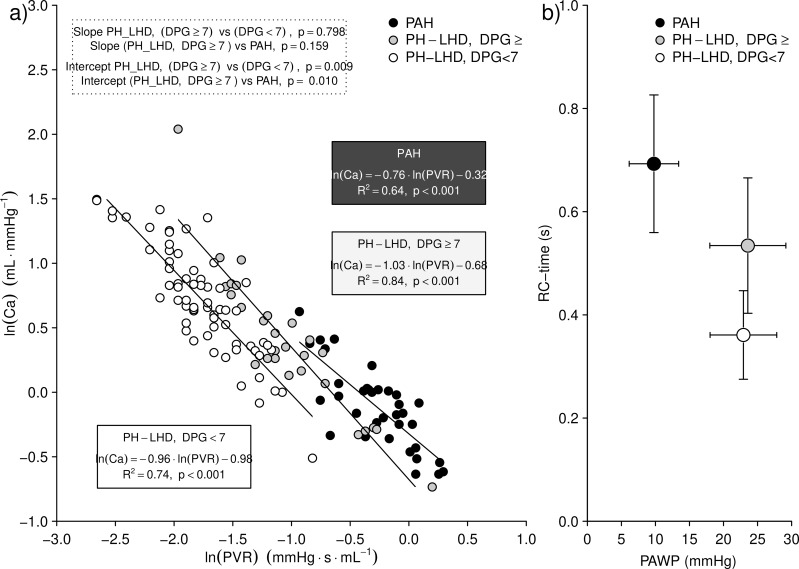
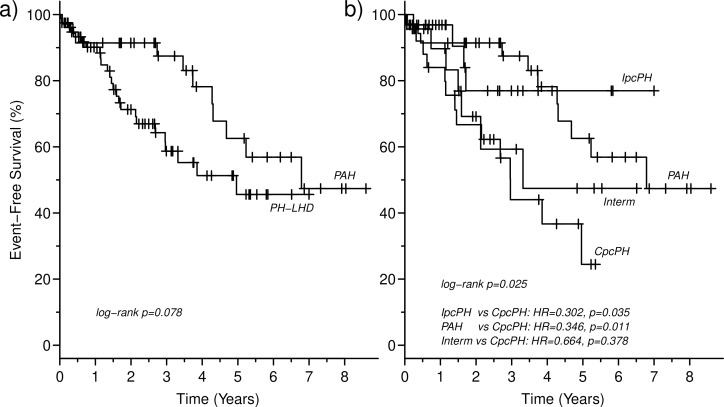
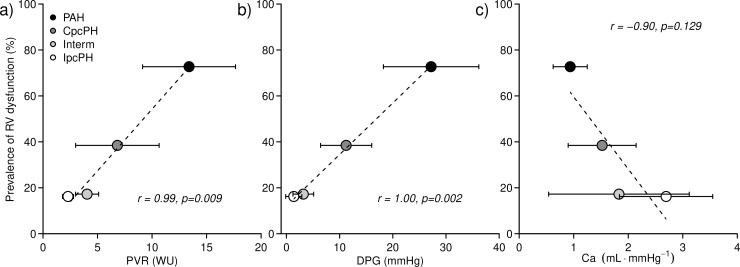
Despite similar PAWP and cardiac index, haemodynamic severity and prevalence of RV dysfunction increased from IpcPH, to "intermediate" and CpcPH. PVR and DPG (but not compliance, Ca) were linearly correlated with RV dysfunction. CpcPH had worse prognosis (p<0.05) than IpcPH and PAH, but similar to "intermediate" patients. Only NTproBNP and Ca independently predicted survival in PH-LHD.
In PH-LHD, haemodynamic characterization according to DPG and PVR provides important information on disease severity, predisposition to RV failure and prognosis. Patients presenting the CpcPH phenotype appear to have haemodynamic profile closer to PAH but with worse prognosis. In PH-LHD, Ca and NTproBNP were independent predictors of survival.
在肺动脉高压(PH)中,楔压升高(PAWP)和毛细血管前成分都可能影响右心室(RV)的后负荷。这些变化可能导致 RV 衰竭和预后不良。我们旨在描述左心疾病(LHD)引起的 PH 患者的不同血流动力学表型,并描述肺血流动力学对 RV 功能和预后的影响。
将 PH-LHD 患者与未经治疗的特发性/遗传性肺动脉高压(PAH,n=35)患者进行比较。将 PH-LHD 患者分为单纯毛细血管后 PH(IpcPH:舒张压力梯度,DPG<7mmHg 和肺血管阻力,PVR≤3WU,n=37)、毛细血管后和前毛细血管 PH 并存(CpcPH:DPG≥7mmHg 和 PVR>3WU,n=27)和“中间”PH-LHD(DPG<7mmHg 或 PVR≤3WU,n=29)。
尽管 PAWP 和心指数相似,但从 IpcPH 到“中间”和 CpcPH,血流动力学严重程度和 RV 功能障碍的发生率增加。PVR 和 DPG(但不是顺应性,Ca)与 RV 功能障碍呈线性相关。CpcPH 的预后(p<0.05)比 IpcPH 和 PAH 差,但与“中间”患者相似。只有 NTproBNP 和 Ca 独立预测 PH-LHD 的生存率。
在 PH-LHD 中,根据 DPG 和 PVR 进行血流动力学特征描述可提供有关疾病严重程度、RV 衰竭易感性和预后的重要信息。表现为 CpcPH 表型的患者似乎具有更接近 PAH 的血流动力学特征,但预后更差。在 PH-LHD 中,Ca 和 NTproBNP 是独立的生存预测指标。