Department of Cardiovascular Medicine, Mayo Clinic and Foundation, 200 First Street SW, Rochester, MN 55905, USA.
Centre for Cardiovascular Diseases, University Hospital Brussels, Jette, Belgium.
Eur Heart J. 2022 Sep 21;43(36):3417-3431. doi: 10.1093/eurheartj/ehac184.
Pulmonary hypertension (PH) and pulmonary vascular disease (PVD) are common and associated with adverse outcomes in left heart disease (LHD). This study sought to characterize the pathophysiology of PVD across the spectrum of PH in LHD.
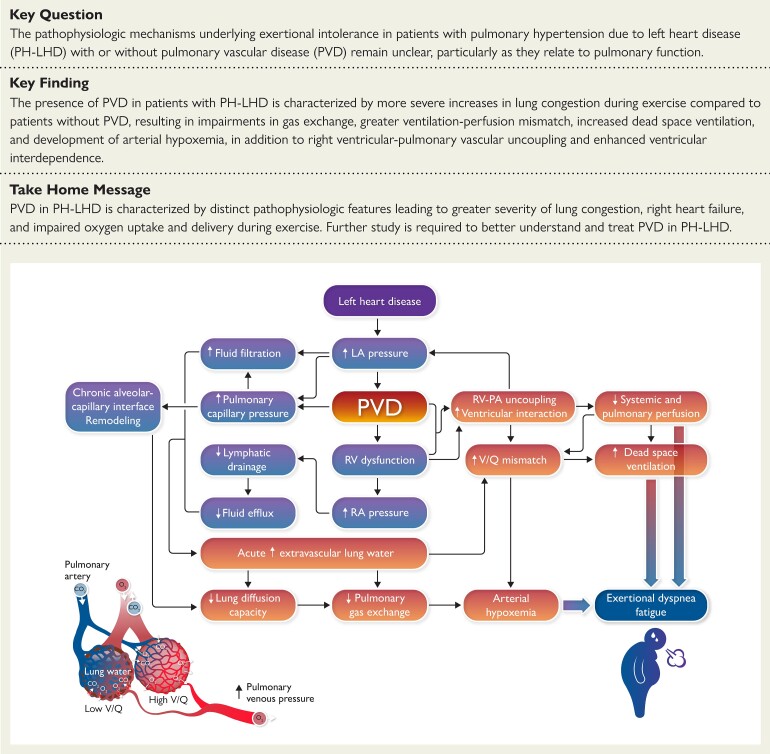
Patients with PH-LHD [mean pulmonary artery (PA) pressure >20 mmHg and PA wedge pressure (PAWP) ≥15 mmHg] and controls free of PH or LHD underwent invasive haemodynamic exercise testing with simultaneous echocardiography, expired air and blood gas analysis, and lung ultrasound in a prospective study. Patients with PH-LHD were divided into isolated post-capillary PH (IpcPH) and PVD [combined post- and pre-capillary PH (CpcPH)] based upon pulmonary vascular resistance (PVR <3.0 or ≥3.0 WU). As compared with controls (n = 69) and IpcPH-LHD (n = 55), participants with CpcPH-LHD (n = 40) displayed poorer left atrial function and more severe right ventricular (RV) dysfunction at rest. With exercise, patients with CpcPH-LHD displayed similar PAWP to IpcPH-LHD, but more severe RV-PA uncoupling, greater ventricular interaction, and more severe impairments in cardiac output, O2 delivery, and peak O2 consumption. Despite higher PVR, participants with CpcPH developed more severe lung congestion compared with both IpcPH-LHD and controls, which was associated lower arterial O2 tension, reduced alveolar ventilation, decreased pulmonary O2 diffusion, and greater ventilation-perfusion mismatch.
Pulmonary vascular disease in LHD is associated with a distinct pathophysiologic signature marked by greater exercise-induced lung congestion, arterial hypoxaemia, RV-PA uncoupling, ventricular interdependence, and impairment in O2 delivery, impairing aerobic capacity. Further study is required to identify novel treatments targeting the pulmonary vasculature in PH-LHD.
肺动脉高压(PH)和肺血管疾病(PVD)在左心疾病(LHD)中很常见且与不良预后相关。本研究旨在描述 LHD 中 PH 谱内 PVD 的病理生理学特征。
在一项前瞻性研究中,对 PH-LHD(平均肺动脉(PA)压>20mmHg 和 PA 楔压(PAWP)≥15mmHg)患者和无 PH 或 LHD 的对照者进行了有创血流动力学运动试验,同时进行了超声心动图、呼气末空气和血气分析以及肺部超声检查。根据肺血管阻力(PVR<3.0 或≥3.0 WU),将 PH-LHD 患者分为单纯毛细血管后 PH(IpcPH)和 PVD[毛细血管前和后 PH 合并(CpcPH)]。与对照组(n=69)和 IpcPH-LHD 组(n=55)相比,CpcPH-LHD 组(n=40)在静息时左心房功能较差,右心室(RV)功能更严重。在运动时,CpcPH-LHD 患者的 PAWP 与 IpcPH-LHD 相似,但 RV-PA 解偶联更严重,心室相互作用更大,心输出量、O2 输送和峰值 O2 消耗的损害更严重。尽管 PVR 较高,但与 IpcPH-LHD 和对照组相比,CpcPH 患者的肺部充血更严重,这与动脉氧张力降低、肺泡通气减少、肺 O2 弥散减少以及通气-灌注不匹配增加有关。
LHD 中的 PVD 与一种独特的病理生理特征相关,其特征为运动引起的肺部充血、动脉低氧血症、RV-PA 解偶联、心室相互依赖以及 O2 输送受损,从而损害有氧能力。需要进一步研究以确定针对 PH-LHD 中肺血管的新型治疗方法。