Kobayashi Keigo, Naoki Katsuhiko, Manabe Tadashi, Masuzawa Keita, Hasegawa Hanako, Yasuda Hiroyuki, Kawada Ichiro, Soejima Kenzo, Betsuyaku Tomoko
Division of Pulmonary Medicine, Department of Medicine, Keio University School of Medicine, Tokyo, Japan.
Department of Respiratory Medicine, Kitasato University School of Medicine, Kanagawa, Japan.
Onco Targets Ther. 2018 Jun 6;11:3335-3343. doi: 10.2147/OTT.S161745. eCollection 2018.
Osimertinib, a third-generation epidermal growth factor receptor-tyrosine kinase inhibitor, exerts remarkable effects against T790M resistance mutation-positive non-small cell lung cancer. Identifying T790M mutation by re-biopsy is essential before prescribing osimertinib. Tissue biopsy is the golden standard for this purpose, but several factors limit its success rate. The liquid biopsy with blood, using circulating tumor DNA, has been an alternative method. However, the true biological meaning and equivalence of liquid biopsy and tumor biopsy are still under investigation. Especially, the usefulness of serum samples to detect T790M mutation is not yet been known.
We prospectively evaluated the sensitivity, specificity, and parallelism of the detection of mutations in tissue re-biopsy and liquid biopsy (plasma and serum), simultaneously, from June 2016 to May 2017. mutations in tumor re-biopsy were evaluated by COBAS ver2 and PNA-LNA PCR clamp method, and those in liquid biopsy were evaluated with COBAS ver2.
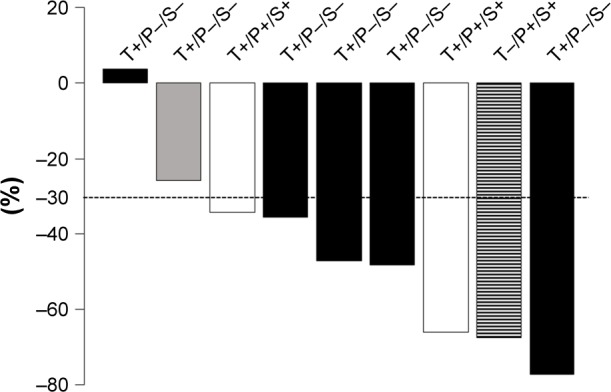
Fifteen patients were enrolled. In 10 patients whose mutation was detected in liquid biopsy, the original mutation (exon 19 del or L858R) was detected in all patients. Detection of mutation by COBAS ver2 and by PNA-LNA method was almost the same in tissue re-biopsy. The detection rate of T790M was lower than that of the original mutation in liquid biopsy compared to that in tissue re-biopsy. The detection of T790M in serum exhibited a higher specificity (67%) and positive predictive value (50%) than that in plasma (50% and 40%, respectively). The detection sensitivity was similar in plasma and serum.
Plasma, serum, and tissue genotyping can have complementary roles for detecting -T790M using COBAS ver2. Repeated tests with different samples and different methods may improve accuracy of T790M detection and will lead to the maximum benefit for the patient.
奥希替尼是一种第三代表皮生长因子受体酪氨酸激酶抑制剂,对T790M耐药突变阳性的非小细胞肺癌有显著疗效。在开奥希替尼之前,通过再次活检鉴定T790M突变至关重要。组织活检是实现这一目的的金标准,但有几个因素限制了其成功率。利用循环肿瘤DNA进行血液液体活检已成为一种替代方法。然而,液体活检与肿瘤活检的真正生物学意义及等效性仍在研究中。特别是,血清样本检测T790M突变的实用性尚不清楚。
2016年6月至2017年5月,我们前瞻性地同时评估了组织再次活检与液体活检(血浆和血清)中突变检测的敏感性、特异性及平行性。肿瘤再次活检中的突变通过COBAS ver2和肽核酸-锁核酸PCR夹法评估,液体活检中的突变用COBAS ver2评估。
纳入15例患者。在10例液体活检中检测到突变的患者中,所有患者均检测到原始突变(外显子19缺失或L858R)。在组织再次活检中,COBAS ver2和肽核酸-锁核酸法检测突变的结果几乎相同。与组织再次活检相比,液体活检中T790M的检测率低于原始突变的检测率。血清中T790M的检测特异性(67%)和阳性预测值(50%)高于血浆(分别为50%和40%)。血浆和血清中的检测敏感性相似。
使用COBAS ver2检测-T790M时,血浆、血清和组织基因分型可发挥互补作用。用不同样本和不同方法重复检测可能提高T790M检测的准确性,并为患者带来最大益处。