Filipits Martin, Kainz Verena, Sebek Viktor, Zach Herwig
Center for Cancer Research, Medical University of Vienna, 1090 Vienna, Austria.
Division of Transplantation, Department of General Surgery, Medical University Vienna, 1090 Vienna, Austria.
Cancers (Basel). 2023 Jul 7;15(13):3528. doi: 10.3390/cancers15133528.
The detection of the EGFR T790M (T790M) mutation in non-small cell lung cancer (NSCLC) patients who progressed under treatment with first- or second-generation EGFR-tyrosine kinase inhibitors (TKIs) is important to offer a subsequent therapy with a third-generation EGFR-TKI. Liquid biopsy is a powerful tool to determine the T790M mutation status. Several liquid biopsy platforms with varying degrees of accuracy are available to test for T790M mutations, and sensitivities may differ among these methods.
As no standard exists for the testing of T790M mutation in liquid biopsy, we performed a collaborative study to describe and compare the sensitivity of different in-house liquid biopsy platforms for the detection of the T790M mutation, EGFR exon 19 deletion (del19) and EGFR L858R mutation (L858R) across multiple participating laboratories in seven Central and Eastern European countries.
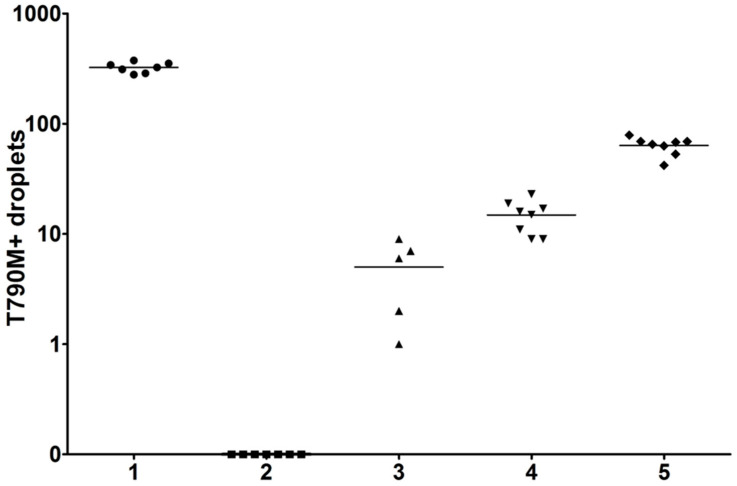
Of the 25 invited laboratories across Central and Eastern Europe, 21 centers participated and received 10 plasma samples spiked with cell-line DNA containing the T790M, del19, or L858R mutation in different concentrations. In-house PCR-based and NGS-based methods were used accordingly, and results were reported as in routine clinical practice. Two laboratories, which used the AmoyDx EGFR 29 Mutations Detection Kit (AmoyDx) with Cobas cfDNA Sample Preparation Kit and QX200 Droplet Digital PCR (ddPCR) with the QIAamp Circulating Nucleic Acid Kit identified all ten samples correctly. Cobas EGFR Mutation Test v2 (Cobas), the NGS methods, and the Idylla detection method used in this study performed within the known sensitivity range of each detection method.
If a negative result was obtained from methods with lower sensitivity (e.g., Cobas), repeated liquid biopsy testing and/or tissue biopsy analysis should be performed whenever possible, to identify T790M-positive patients to allow them to receive the optimal second-line treatment with a third-generation EGFR TKI.
对于在第一代或第二代表皮生长因子受体酪氨酸激酶抑制剂(EGFR-TKI)治疗期间病情进展的非小细胞肺癌(NSCLC)患者,检测其表皮生长因子受体T790M(T790M)突变对于后续给予第三代EGFR-TKI治疗至关重要。液体活检是确定T790M突变状态的有力工具。有几种准确性各异的液体活检平台可用于检测T790M突变,这些方法的灵敏度可能有所不同。
由于液体活检中T790M突变检测尚无标准,我们开展了一项合作研究,以描述和比较不同的内部液体活检平台在七个中东欧国家多个参与实验室中检测T790M突变、EGFR外显子19缺失(del19)和EGFR L858R突变(L858R)的灵敏度。
在中东欧地区受邀的25个实验室中,有21个中心参与并接收了10份添加了含有不同浓度T790M、del19或L858R突变的细胞系DNA的血浆样本。相应地使用了基于内部聚合酶链反应(PCR)和基于二代测序(NGS)的方法,并按照常规临床实践报告结果。两个实验室分别使用了搭配Cobas cfDNA样本制备试剂盒的厦门艾德EGFR 29种突变检测试剂盒(AmoyDx)以及搭配QIAamp循环核酸试剂盒的QX200微滴式数字PCR(ddPCR),均正确鉴定出了所有十个样本。本研究中使用的Cobas EGFR突变检测试剂盒v2(Cobas)、NGS方法以及Idylla检测方法均在各检测方法已知的灵敏度范围内。
如果采用较低灵敏度的方法(如Cobas)得到阴性结果,应尽可能重复进行液体活检检测和/或组织活检分析,以识别T790M阳性患者,使其能够接受最佳的第三代EGFR-TKI二线治疗。