van der Kuil Milan N A, Visser-Meily Johanna M A, Evers Andrea W M, van der Ham Ineke J M
Department of Health, Medical and Neuropsychology, Leiden University, Leiden, Netherlands.
Center of Excellence in Rehabilitation Medicine, Brain Center Rudolf Magnus, University Medical Center Utrecht and De Hoogstraat Rehabilitation, Utrecht, Netherlands.
Front Psychol. 2018 Jun 5;9:846. doi: 10.3389/fpsyg.2018.00846. eCollection 2018.
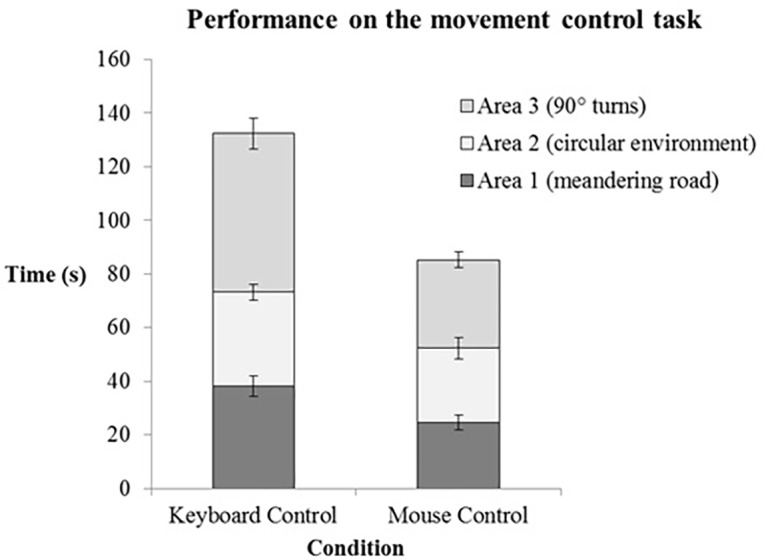
Acquired brain injury patients often report navigation impairments. A cognitive rehabilitation therapy has been designed in the form of a serious game. The aim of the serious game is to aid patients in the development of compensatory navigation strategies by providing exercises in 3D virtual environments on their home computers. The objective of this study was to assess the usability of three critical gaming attributes: movement control in 3D virtual environments, instruction modality and feedback timing. Thirty acquired brain injury patients performed three tasks in which objective measures of usability were obtained. Mouse controlled movement was compared to keyboard controlled movement in a navigation task. Text-based instructions were compared to video-based instructions in a knowledge acquisition task. The effect of feedback timing on performance and motivation was examined in a navigation training game. Subjective usability ratings of all design options were assessed using questionnaires. Results showed that mouse controlled interaction in 3D environments is more effective than keyboard controlled interaction. Patients clearly preferred video-based instructions over text-based instructions, even though video-based instructions were not more effective in context of knowledge acquisition and comprehension. No effect of feedback timing was found on performance and motivation in games designed to train navigation abilities. Overall appreciation of the serious game was positive. The results provide valuable insights in the design choices that facilitate the transfer of skills from serious games to real-life situations.
后天性脑损伤患者经常报告有导航障碍。一种认知康复疗法已被设计成一款严肃游戏的形式。这款严肃游戏的目的是通过让患者在家用电脑上的三维虚拟环境中进行练习,来帮助他们开发补偿性导航策略。本研究的目的是评估三个关键游戏属性的可用性:三维虚拟环境中的运动控制、指导方式和反馈时机。30名后天性脑损伤患者完成了三项任务,从中获得了可用性的客观测量结果。在一项导航任务中,将鼠标控制的运动与键盘控制的运动进行了比较。在一项知识获取任务中,将基于文本的指导与基于视频的指导进行了比较。在一项导航训练游戏中,研究了反馈时机对表现和动机的影响。使用问卷对所有设计选项的主观可用性评级进行了评估。结果表明,在三维环境中,鼠标控制的交互比键盘控制的交互更有效。患者明显更喜欢基于视频的指导而不是基于文本的指导,尽管在知识获取和理解方面,基于视频的指导并不更有效。在旨在训练导航能力的游戏中,未发现反馈时机对表现和动机有影响。对这款严肃游戏的总体评价是积极的。这些结果为促进技能从严肃游戏向现实生活情境转移的设计选择提供了有价值的见解。