Institute for Promotion of Higher Education, Hirosaki University, Aomori, 036-8560, Japan.
Sci Rep. 2024 May 4;14(1):10261. doi: 10.1038/s41598-024-60992-w.
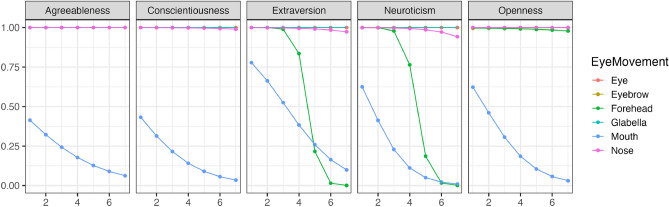
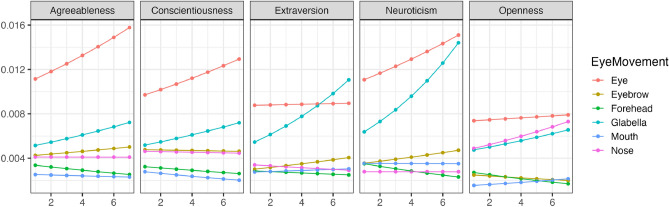
Previous studies have suggested behavioral patterns, such as visual attention and eye movements, relate to individual personality traits. However, these studies mainly focused on free visual tasks, and the impact of visual field restriction remains inadequately understood. The primary objective of this study is to elucidate the patterns of conscious eye movements induced by visual field restriction and to examine how these patterns relate to individual personality traits. Building on previous research, we aim to gain new insights through two behavioral experiments, unraveling the intricate relationship between visual behaviors and individual personality traits. As a result, both Experiment 1 and Experiment 2 revealed differences in eye movements during free observation and visual field restriction. Particularly, simulation results based on the analyzed data showed clear distinctions in eye movements between free observation and visual field restriction conditions. This suggests that eye movements during free observation involve a mixture of conscious and unconscious eye movements. Furthermore, we observed significant correlations between conscious eye movements and personality traits, with more pronounced effects in the visual field restriction condition used in Experiment 2 compared to Experiment 1. These analytical findings provide a novel perspective on human cognitive processes through visual perception.
先前的研究表明,行为模式,如视觉注意力和眼球运动,与个体的性格特征有关。然而,这些研究主要集中在自由视觉任务上,对视野限制的影响仍了解不足。本研究的主要目的是阐明由视野限制引起的有意识眼球运动模式,并研究这些模式与个体性格特征之间的关系。基于先前的研究,我们旨在通过两个行为实验获得新的见解,揭示视觉行为与个体性格特征之间的复杂关系。结果表明,实验 1 和实验 2 都揭示了在自由观察和视野限制期间眼球运动的差异。特别是,基于分析数据的模拟结果表明,在自由观察和视野限制条件下,眼球运动存在明显差异。这表明在自由观察期间的眼球运动涉及有意识和无意识眼球运动的混合。此外,我们观察到有意识眼球运动与个性特征之间存在显著相关性,在实验 2 中使用的视野限制条件下比实验 1 中更为明显。这些分析结果通过视觉感知为人类认知过程提供了新的视角。