Infectious Disease Research Laboratory, Department of Medicine, Institute of Medical Sciences, Banaras Hindu University, Varanasi, Uttar Pradesh, 221 005, India.
Mol Diagn Ther. 2018 Aug;22(4):443-457. doi: 10.1007/s40291-018-0343-y.
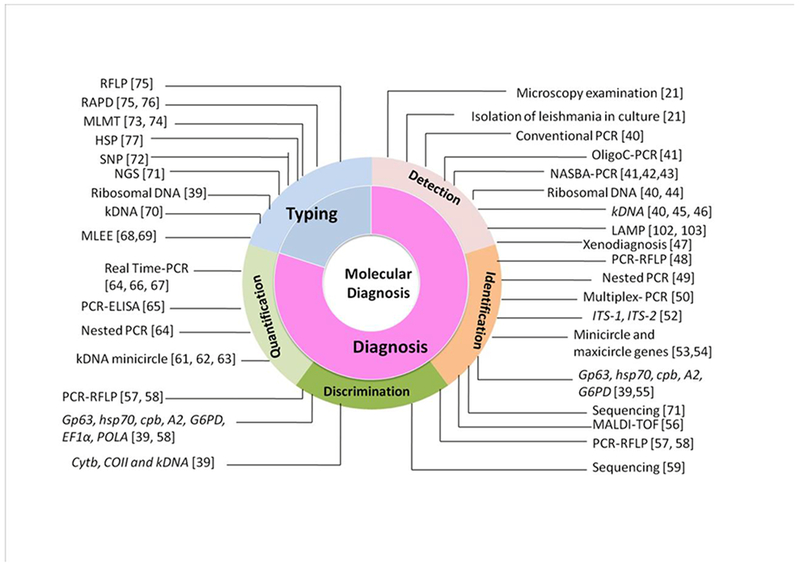
Visceral leishmaniasis (VL), a deadly parasitic disease, is a major public health concern globally. Countries affected by VL have signed the London Declaration on Neglected Tropical Diseases and committed to eliminate VL as a public health problem by 2020. To achieve and sustain VL elimination, it will become progressively important not to miss any remaining cases in the community who can maintain transmission. This requires accurate identification of symptomatic and asymptomatic carriers using highly sensitive diagnostic tools at the primary health service setting. The rK39 rapid diagnostic test (RDT) is the most widely used tool and with its good sensitivity and specificity is the first choice for decentralized diagnosis of VL in endemic areas. However, this test cannot discriminate between current, subclinical, or past infections and is useless for diagnosis of relapses and as a prognostic (cure) test. Importantly, as the goal of elimination of VL as a public health problem is approaching, the number of people susceptible to infection will increase. Therefore, correct diagnosis using a highly sensitive diagnostic test is crucial for applying appropriate treatment and management of cases. Recent advances in molecular techniques have improved Leishmania detection and quantification, and therefore this technology has become increasingly relevant due to its possible application in a variety of clinical sample types. Most importantly, given current problems in identifying asymptomatic individuals because of poor correlation between the main methods of detection, molecular tests are valuable for VL elimination programs, especially to monitor changes in burden of infection in specific communities. This review provides a comprehensive overview of the available VL diagnostics and discusses the usefulness of molecular methods in the diagnosis, quantification, and species differentiation as well as their clinical applications.
内脏利什曼病(VL)是一种致命的寄生虫病,是全球主要的公共卫生关注点。受 VL 影响的国家签署了《伦敦关于被忽视热带病宣言》,承诺到 2020 年消除 VL 这一公共卫生问题。为了实现并维持 VL 的消除,在初级卫生服务机构中使用高度敏感的诊断工具准确识别社区中可能传播疾病的有症状和无症状携带者将变得越来越重要。rK39 快速诊断检测(RDT)是应用最广泛的工具,其具有良好的敏感性和特异性,是在流行地区进行 VL 分散诊断的首选方法。然而,该检测不能区分当前、亚临床或过去的感染,对于诊断复发和预后(治愈)检测也没有用。重要的是,随着 VL 作为公共卫生问题消除目标的临近,易受感染的人数将会增加。因此,使用高度敏感的诊断检测进行正确诊断对于应用适当的治疗和管理病例至关重要。分子技术的最新进展提高了利什曼原虫的检测和定量能力,因此由于其在各种临床样本类型中的潜在应用,该技术变得越来越相关。最重要的是,鉴于目前由于主要检测方法之间相关性差而无法识别无症状个体的问题,分子检测对于 VL 消除计划非常有价值,特别是用于监测特定社区感染负担的变化。本文综述了现有的 VL 诊断方法,并讨论了分子方法在诊断、定量和物种分化以及临床应用中的有用性。