Department of Psychiatry, Center for Behavior Genetics of Aging, University of California, San Diego, 9500 Gilman Dr. (MC 0738), La Jolla, CA, 92093, USA.
Department of Psychology, San Diego State University, San Diego, CA, USA.
Behav Genet. 2018 Sep;48(5):361-373. doi: 10.1007/s10519-018-9910-6. Epub 2018 Jun 19.
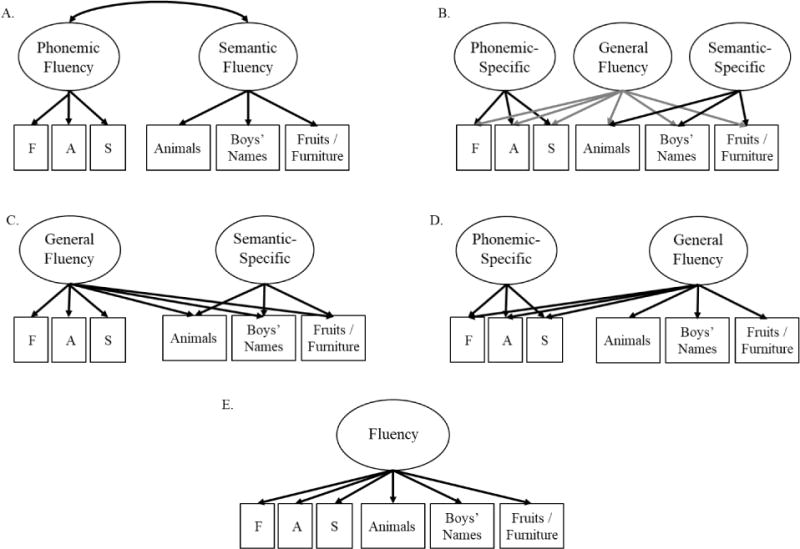
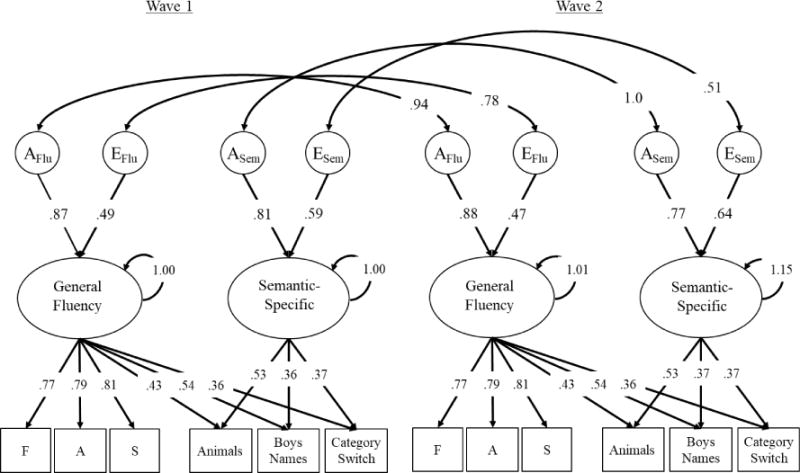
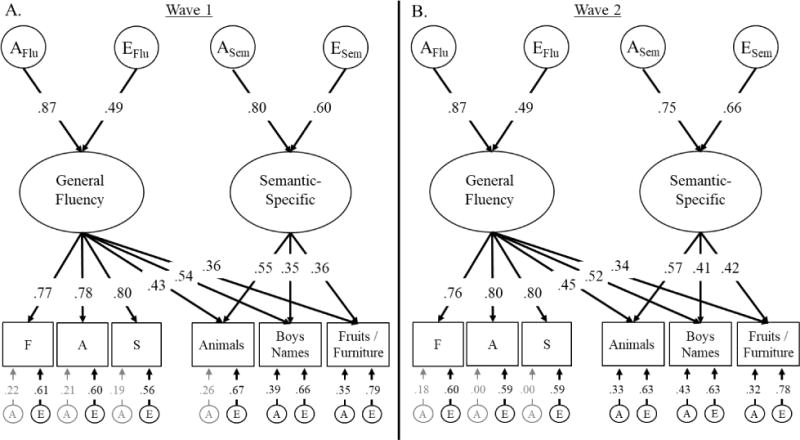
Mounting evidence suggests that measures of phonemic fluency and semantic fluency are differentially associated with other cognitive and health phenotypes, but few studies have examined their shared and unique variance, especially using genetically-informative designs. In this study, 1464 middle-aged twins completed six fluency subtests at up to two time-points (mean age 56 and 62 years). Confirmatory factor analyses supported a two-factor solution: a General Fluency latent factor explained variation in all six subtests and a Semantic-Specific factor accounted for additional variance in semantic subtests. Both factors were explained primarily by genetic influences at both waves (a = 0.57-0.76). There was considerable stability of individual differences over 6 years (r = .90 for General Fluency, r = .81 for Semantic-Specific), especially for genetic influences (r = .94 and 1.0, respectively). These results suggest that semantic fluency can be viewed as a combination of general and semantic-specific variance, but phonemic fluency is captured entirely by the general factor.
越来越多的证据表明,音韵流畅度和语义流畅度的衡量标准与其他认知和健康表现型有不同的关联,但很少有研究使用遗传信息设计来检验它们的共同和独特差异。在这项研究中,1464 名中年双胞胎在两个时间点(平均年龄为 56 岁和 62 岁)完成了六项流畅性子测试。验证性因子分析支持了一个两因素解决方案:一般流畅度潜在因素解释了所有六项子测试的变化,语义特异性因素解释了语义子测试的额外变化。这两个因素在两个波次中主要由遗传影响来解释(a=0.57-0.76)。个体差异在 6 年内具有相当大的稳定性(一般流畅度的 r=0.90,语义特异性的 r=0.81),尤其是遗传影响(分别为 r=0.94 和 1.0)。这些结果表明,语义流畅度可以被视为一般和语义特异性差异的组合,但音韵流畅度完全由一般因素来解释。