Idrees M, Nassani M-Z, Kujan O
UWA Dental School, University of Western Australia, 17 Monash Avenue, Nedlands WA6009, Australia,
Med Oral Patol Oral Cir Bucal. 2018 Jul 1;23(4):e384-e390. doi: 10.4317/medoral.22245.
This study aimed to test the association between the unstimulated whole salivary flow rate (UWSFR) and the oral health status represented by dental and gingival status among healthy adult subjects.
This work was a cross-sectional study of patients attending the undergraduate dental clinics at AlFarabi College for Dentistry and Nursing, Riyadh, Saudi Arabia. The study population consisted of 502 systemically healthy adults aged 18-35 years. UWSFR was collected for all study participants and expressed as ml/min. Oral health status was estimated using the Community Periodontal Index (CPI) and the Oral Hygiene Index-Simplified (OHI-S). The number of decayed teeth and the number of available teeth were also calculated to evaluate dental status.
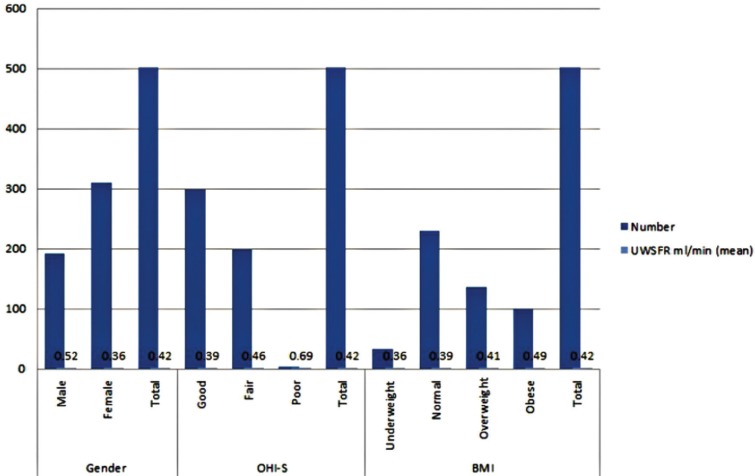
The mean UWSFR was 0.42 (±0.3) ml/min, and the male participants significantly had more UWSFR than the females. UWSFR was significantly affected by CPI, OHI-S, body mass index (BMI) and gender as indicated in the univariate analysis. However, multiple regression analysis revealed that only gender was a significant predictor of UWSFR. The male subjects were shown to have a higher average of 0.133 ml/min than the females.
High BMI scores, moderate-to-severe gingivitis and low level of oral hygiene increased UWSFR. However, further longitudinal studies are recommended to test the role of salivary cytokine levels to validate the exact association between the UWSFR and the oral health status.
本研究旨在测试健康成年受试者中未刺激全唾液流速(UWSFR)与由牙齿和牙龈状况所代表的口腔健康状况之间的关联。
这项研究是对沙特阿拉伯利雅得法拉比牙科学院和护理学院本科牙科诊所的患者进行的横断面研究。研究人群包括502名年龄在18 - 35岁的全身健康成年人。收集了所有研究参与者的UWSFR,并以毫升/分钟表示。使用社区牙周指数(CPI)和简化口腔卫生指数(OHI - S)评估口腔健康状况。还计算了龋齿数量和可用牙齿数量以评估牙齿状况。
UWSFR的平均值为0.42(±0.3)毫升/分钟,男性参与者的UWSFR显著高于女性。单因素分析表明,UWSFR受CPI、OHI - S、体重指数(BMI)和性别的显著影响。然而,多元回归分析显示只有性别是UWSFR的显著预测因素。男性受试者的平均UWSFR比女性高0.133毫升/分钟。
高BMI分数、中度至重度牙龈炎和低口腔卫生水平会增加UWSFR。然而,建议进一步进行纵向研究以测试唾液细胞因子水平的作用,从而验证UWSFR与口腔健康状况之间的确切关联。