Calderón Díaz Julia A, García Manzanilla Edgar, Diana Alessia, Boyle Laura A
Pig Development Department, Teagasc Animal and Grassland Research and Innovation Centre, Fermoy, Ireland.
School of Veterinary Medicine, University College Dublin, Dublin, Ireland.
Front Vet Sci. 2018 Jun 6;5:123. doi: 10.3389/fvets.2018.00123. eCollection 2018.
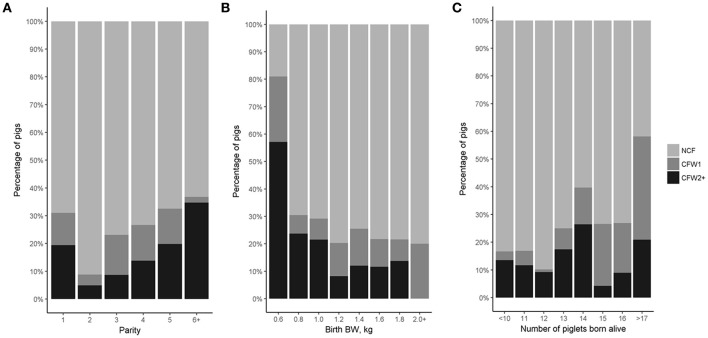
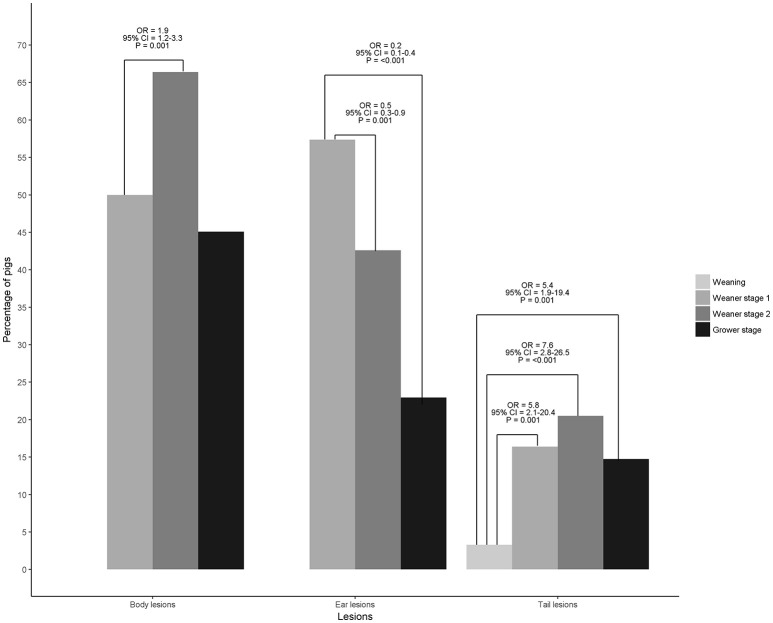
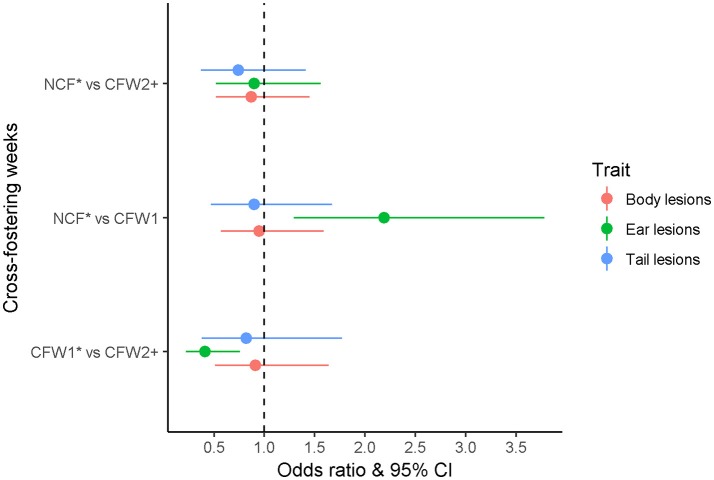
This study aimed to (1) identify cross-fostering (CF) practices employed on a commercial farm; (2) characterize CF pigs according to litter of origin traits, and (3) investigate the implications of CF practices on pig mortality, performance and welfare. This was an observational study whereby pigs were managed according to normal farming practice. Pigs ( = 1,016) born within 1 week were classified as non-CF (NCF); CF during the first (CFW1) and second or third (CFW2+) weeks of lactation. Pigs were individually weighed and inspected for the presence of tail (TL), ear (EL) and body lesions (BL) at weaning (7.03 ± 1.61 kg) and at the end of the first (12.9 ± 3.03 kg) and second (31.9 ± 5.50 kg) weaner and grower (66.3 ± 9.12 kg) stages. Mortality was recorded through to slaughter (c. 115 kg). At slaughter, TL were scored and carcass characteristics, presence of pleurisy, enzootic pneumonia, pericarditis and heart condemnations were recorded. 40.8% of CF pigs were CFW1; ANOVA tests revealed these were born to sows with a higher number of piglets born alive than NCF pigs (14.6 ± 2.61 and 12.8 ± 2.68, respectively). The remaining 59.2% of CF pigs were CFW2+; these were, on average, 0.14 kg lighter at birth than NCF pigs. Therefore, a nested case control design was retrospectively applied whereby pigs with complete records to slaughter, were matched for these variables to investigate associations between CF weeks, welfare and performance traits. Growth performance did not differ between CF week ( > 0.05); however, CFW2+ carcasses were 4.9 kg lighter ( < 0.05) compared with NCF and CFW1 pigs. EL were more likely in CFW1 compared to NCF and CFW2+ ( < 0.05) pigs. To investigate the effect of CF week on the risk of mortality, all 1,016 pigs were used. CF pigs were at higher risk of death ( < 0.05) with similar odds in CFW1 and CFW2+ pigs compared with NCF pigs, although other underlying factors could contribute to this result. Performance and health traits were similar between CF weeks. Early cross-fostering appeared to influence the presence of ear lesions but the mechanism is likely indirect and difficult to explain.
(1)确定商业化农场中采用的交叉寄养(CF)做法;(2)根据出生窝次特征对交叉寄养仔猪进行特征描述;(3)研究交叉寄养做法对仔猪死亡率、生产性能和福利的影响。这是一项观察性研究,仔猪按照正常养殖方式进行管理。出生在1周内的仔猪(n = 1,016)被分类为非交叉寄养(NCF);在哺乳期第一周(CFW1)以及第二或第三周(CFW2+)进行交叉寄养。在断奶时(体重7.03±1.61千克)、第一阶段断奶仔猪期末(体重12.9±3.03千克)、第二阶段断奶仔猪期末(体重31.9±5.50千克)以及生长育肥期末(体重66.3±9.12千克),对仔猪进行个体称重,并检查是否存在尾巴损伤(TL)、耳部损伤(EL)和身体损伤(BL)。记录直至屠宰(约115千克)时的死亡率。在屠宰时,对尾巴损伤进行评分,并记录胴体特征、胸膜炎、地方性肺炎、心包炎的存在情况以及心脏不合格情况。40.8%的交叉寄养仔猪为CFW1;方差分析测试显示,这些仔猪的生母所产活仔数高于非交叉寄养仔猪(分别为14.6±2.61头和12.8±2.68头)。其余59.2%的交叉寄养仔猪为CFW2+;这些仔猪出生时平均比非交叉寄养仔猪轻0.14千克。因此,采用了回顾性巢式病例对照设计,对有完整屠宰记录的仔猪,根据这些变量进行匹配,以研究交叉寄养周数、福利和生产性能特征之间的关联。不同交叉寄养周数的生长性能没有差异(P>0.05);然而,与非交叉寄养和CFW1仔猪相比,CFW2+仔猪的胴体轻4.9千克(P<0.05)。与非交叉寄养和CFW2+仔猪相比,CFW1仔猪耳部损伤更常见(P<0.05)。为了研究交叉寄养周数对死亡风险的影响,使用了全部1,016头仔猪。与非交叉寄养仔猪相比,交叉寄养仔猪死亡风险更高(P<0.05),CFW1和CFW2+仔猪的死亡几率相似,不过其他潜在因素可能导致了这一结果。不同交叉寄养周数之间的生产性能和健康特征相似。早期交叉寄养似乎影响耳部损伤的出现,但机制可能是间接的,难以解释。