Ijiri Akira, Inagaki Fumio, Kubo Yusuke, Adhikari Rishi R, Hattori Shohei, Hoshino Tatsuhiko, Imachi Hiroyuki, Kawagucci Shinsuke, Morono Yuki, Ohtomo Yoko, Ono Shuhei, Sakai Sanae, Takai Ken, Toki Tomohiro, Wang David T, Yoshinaga Marcos Y, Arnold Gail L, Ashi Juichiro, Case David H, Feseker Tomas, Hinrichs Kai-Uwe, Ikegawa Yojiro, Ikehara Minoru, Kallmeyer Jens, Kumagai Hidenori, Lever Mark A, Morita Sumito, Nakamura Ko-Ichi, Nakamura Yuki, Nishizawa Manabu, Orphan Victoria J, Røy Hans, Schmidt Frauke, Tani Atsushi, Tanikawa Wataru, Terada Takeshi, Tomaru Hitoshi, Tsuji Takeshi, Tsunogai Urumu, Yamaguchi Yasuhiko T, Yoshida Naohiro
Kochi Institute for Core Sample Research, Japan Agency for Marine-Earth Science and Technology (JAMSTEC), Nankoku, Kochi 783-8502, Japan.
Research and Development Center for Submarine Resources, JAMSTEC, Yokosuka 237-0061, Japan.
Sci Adv. 2018 Jun 13;4(6):eaao4631. doi: 10.1126/sciadv.aao4631. eCollection 2018 Jun.
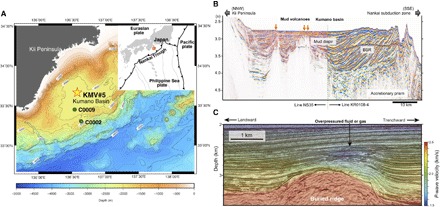
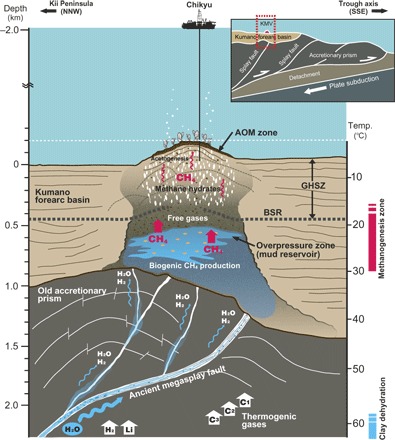
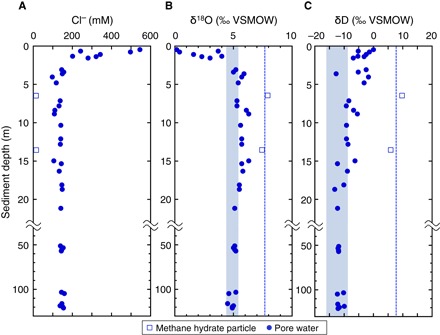
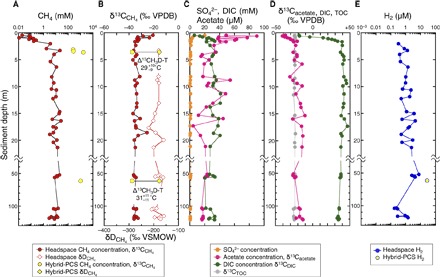
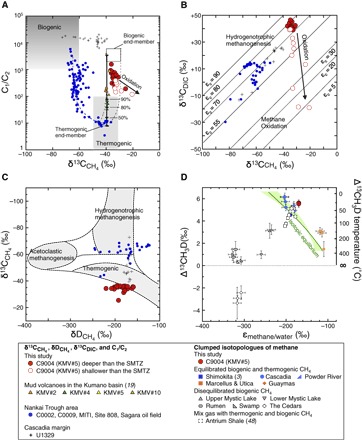
Microbial life inhabiting subseafloor sediments plays an important role in Earth's carbon cycle. However, the impact of geodynamic processes on the distributions and carbon-cycling activities of subseafloor life remains poorly constrained. We explore a submarine mud volcano of the Nankai accretionary complex by drilling down to 200 m below the summit. Stable isotopic compositions of water and carbon compounds, including clumped methane isotopologues, suggest that ~90% of methane is microbially produced at 16° to 30°C and 300 to 900 m below seafloor, corresponding to the basin bottom, where fluids in the accretionary prism are supplied via megasplay faults. Radiotracer experiments showed that relatively small microbial populations in deep mud volcano sediments (10 to 10 cells cm) include highly active hydrogenotrophic methanogens and acetogens. Our findings indicate that subduction-associated fluid migration has stimulated microbial activity in the mud reservoir and that mud volcanoes may contribute more substantially to the methane budget than previously estimated.
栖息于海底以下沉积物中的微生物生命在地球碳循环中发挥着重要作用。然而,地球动力学过程对海底以下生命的分布和碳循环活动的影响仍知之甚少。我们通过钻探到南加积复合体一座海底泥火山山顶以下200米处进行了探索。水和碳化合物(包括团簇甲烷同位素异构体)的稳定同位素组成表明,约90%的甲烷是在海底以下16°至30°C和300至900米处由微生物产生的,对应于盆地底部,增生楔中的流体通过大型张性断层供应到此处。放射性示踪剂实验表明,深部泥火山沉积物中相对较少的微生物种群(每立方厘米10⁵至10⁶个细胞)包括高度活跃的氢营养型产甲烷菌和产乙酸菌。我们的研究结果表明,与俯冲相关的流体迁移刺激了泥质储层中的微生物活动,并且泥火山对甲烷收支的贡献可能比先前估计的更大。