Kim Min Jung, Oh Hyun Ju, Hwang Sun Young, Hur Tai Young, Lee Byeong Chun
Department of Theriogenology and Biotechnology, College of Veterinary Medicine, Seoul National University, Seoul 08826, Korea.
Haemaru Referral Animal Hospital and Small Animal Clinical Research Institute, Seongnam 13590, Korea.
J Vet Sci. 2018 Sep 30;19(5):585-591. doi: 10.4142/jvs.2018.19.5.585.
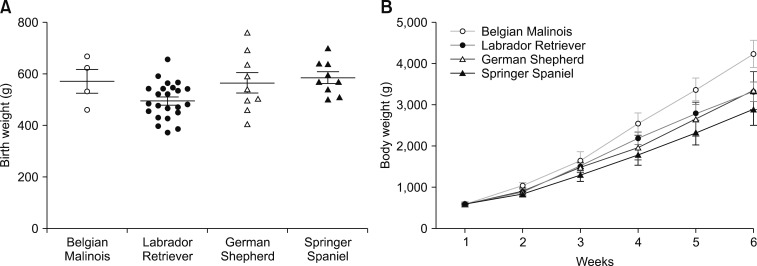
Dogs serve human society in various ways by working at tasks that are based on their superior olfactory sensitivity. However, it has been reported that only about half of all trained dogs may qualify as working dogs through conventional breeding management because proper temperament and health are needed in addition to their innate scent detection ability. To overcome this low efficiency of breeding qualified working dogs, and to reduce the enormous costs of maintaining unqualified dogs, somatic cell nuclear transfer has been applied in the propagation of working dogs. Herein, we review the history of cloning working dogs and evaluate the health development, temperaments, and behavioral similarities among the cloned dogs. We also discuss concerns about dog cloning including those related to birth defects, lifespan, and cloning efficiency.
狗通过执行基于其卓越嗅觉灵敏度的任务,以各种方式服务于人类社会。然而,据报道,在所有经过训练的狗中,只有大约一半能够通过传统的繁殖管理成为工作犬,因为除了天生的气味检测能力外,还需要具备适当的性情和健康状况。为了克服培育合格工作犬效率低下的问题,并降低饲养不合格犬只的巨大成本,体细胞核移植已被应用于工作犬的繁殖。在此,我们回顾了克隆工作犬的历史,并评估了克隆犬的健康发育、性情以及行为相似性。我们还讨论了有关狗克隆的问题,包括与出生缺陷、寿命和克隆效率相关的问题。