Biostatistics, Biomathematics, Pharmacoepidemiology and Infectious Diseases (B2PHI), Inserm, UVSQ, Institut Pasteur, Université Paris-Saclay, 16 Avenue Paul Vaillant-Couturier, Villejuif, 94807, France.
BMC Med Res Methodol. 2018 Jun 22;18(1):61. doi: 10.1186/s12874-018-0513-y.
In pharmacoepidemiology, the prescription preference-based instrumental variables (IV) are often used with linear models to solve the endogeneity due to unobserved confounders even when the outcome and the endogenous treatment are dichotomous variables. Using this instrumental variable, we proceed by Monte-Carlo simulations to compare the IV-based generalized method of moment (IV-GMM) and the two-stage residual inclusion (2SRI) method in this context.
We established the formula allowing us to compute the instrument's strength and the confounding level in the context of logistic regression models. We then varied the instrument's strength and the confounding level to cover a large range of scenarios in the simulation study. We also explore two prescription preference-based instruments.
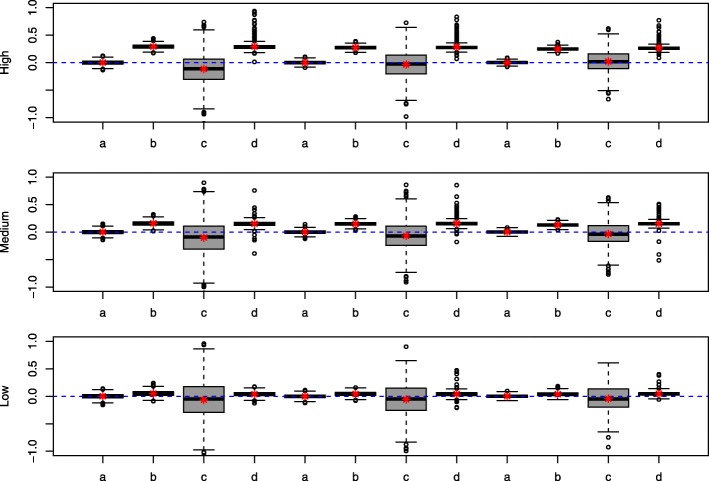
We found that the 2SRI is less biased than the other methods and yields satisfactory confidence intervals. The proportion of previous patients of the same physician who were prescribed the treatment of interest displayed a good performance as a proxy of the physician's preference instrument.
This work shows that when analysing real data with dichotomous outcome and exposure, appropriate 2SRI estimation could be used in presence of unmeasured confounding.
在药物流行病学中,基于处方偏好的工具变量(IV)常被用于线性模型,以解决因未观察到的混杂因素而导致的内生性问题,即使结局和内源性治疗都是二分类变量。在这种情况下,我们通过蒙特卡罗模拟,使用基于该工具变量的广义矩估计法(IV-GMM)和两阶段残差纳入法(2SRI)进行比较。
我们建立了一个公式,用于计算逻辑回归模型中工具变量的强度和混杂程度。然后,我们改变了工具变量的强度和混杂程度,以涵盖模拟研究中的广泛场景。我们还探索了两种基于处方偏好的工具变量。
我们发现 2SRI 比其他方法的偏差更小,且置信区间令人满意。感兴趣的治疗的同一医生之前的患者比例作为医生偏好工具的替代指标,表现良好。
这项工作表明,当分析具有二分类结局和暴露的真实数据时,在存在未测量混杂的情况下,可以使用适当的 2SRI 估计。