Farge Dominique, Cajfinger Francis, Falvo Nicolas, Berremili Toufek, Couturaud Francis, Bensaoula Okba, Védrine Lionel, Bensalha Hocine, Bonnet Isabelle, Péré-Vergé Denis, Coudurier Marie, Li Veronique, Rafii Hanadi, Benzidia Ilham, Connors Jean M, Resche-Rigon Matthieu
Assistance Publique-Hopitaux de Paris, Saint-Louis Hospital, Internal Medicine, Autoimmune and Vascular Disease Unit, UF 04, Diderot University, Paris, France.
Medical Oncology, Hôpital Pitié-Salpêtrière, Paris, France.
Oncotarget. 2018 Jun 5;9(43):26990-26999. doi: 10.18632/oncotarget.25454.
Clinical guidelines recommend at least 3-months low molecular weight heparin (LMWH) treatment for established venous thromboembolism (VTE) in cancer patients. However, no study has analyzed the impact of 3-6 months of LMWH therapy on quality-of-life (QoL) in cancer patients.
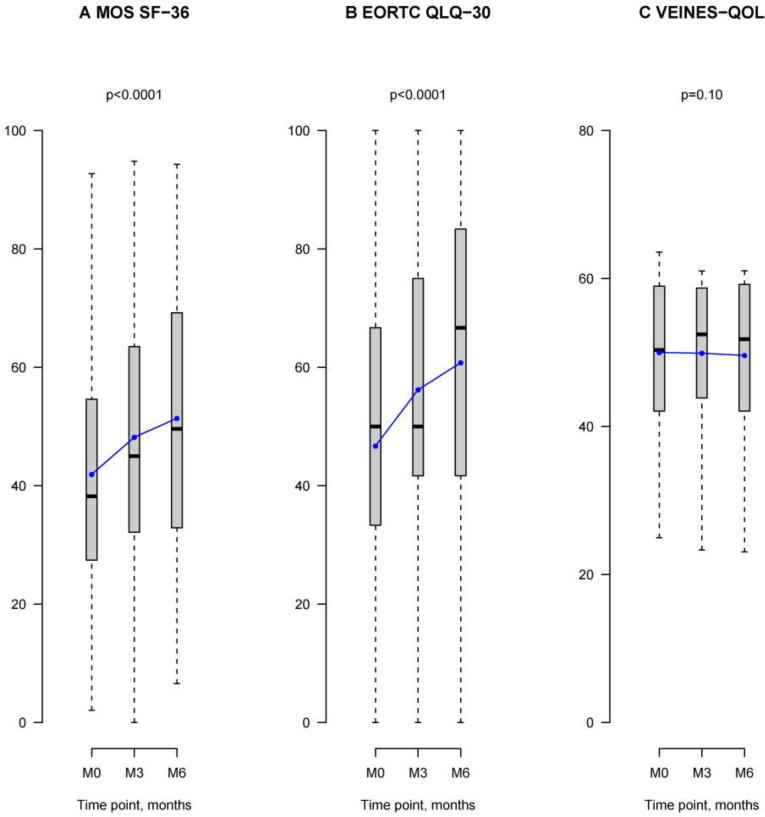
Among 400 cancer patients included at M0, 88.8% received long-term LMWH. Using a random-effects linear regression model with time as covariate, QoL scores in the MOS SF-36 (Global HRQoL, 1.3-fold per month [95% confidence interval (CI) 0.81-1.79], < 0.0001) and EORTC QLQ-C30 (global health status/qol, 2.25-fold per month [95% CI 1.63-2.88]; < 0.0001) questionnaires significantly improved over the 6-month study period in patients treated with LMWH, while VEINES-QOL scores did not change. In the MOS SF-36 and EORTC QLQ-C30, the following factors were associated with change in QoL: symptomatic VTE, cancer dissemination and histological type. Factors pertaining to reduced mobility were also identified as significant predictors of QoL outcomes, including being bedridden in the MOS SF-36 and ECOG score ≥ 2 in the EORTC QLQ-C30. Presence of acute infection and not undergoing anti-angiogenic therapy were additional factors associated with QoL improvement in the EORTC QLQ-C30.
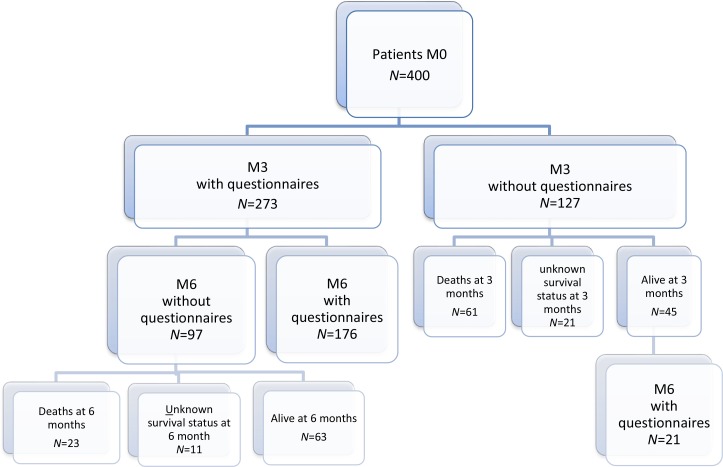
QUAVITEC, a prospective, longitudinal, multicenter study, recruited all consecutive eligible adult cancer patients with objectively confirmed VTE between February 2011 and 2012. Patients were asked to answer three QoL questionnaires at anticoagulant treatment initiation (M0) and at 3 (M3) and 6 (M6)-month follow-ups.
QUAVITEC is the first study to show that QoL was improved in cancer patients receiving long-term LMWH treatment for established VTE.
临床指南推荐对确诊的癌症患者静脉血栓栓塞(VTE)进行至少3个月的低分子量肝素(LMWH)治疗。然而,尚无研究分析3 - 6个月LMWH治疗对癌症患者生活质量(QoL)的影响。
在纳入研究的400例处于M0期的癌症患者中,88.8%接受了长期LMWH治疗。采用以时间为协变量的随机效应线性回归模型,在接受LMWH治疗的患者中,6个月研究期间,MOS SF - 36问卷中的生活质量评分(总体健康相关生活质量,每月提高1.3倍[95%置信区间(CI)0.81 - 1.79],P < 0.0001)以及EORTC QLQ - C30问卷中的生活质量评分(总体健康状况/生活质量,每月提高2.25倍[95% CI 1.63 - 2.88];P < 0.0001)显著改善,而VEINES - QOL评分未发生变化。在MOS SF - 36和EORTC QLQ - C30中,以下因素与生活质量变化相关:有症状的VTE、癌症播散和组织学类型。与活动能力下降相关的因素也被确定为生活质量结果的重要预测因素,包括在MOS SF - 36中卧床以及在EORTC QLQ - C30中ECOG评分≥2。急性感染的存在以及未接受抗血管生成治疗是EORTC QLQ - C30中与生活质量改善相关的其他因素。
QUAVITEC是一项前瞻性、纵向、多中心研究,在2011年2月至2012年期间招募了所有连续入选的、经客观证实患有VTE的成年癌症患者。患者被要求在抗凝治疗开始时(M0)以及在3个月(M3)和6个月(M6)随访时回答三份生活质量问卷。
QUAVITEC是第一项表明接受长期LMWH治疗确诊VTE的癌症患者生活质量得到改善的研究。