Yang Hongso, Park Chan, Shin Jin-Ho, Yun Kwi-Dug, Lim Hyun-Pil, Park Sang-Won, Chung Hyunju
Department of Prosthodontics, School of Dentistry, Chonnam National University, Gwangju, Republic of Korea.
Department of Periodontology, School of Dentistry, Chonnam National University, Gwangju, Republic of Korea.
J Adv Prosthodont. 2018 Jun;10(3):184-190. doi: 10.4047/jap.2018.10.3.184. Epub 2018 Jun 12.
To analyze stress distribution in premolars restored with inlays or onlays using various materials.
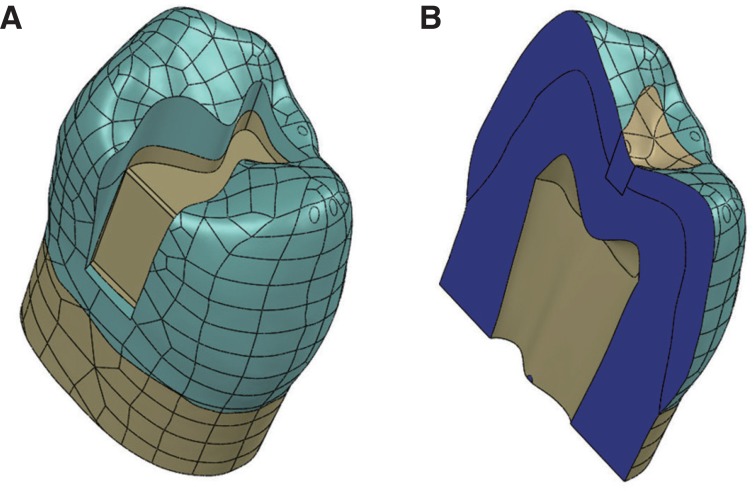
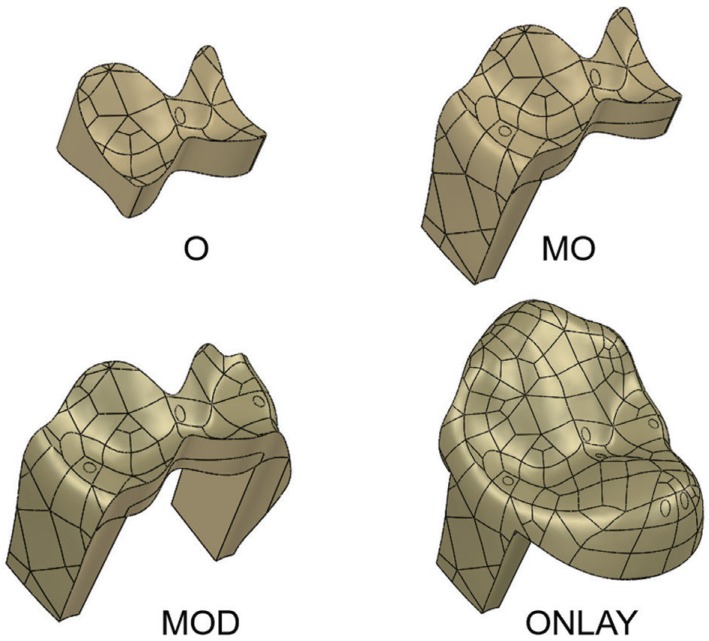
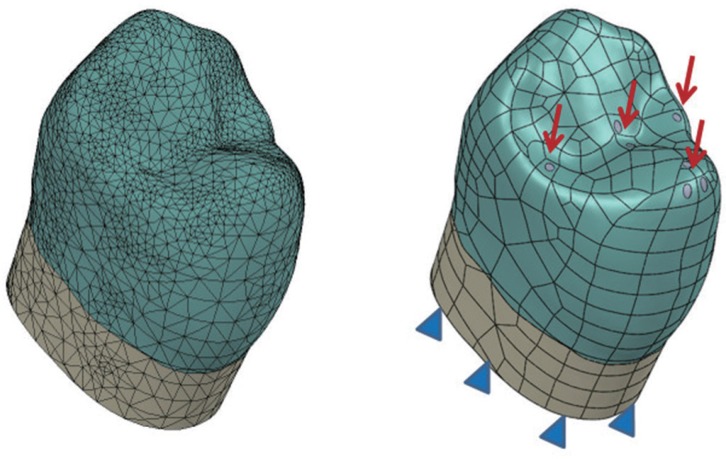
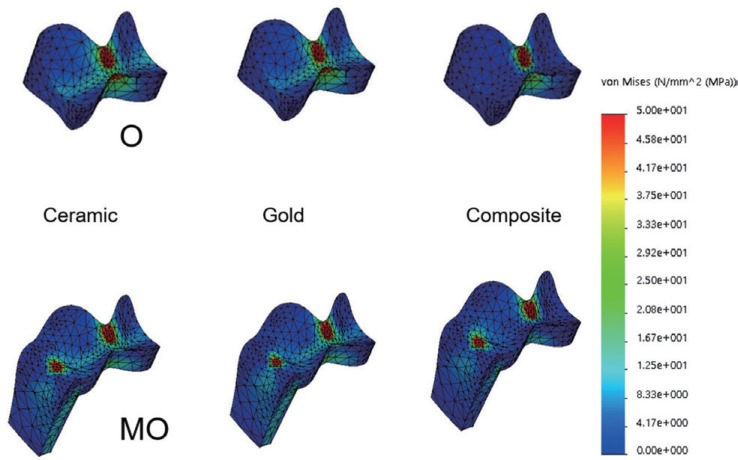
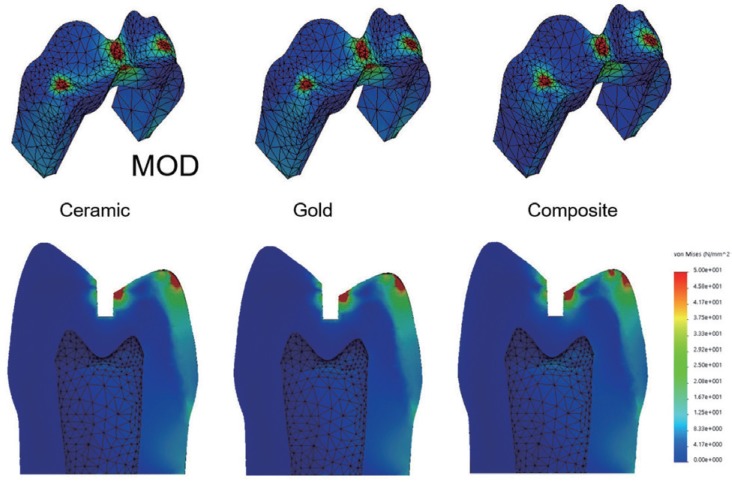
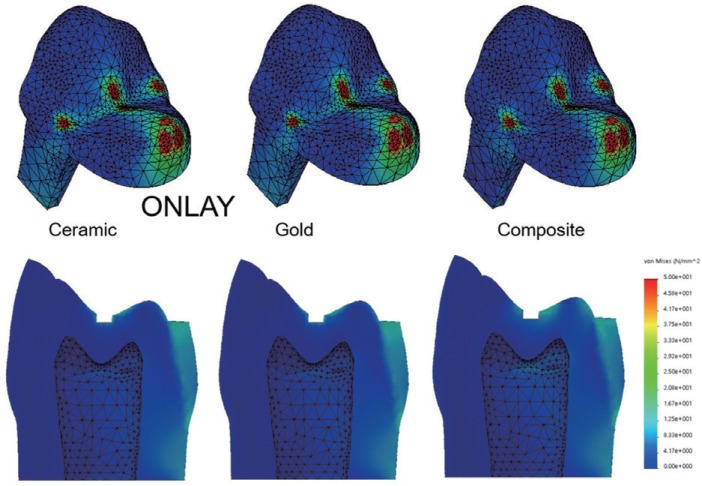
Three-dimensional maxillary premolar models of abutments were designed to include the following: 1) inlay with O cavity (O group), 2) inlay with MO cavity (MO group), 3) inlay with MOD cavity (MOD group), and 4) onlay (ONLAY group). A restoration of each inlay or onlay cavity was simulated using gold alloy, e.max ceramic, or composite resin for restoration. To simulate masticatory forces, a total of 140 N static axial force was applied onto the tooth at the occlusal contact areas. A finite element analysis was performed to predict the magnitude and pattern of stresses generated by occlusal loading.
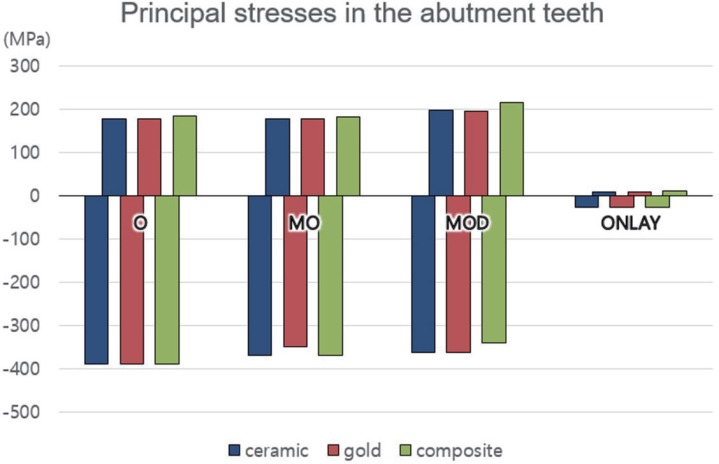
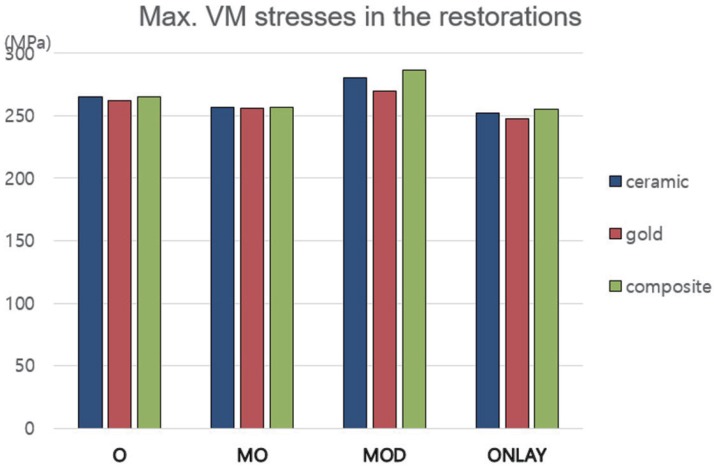
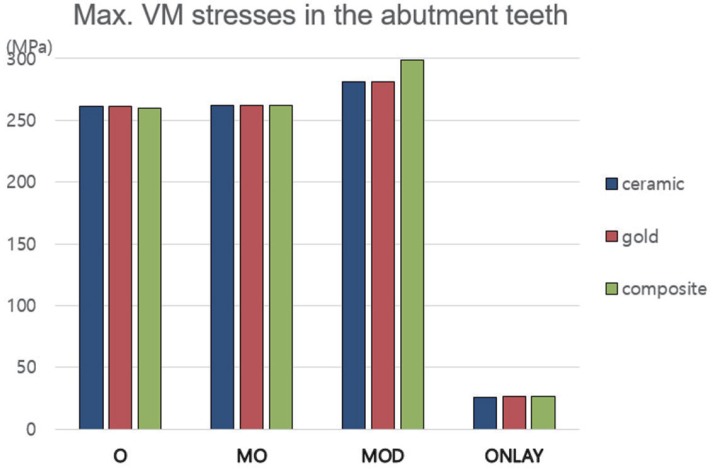
Maximum von Mises stress values generated in the abutment teeth of the ONLAY group were ranged from 26.1 to 26.8 MPa, which were significantly lower than those of inlay groups (O group: 260.3-260.7 MPa; MO group: 252.1-262.4 MPa; MOD group: 281.4-298.8 MPa). Maximum von Mises stresses generated with ceramic, gold, and composite restorations were 280.1, 269.9, and 286.6 MPa, respectively, in the MOD group. They were 252.2, 248.0, 255.1 MPa, respectively, in the ONLAY group.
The onlay design (ONLAY group) protected tooth structures more effectively than inlay designs (O, MO, and MOD groups). However, stress magnitudes in restorations with various dental materials exhibited no significant difference among groups (O, MO, MOD, ONLAY).
分析使用不同材料制作嵌体或高嵌体修复的前磨牙的应力分布情况。
设计上颌前磨牙基牙的三维模型,包括以下几种:1)O洞型嵌体(O组),2)MO洞型嵌体(MO组),3)MOD洞型嵌体(MOD组),4)高嵌体(高嵌体组)。分别使用金合金、e.max陶瓷或复合树脂模拟修复每种嵌体或高嵌体洞型。为模拟咀嚼力,在牙合接触区域对牙齿施加总共140 N的静态轴向力。进行有限元分析以预测牙合加载产生的应力大小和模式。
高嵌体组基牙产生的最大冯·米塞斯应力值范围为26.1至26.8 MPa,显著低于嵌体组(O组:260.3 - 260.7 MPa;MO组:252.1 - 262.4 MPa;MOD组:281.4 - 298.8 MPa)。在MOD组中,陶瓷、金和复合树脂修复体产生的最大冯·米塞斯应力分别为280.1、269.9和286.6 MPa。在高嵌体组中,它们分别为252.2、248.0、255.1 MPa。
高嵌体设计(高嵌体组)比嵌体设计(O、MO和MOD组)更有效地保护牙体结构。然而,不同牙科材料修复体中的应力大小在各实验组(O、MO、MOD、高嵌体)之间无显著差异。