
平台转换种植体的三维有限元分析
Three-dimensional finite element analysis of platform switched implant.
作者信息
Moon Se-Young, Lim Young-Jun, Kim Myung-Joo, Kwon Ho-Beom
机构信息
School of Dentistry, Seoul National University, Seoul, Republic of Korea.
Dental Research Institute and Department of Prosthodontics, School of Dentistry, Seoul National University, Seoul, Republic of Korea.
出版信息
J Adv Prosthodont. 2017 Feb;9(1):31-37. doi: 10.4047/jap.2017.9.1.31. Epub 2017 Feb 7.
PURPOSE
The purpose of this study was to analyze the influence of the platform switching concept on an implant system and peri-implant bone using three-dimensional finite element analysis.
MATERIALS AND METHODS
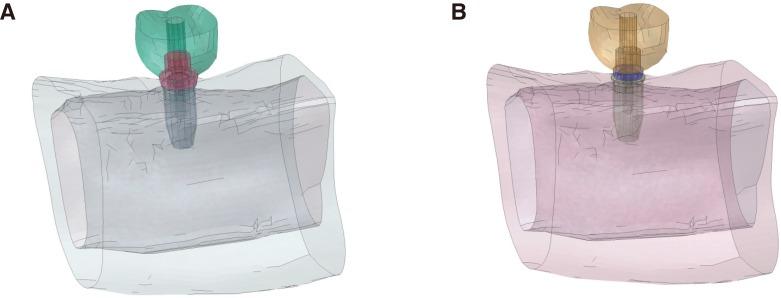
Two three-dimensional finite element models for wide platform and platform switching were created. In the wide platform model, a wide platform abutment was connected to a wide platform implant. In the platform switching model, the wide platform abutment of the wide platform model was replaced by a regular platform abutment. A contact condition was set between the implant components. A vertical load of 300 N was applied to the crown. The maximum von Mises stress values and displacements of the two models were compared to analyze the biomechanical behavior of the models.
RESULTS
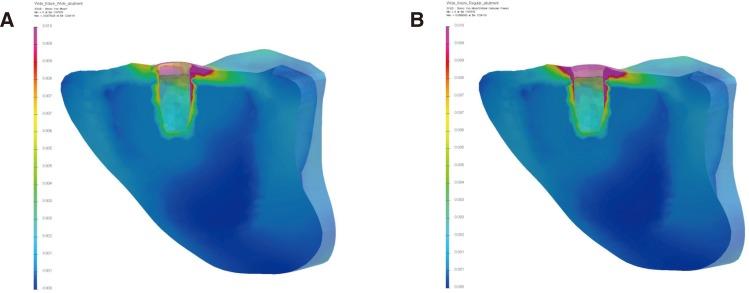
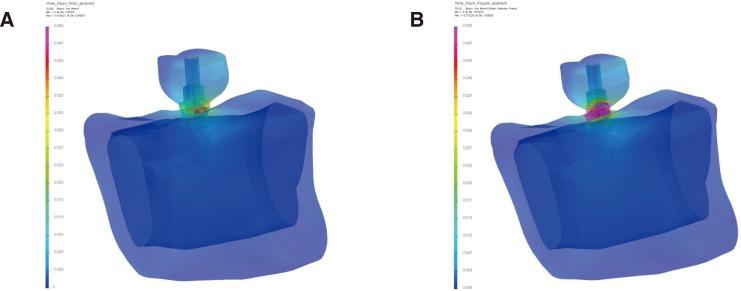
In the two models, the stress was mainly concentrated at the bottom of the abutment and the top surface of the implant in both models. However, the von Mises stress values were much higher in the platform switching model in most of the components, except for the bone. The highest von Mises values and stress distribution pattern of the bone were similar in the two models. The components of the platform switching model showed greater displacement than those of the wide platform model.
CONCLUSION
Due to the stress concentration generated in the implant and the prosthodontic components of the platform switched implant, the mechanical complications might occur when platform switching concept is used.
目的
本研究旨在通过三维有限元分析,探讨平台转换概念对种植系统及种植体周围骨组织的影响。
材料与方法
建立了宽平台和平台转换的两个三维有限元模型。在宽平台模型中,宽平台基台与宽平台种植体相连。在平台转换模型中,宽平台模型的宽平台基台被常规平台基台取代。在种植体部件之间设置了接触条件。在牙冠上施加300 N的垂直载荷。比较两个模型的最大von Mises应力值和位移,以分析模型的生物力学行为。
结果
在两个模型中,应力主要集中在基台底部和种植体顶面。然而,除骨组织外,平台转换模型中大多数部件的von Mises应力值要高得多。两个模型中骨组织的最高von Mises值和应力分布模式相似。平台转换模型的部件比宽平台模型的部件位移更大。
结论
由于平台转换种植体的种植体和修复部件中产生应力集中,使用平台转换概念时可能会出现机械并发症。

 Zotero 插件