Tekçe Neslihan, Tuncer Safa, Demirci Mustafa
Department of Restorative Dentistry, Faculty of Dentistry, University of Kocaeli, Kocaeli, Turkey.
Department of Restorative Dentistry, Faculty of Dentistry, University of Istanbul, Istanbul, Turkey.
J Adv Prosthodont. 2018 Jun;10(3):211-217. doi: 10.4047/jap.2018.10.3.211. Epub 2018 Jun 12.
To evaluate the effect of prolonged sandblasting on the bond durability of dual-cure adhesive resin cement to computer-aided design and computer-aided manufacturing (CAD/CAM) restoratives.
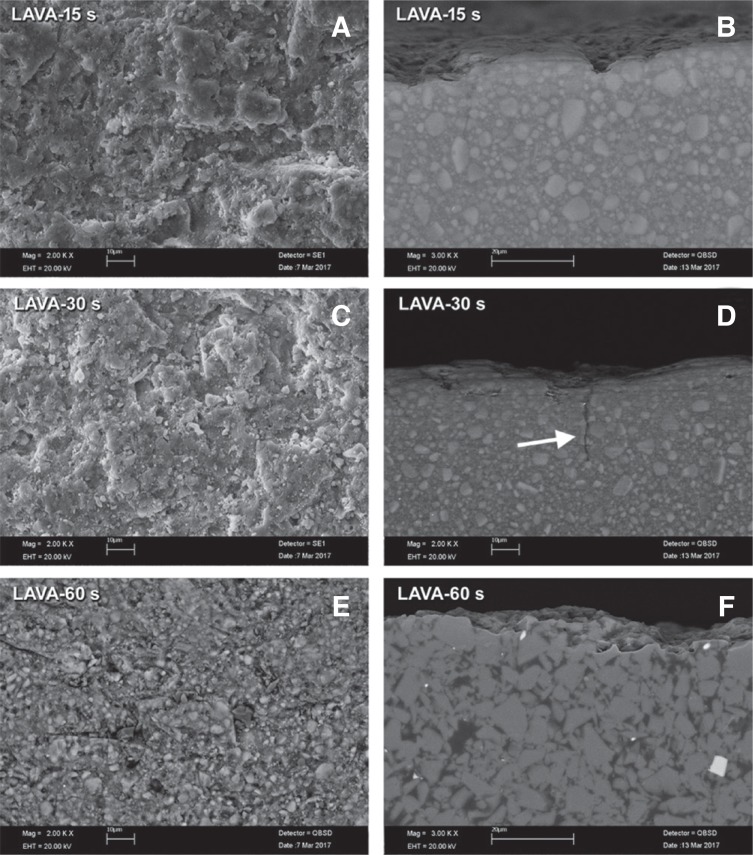
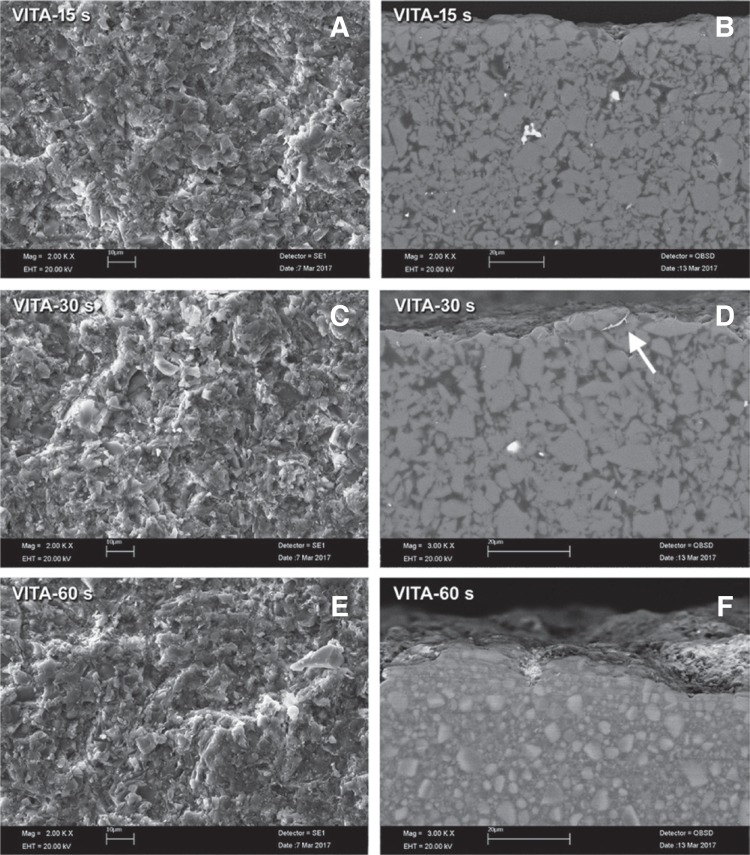
Nano-ceramic LAVA Ultimate and hybrid-ceramic VITA Enamic CAD/CAM blocks were used for this study. Each CAD/CAM block was sectioned into slabs of 4-mm thickness for the microtensile test (µTBS) test and 2-mm thickness for the surface roughness test. Three groups were created according to the sandblasting protocols; group 1: specimens were sandblasted for 15 seconds, group 2: specimens were sandblasted for 30 seconds, and group 3: specimens were sandblasted for 60 seconds. After sandblasting, all specimens were luted using RelyX Ultimate Clicker. Half the specimens were subjected to µTBS tests at 24 hours, and the other half were subjected to tests after 5000 thermocycles. Additionally, a total of 96 CAD/CAM block sections were prepared for surface roughness tests and scanning electron microscopy (SEM) evaluations. The Mann-Whitney U test, Kruskal-Wallis one-way analysis of variance, and Dunn's post hoc test were used to compare continuous variables among the groups.
At baseline, group 1, group 2, and group 3 exhibited statistically similar µTBS results for LAVA. However, group 3 had significantly lower µTBS values than groups 1 and 2 for VITA. After 5000 thermocycles, µTBS values significantly decreased for each block (<.05).
It is important to perform controlled sandblasting because it may affect bond strength results. Sixty seconds of sandblasting disturbs the initial µTBS values and the stability of adhesion of CAD/CAM restoratives to dual-cure adhesive resin cement for VITA Enamic.
评估延长喷砂时间对双固化粘接树脂水门汀与计算机辅助设计和计算机辅助制造(CAD/CAM)修复体之间粘接耐久性的影响。
本研究使用纳米陶瓷LAVA Ultimate和混合陶瓷VITA Enamic CAD/CAM块。将每个CAD/CAM块切成4毫米厚的薄片用于微拉伸试验(µTBS),切成2毫米厚的薄片用于表面粗糙度测试。根据喷砂方案分为三组;第1组:试样喷砂15秒,第2组:试样喷砂30秒,第3组:试样喷砂60秒。喷砂后,所有试样均使用RelyX Ultimate Clicker进行粘接。一半试样在24小时时进行µTBS测试,另一半在5000次热循环后进行测试。此外,总共制备了96个CAD/CAM块切片用于表面粗糙度测试和扫描电子显微镜(SEM)评估。采用Mann-Whitney U检验、Kruskal-Wallis单因素方差分析和Dunn事后检验来比较各组之间的连续变量。
在基线时,第1组、第2组和第3组的LAVA的µTBS结果在统计学上相似。然而,对于VITA,第3组的µTBS值显著低于第1组和第2组。在5000次热循环后,每个块的µTBS值均显著降低(<.05)。
进行可控喷砂很重要,因为它可能会影响粘接强度结果。60秒的喷砂会干扰初始µTBS值以及VITA Enamic的CAD/CAM修复体与双固化粘接树脂水门汀之间的粘接稳定性。