Knighton Andrew J, Brunisholz Kimberly D, Savitz Samuel T
Intermountain Healthcare, US.
University of North Carolina at Chapel Hill, US.
EGEMS (Wash DC). 2017 Dec 15;5(3):7. doi: 10.5334/egems.191.
Socio-economic status (SES) and low health literacy (LHL) are closely correlated. Both are directly associated with clinical and behavioral risk factors and healthcare outcomes. Learning healthcare systems are introducing small-area measures to address the challenges associated with maintaining patient-reported measures of SES and LHL. This study's purpose was to measure the association between two available census block measures associated with SES and LHL. Understanding the relationship can guide the identification of a multi-purpose area based measure for delivery system use.
A retrospective observational design was deployed using all US Census block groups in Utah. The principal dependent variable was a nationally-standardized health literacy score (HLS). The primary explanatory variable was a state-standardized area deprivation index (ADI). Statistical methods included linear regression and tests of association. Receiver operating characteristic (ROC) analysis was used to develop LHL criteria using ADI.
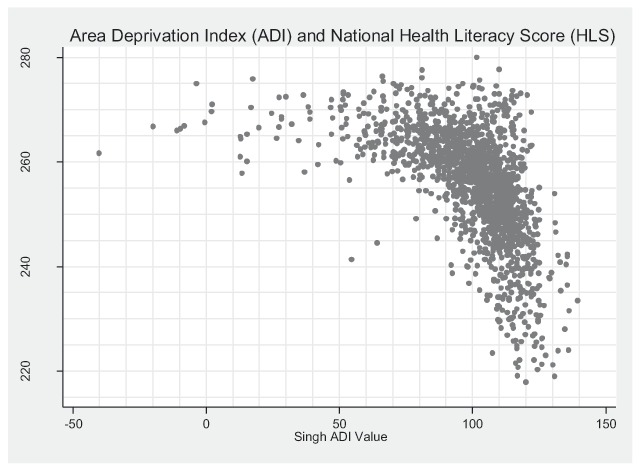
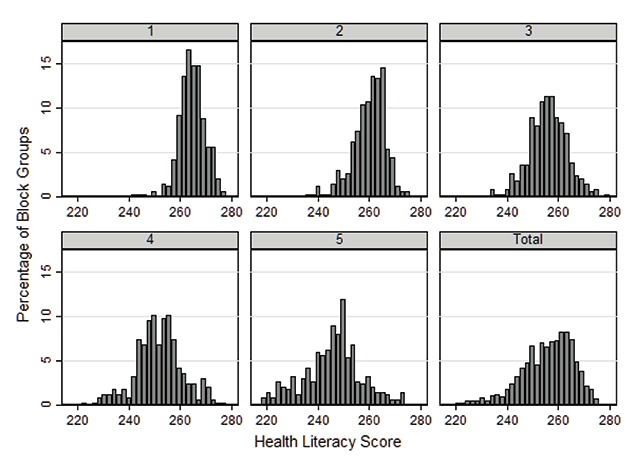
A significant negative association between the HLS and the ADI score remained after adjusting for area-level risk factors (β: -0.21 (95% CI: -0.22, -0.19) p < .001). Eighteen block groups (<1%) were identified as having LHL using HLS. A combination of three or more ADI components correlated with LHL predicted 78% of HLS LHL block groups and 35 additional block groups not identified using HLS (c-statistic: 0.64; 95% CI: 0.62, 0.66).
HLS and ADI use differing measurement criteria but are closely correlated. A state-based ADI detected additional neighborhoods with risk of LHL compared to use of a national HLS. An ADI represents a multi-purpose area measure of social determinants useful for learning health systems tailoring care.
社会经济地位(SES)与低健康素养(LHL)密切相关。两者均与临床和行为风险因素以及医疗保健结果直接相关。学习型医疗系统正在引入小区域测量方法,以应对与维持患者报告的SES和LHL测量相关的挑战。本研究的目的是测量与SES和LHL相关的两种可用普查街区测量方法之间的关联。了解这种关系可以指导确定一种用于交付系统使用的多用途区域测量方法。
采用回顾性观察设计,使用犹他州所有美国普查街区组。主要因变量是全国标准化的健康素养得分(HLS)。主要解释变量是州标准化的区域贫困指数(ADI)。统计方法包括线性回归和关联性检验。使用ADI通过受试者操作特征(ROC)分析来制定LHL标准。
在调整区域层面的风险因素后,HLS与ADI得分之间仍存在显著的负相关(β:-0.21(95%置信区间:-0.22,-0.19),p <.001)。使用HLS确定了18个街区组(<1%)具有低健康素养。三个或更多ADI成分与LHL的组合预测了78%的HLS低健康素养街区组以及另外35个未使用HLS识别出的街区组(c统计量:0.64;95%置信区间:0.62,0.66)。
HLS和ADI使用不同的测量标准,但密切相关。与使用全国性HLS相比,基于州的ADI检测到了更多有低健康素养风险的社区。ADI代表了一种多用途的社会决定因素区域测量方法,有助于学习型医疗系统调整护理。