National Institute of Food and Drug Safety Evaluation (NIFDS), Ministry of Food and Drug Safety (MFDS), OHTAC 187, Osongsaengmyong 2-ro, Cheongju-si, Chungbuk 28159, Korea.
College of Pharmacy, Wonkwang University, Iksandaero 460, Iksan, Jeonbuk 54538, Korea.
Int J Mol Sci. 2018 Jun 22;19(7):1836. doi: 10.3390/ijms19071836.
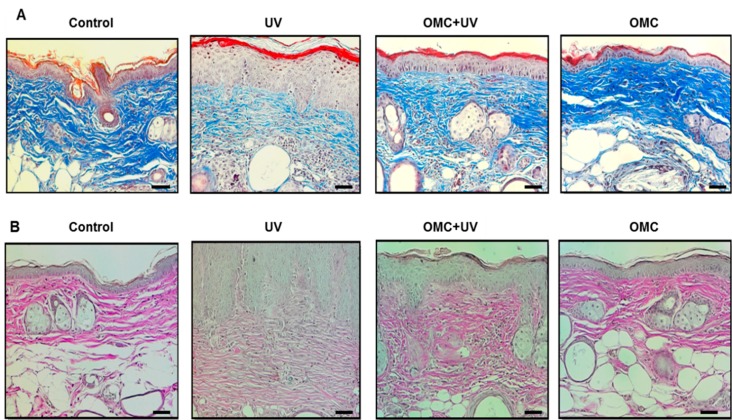
Ultraviolet (UV) irradiation damages skin and produces symptoms of photoaging, such as thickening, rough texture, wrinkles, and pigmentation. However, the cellular and molecular mechanisms underlying photoaging induced by chronic UV irradiation are not yet fully understood. Matrix metalloproteinases (MMPs) have been reported to be involved in the response to UV irradiation. In this study, we examined the effects of the sunscreen agent Octylmethoxycinnamate (OMC) on photoaging of the skin induced by chronic UV exposure in hairless albino Crl:SKH1- (SKH-1) mice. We demonstrated that the expression of MMPs was elevated by UV irradiation, whereas the topical application of OMC inhibited the upregulation of MMPs. Furthermore, UV-induced wrinkle formation was decreased by OMC treatment. These results suggest that OMC is a potential agent for the prevention and treatment of skin photoaging.
紫外线(UV)辐射会损害皮肤,并产生光老化的症状,如增厚、粗糙纹理、皱纹和色素沉着。然而,慢性 UV 辐射引起光老化的细胞和分子机制尚未完全阐明。已有报道称基质金属蛋白酶(MMPs)参与了对 UV 辐射的反应。在这项研究中,我们研究了防晒剂辛甲氧肉桂酸(OMC)对无毛白化 Crl:SKH1-(SKH-1)小鼠慢性 UV 暴露引起的皮肤光老化的影响。我们证明 MMPs 的表达被 UV 辐射上调,而 OMC 的局部应用抑制了 MMPs 的上调。此外,OMC 处理可减少 UV 诱导的皱纹形成。这些结果表明 OMC 是预防和治疗皮肤光老化的潜在药物。