McIsaac Daniel I, Saunders Chelsey, Hladkowicz Emily, Bryson Gregory L, Forster Alan J, Gagne Sylvain, Huang Allen, Lalu Manoj, Lavallee Luke T, Moloo Husein, Nantel Julie, Power Barbara, Scheede-Bergdahl Celena, Taljaard Monica, van Walraven Carl, McCartney Colin J L
Department of Anesthesiology and Pain Medicine, The Ottawa Hospital, University of Ottawa, Ottawa, Ontario, Canada.
Clinical Epidemiology Program, The Ottawa Hospital Research Institute, Ottawa, Ontario, Canada.
BMJ Open. 2018 Jun 22;8(6):e022057. doi: 10.1136/bmjopen-2018-022057.
Exercise prehabilitation may improve outcomes after surgery. Frailty is a key predictor of adverse postoperative outcomes in older people; the multidimensional nature of frailty makes this a population who may derive substantial benefit from exercise prehabilitation. The objective of this trial is to test the efficacy of exercise prehabilitation to improve postoperative functional outcomes for people living with frailty having cancer surgery with curative intent.
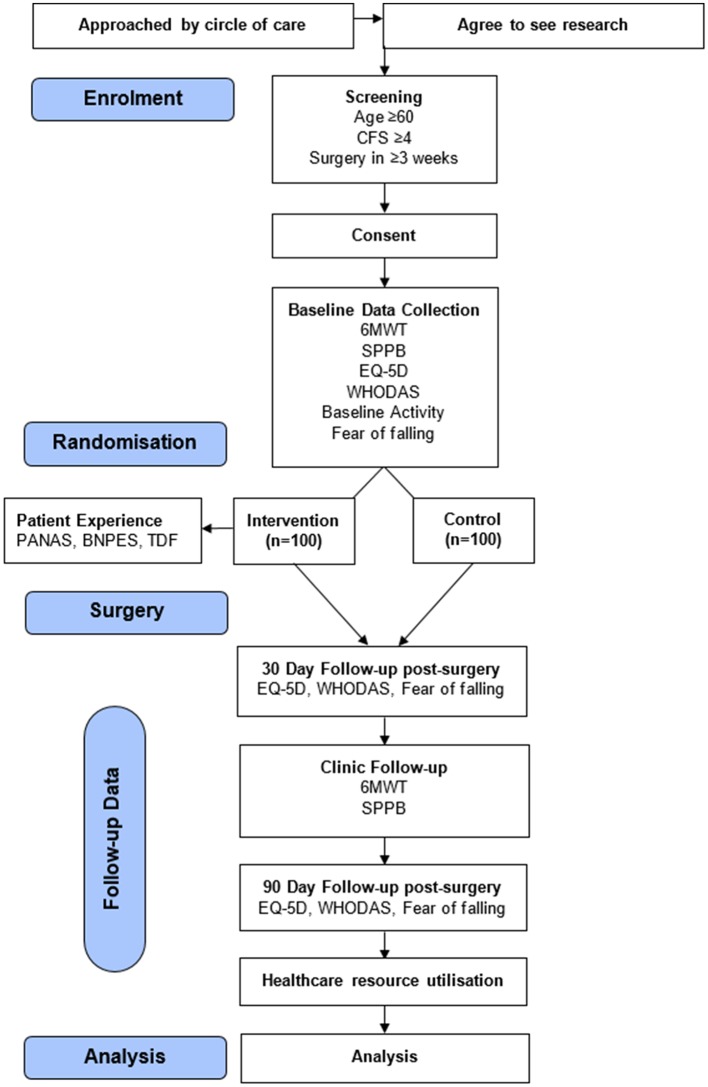
We will conduct a single-centre, parallel-arm randomised controlled trial of home-based exercise prehabilitation versus standard care among consenting patients >60 years having elective cancer surgery (intra-abdominal and intrathoracic) and who are frail (Clinical Frailty Scale >4. The intervention consists of 3 weeks of exercise prehabilitation (strength, aerobic and stretching). The primary outcome is the 6 min walk test at the first postoperative clinic visit. Secondary outcomes include the short physical performance battery, health-related quality of life, disability-free survival, complications and health resource utilisation. The primary outcome will be analysed by intention to treat using analysis of covariance. Outcomes up to 1 year after surgery will be ascertained through linkage to administrative data.
Ethical approval has been granted by our ethics review board (Protocol Approval #2016009-01H). Results will be disseminated through presentation at scientific conferences, through peer-reviewed publication, stakeholder organisations and engagement of social and traditional media.
NCT02934230; Pre-results.
运动预康复可能会改善术后结局。虚弱是老年人术后不良结局的关键预测因素;虚弱的多维性质使得这一人群可能从运动预康复中获得显著益处。本试验的目的是检验运动预康复对有治愈性意图的癌症手术的虚弱患者术后功能结局的改善效果。
我们将在年龄大于60岁、同意参与的择期癌症手术(腹腔内和胸腔内)且虚弱(临床虚弱量表>4)的患者中开展一项单中心、平行组随机对照试验,比较居家运动预康复与标准护理。干预措施包括为期3周的运动预康复(力量、有氧运动和伸展运动)。主要结局是术后首次门诊就诊时的6分钟步行试验。次要结局包括简短体能测试、健康相关生活质量、无残疾生存期、并发症和卫生资源利用情况。主要结局将采用协方差分析按意向性分析进行分析。术后长达1年的结局将通过与行政数据的关联来确定。
我们的伦理审查委员会已批准伦理许可(方案批准号#2016009-01H)。结果将通过在科学会议上报告、同行评审发表、利益相关者组织以及社会和传统媒体的参与来传播。
NCT02934230;预结果。