de Kok Remco J, Tuinenburg Obbe A, Bonekamp Pleun N J, Immerzeel Walter W
Department of Physical Geography Utrecht University Utrecht Netherlands.
Copernicus Institute of Sustainable Development Utrecht University Utrecht Netherlands.
Geophys Res Lett. 2018 Feb 28;45(4):2047-2054. doi: 10.1002/2017GL076158. Epub 2018 Feb 20.
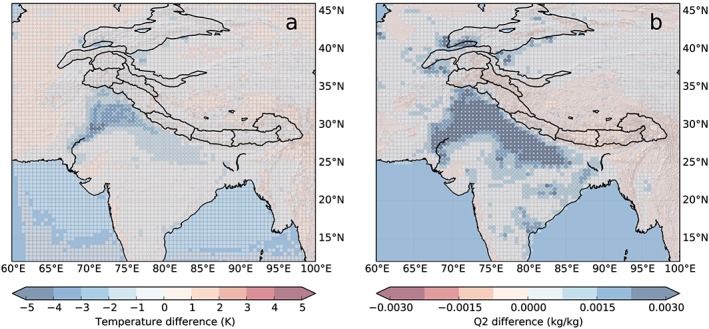
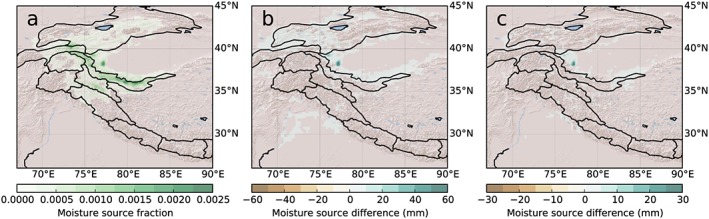
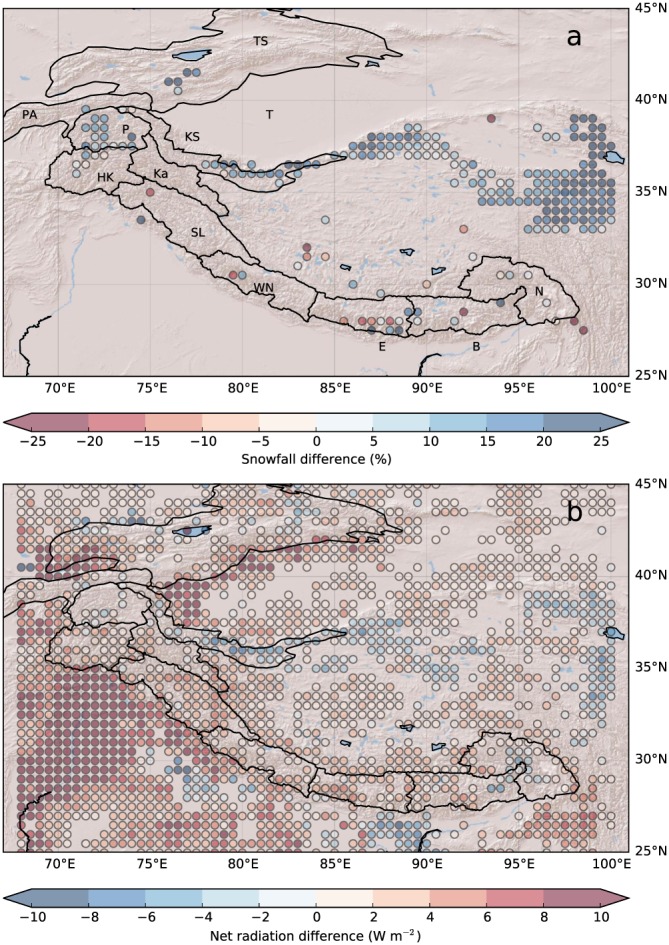
Many glaciers in the northwest of High Mountain Asia (HMA) show an almost zero or positive mass balance, despite the global trend of melting glaciers. This phenomenon is often referred to as the "Karakoram anomaly," although strongest positive mass balances can be found in the Kunlun Shan mountain range, northeast of the Karakoram. Using a regional climate model, in combination with a moisture-tracking model, we show that the increase in irrigation intensity in the lowlands surrounding HMA, particularly in the Tarim basin, can locally counter the effects of global warming on glaciers in Kunlun Shan, and parts of Pamir and northern Tibet, through an increase in summer snowfall and decrease in net radiance. Irrigation can thus affect the regional climate in a way that favors glacier growth, and future projections of glacier melt, which may impact millions of inhabitants surrounding HMA, will need to take into account predicted changes in irrigation intensity.
尽管全球冰川呈融化趋势,但亚洲高山地区(HMA)西北部的许多冰川显示出几乎为零或正的物质平衡。这种现象通常被称为“喀喇昆仑异常”,尽管最强的正物质平衡出现在喀喇昆仑山脉东北部的昆仑山脉。通过使用区域气候模型并结合水分追踪模型,我们表明,HMA周边低地,特别是塔里木盆地灌溉强度的增加,可通过夏季降雪增加和净辐射减少,在局部抵消全球变暖对昆仑山脉、部分帕米尔地区和藏北冰川的影响。因此,灌溉能够以有利于冰川生长的方式影响区域气候,而未来可能影响HMA周边数百万居民的冰川融化预测,将需要考虑灌溉强度的预测变化。