• 文献检索
  • 文档翻译
  • 深度研究
  • 学术资讯
  • Suppr Zotero 插件Zotero 插件
  • 邀请有礼
  • 套餐&价格
  • 历史记录
应用&插件
Suppr Zotero 插件Zotero 插件浏览器插件Mac 客户端Windows 客户端微信小程序
定价
高级版会员购买积分包购买API积分包
服务
文献检索文档翻译深度研究API 文档MCP 服务
关于我们
关于 Suppr公司介绍联系我们用户协议隐私条款
关注我们

Suppr 超能文献

核心技术专利:CN118964589B侵权必究
粤ICP备2023148730 号-1Suppr @ 2026

文献检索

告别复杂PubMed语法,用中文像聊天一样搜索,搜遍4000万医学文献。AI智能推荐,让科研检索更轻松。

立即免费搜索

文件翻译

保留排版,准确专业,支持PDF/Word/PPT等文件格式,支持 12+语言互译。

免费翻译文档

深度研究

AI帮你快速写综述,25分钟生成高质量综述,智能提取关键信息,辅助科研写作。

立即免费体验

本地和外来淡水甲壳纲十足目动物的热极限:栖息地利用和氧气限制的作用。

Thermal limits in native and alien freshwater peracarid Crustacea: The role of habitat use and oxygen limitation.

作者信息

Verberk Wilco C E P, Leuven Rob S E W, van der Velde Gerard, Gabel Friederike

机构信息

Department of Animal Ecology and Physiology Institute for Water and Wetland Research (IWWR) Radboud University Nijmegen The Netherlands.

Department of Environmental Science Institute for Water and Wetland Research (IWWR) Radboud University Nijmegen The Netherlands.

出版信息

Funct Ecol. 2018 Apr;32(4):926-936. doi: 10.1111/1365-2435.13050. Epub 2018 Feb 6.

DOI:10.1111/1365-2435.13050
PMID:29937614
原文链接:https://pmc.ncbi.nlm.nih.gov/articles/PMC5993316/
Abstract

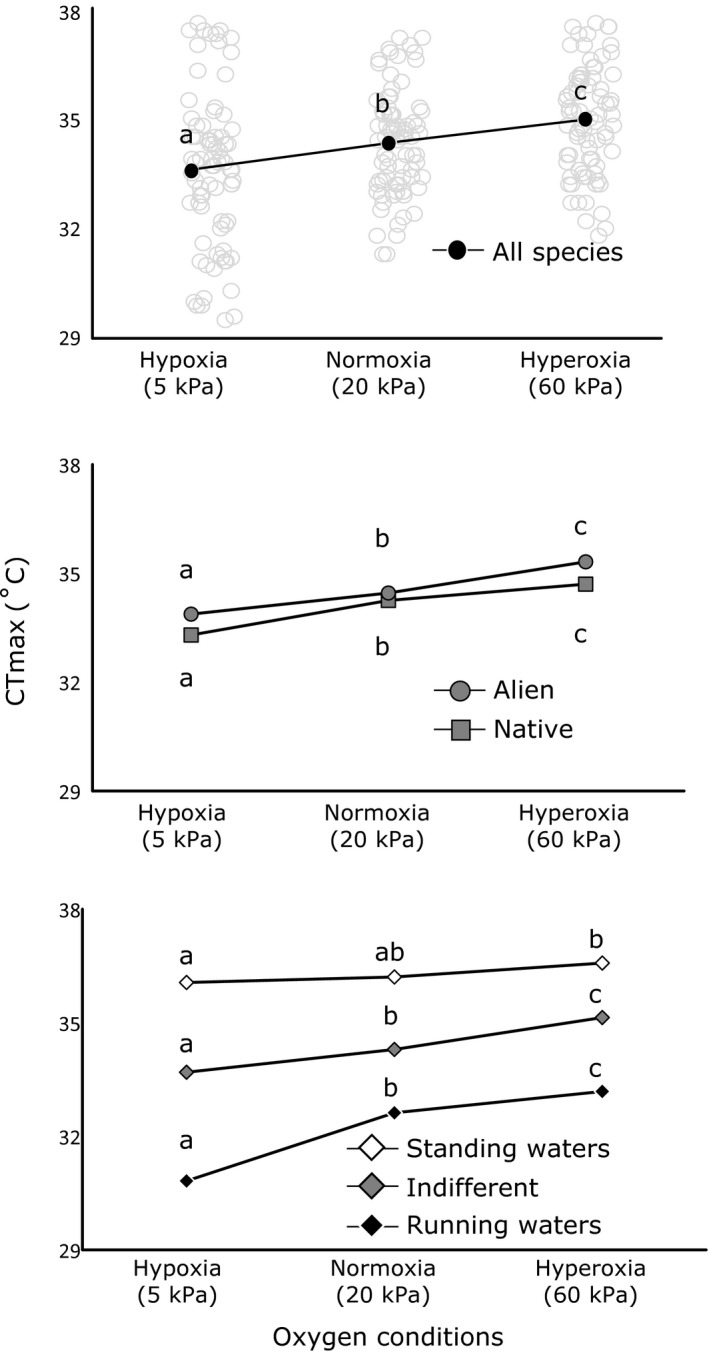
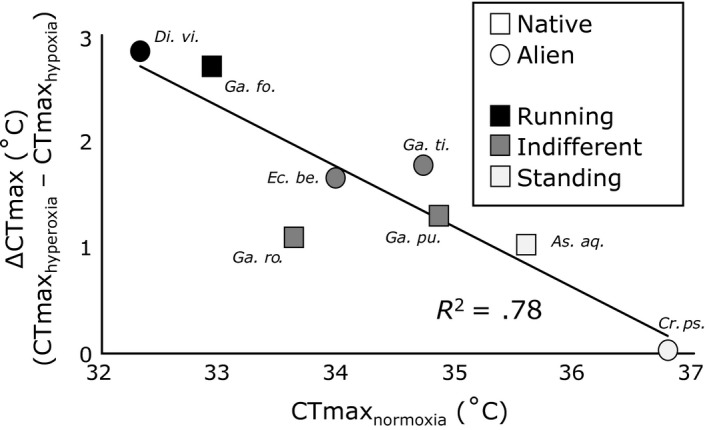
In order to predict which species can successfully cope with global warming and how other environmental stressors modulate their vulnerability to climate-related environmental factors, an understanding of the ecophysiology underpinning thermal limits is essential for both conservation biology and invasion biology.Heat tolerance and the extent to which heat tolerance differed with oxygen availability were examined for four native and four alien freshwater peracarid crustacean species, with differences in habitat use across species. Three hypotheses were tested: (1) Heat and lack of oxygen synergistically reduce survival of species; (2) patterns in heat tolerance and the modulation thereof by oxygen differ between alien and native species and between species with different habitat use; (3) small animals can better tolerate heat than large animals, and this difference is more pronounced under hypoxia.To assess heat tolerances under different oxygen levels, animal survival was monitored in experimental chambers in which the water temperature was ramped up (0.25°C min). Heat tolerance (CTmax) was scored as the cessation of all pleopod movement, and heating trials were performed under hypoxia (5 kPa oxygen), normoxia (20 kPa) and hyperoxia (60 kPa).Heat tolerance differed across species as did the extent by which heat tolerance was affected by oxygen conditions. Heat-tolerant species, for example, and , showed little response to oxygen conditions in their CTmax, whereas the CTmax of heat-sensitive species, for example, s and , was more plastic, being increased by hyperoxia and reduced by hypoxia.In contrast to other studies on crustaceans, alien species were not more heat-tolerant than native species. Instead, differences in heat tolerance were best explained by habitat use, with species from standing waters being heat tolerant and species from running waters being heat sensitive. In addition, larger animals displayed lower critical maximum temperature, but only under hypoxia. An analysis of data available in the literature on metabolic responses of the study species to temperature and oxygen conditions suggests that oxygen conformers and species whose oxygen demand rapidly increases with temperature (low activation energy) may be more heat sensitive.The alien species appeared most susceptible to hypoxia and heat stress. This may explain why this species is very successful in colonizing new areas in littoral zones with rocky substrate which are well aerated due to continuous wave action generated by passing ships or prevailing winds. This species is less capable of spreading to other waters which are poorly oxygenated and where is the more likely dominant alien species. A http://onlinelibrary.wiley.com/doi/10.1111/1365-2435.13050/suppinfo is available for this article.
https://cdn.ncbi.nlm.nih.gov/pmc/blobs/115c/5993316/c29e4be15916/FEC-32-926-g002.jpg
https://cdn.ncbi.nlm.nih.gov/pmc/blobs/115c/5993316/55e42c98cc1b/FEC-32-926-g001.jpg
https://cdn.ncbi.nlm.nih.gov/pmc/blobs/115c/5993316/c29e4be15916/FEC-32-926-g002.jpg
https://cdn.ncbi.nlm.nih.gov/pmc/blobs/115c/5993316/55e42c98cc1b/FEC-32-926-g001.jpg
https://cdn.ncbi.nlm.nih.gov/pmc/blobs/115c/5993316/c29e4be15916/FEC-32-926-g002.jpg
摘要

为了预测哪些物种能够成功应对全球变暖,以及其他环境压力源如何调节它们对气候相关环境因素的脆弱性,了解支撑热极限的生态生理学对于保护生物学和入侵生物学都至关重要。研究了四种本地和四种外来淡水十足目甲壳类动物的耐热性以及耐热性随氧气供应的变化程度,这些物种在栖息地利用方面存在差异。测试了三个假设:(1)高温和缺氧协同降低物种的存活率;(2)外来物种和本地物种之间以及具有不同栖息地利用的物种之间,耐热性及其受氧气调节的模式存在差异;(3)小型动物比大型动物更能耐受高温,并且这种差异在缺氧条件下更为明显。为了评估不同氧气水平下的耐热性,在实验室内监测动物的存活情况,实验室内水温以0.25°C/分钟的速度上升。耐热性(CTmax)以所有腹肢运动停止来计分,加热试验在缺氧(5 kPa氧气)、常氧(20 kPa)和高氧(60 kPa)条件下进行。不同物种的耐热性不同,耐热性受氧气条件影响的程度也不同。例如,耐热物种 和 ,其CTmax对氧气条件的反应很小,而热敏物种,例如 和 ,其CTmax更具可塑性,在高氧条件下增加,在缺氧条件下降低。与其他关于甲壳类动物的研究不同,外来物种并不比本地物种更耐热。相反,耐热性的差异最好用栖息地利用来解释,静水物种耐热,流水物种热敏。此外,较大的动物表现出较低的临界最高温度,但仅在缺氧条件下如此。对文献中关于研究物种对温度和氧气条件的代谢反应数据的分析表明,氧气顺应者以及氧气需求随温度迅速增加(低活化能)的物种可能对热更敏感。外来物种 似乎对缺氧和热应激最为敏感。这可能解释了为什么该物种在有岩石基质的沿岸带新区域定殖非常成功,这些区域由于过往船只或盛行风产生的持续波浪作用而通气良好。该物种不太能够扩散到其他含氧量低的水域,而在这些水域 是更可能占优势的外来物种。本文有一个http://onlinelibrary.wiley.com/doi/10.1111/1365-2435.13050/suppinfo。

相似文献

1
Thermal limits in native and alien freshwater peracarid Crustacea: The role of habitat use and oxygen limitation.本地和外来淡水甲壳纲十足目动物的热极限:栖息地利用和氧气限制的作用。
Funct Ecol. 2018 Apr;32(4):926-936. doi: 10.1111/1365-2435.13050. Epub 2018 Feb 6.
2
Does oxygen limit thermal tolerance in arthropods? A critical review of current evidence.氧气是否限制节肢动物的耐热性?对当前证据的批判性综述。
Comp Biochem Physiol A Mol Integr Physiol. 2016 Feb;192:64-78. doi: 10.1016/j.cbpa.2015.10.020. Epub 2015 Oct 24.
3
It's about time: Linkages between heat tolerance, thermal acclimation and metabolic rate at different temporal scales in the freshwater amphipod Gammarus fossarum Koch, 1836.时间到了:1836年淡水双栖动物霍氏钩虾(Gammarus fossarum Koch)在不同时间尺度下耐热性、热适应与代谢率之间的联系
J Therm Biol. 2018 Jul;75:31-37. doi: 10.1016/j.jtherbio.2018.04.016. Epub 2018 May 1.
4
Physico-chemical variables determining the invasion risk of freshwater habitats by alien mollusks and crustaceans.决定外来贝类和甲壳类动物入侵淡水生境风险的理化变量。
Ecol Evol. 2012 Nov;2(11):2843-53. doi: 10.1002/ece3.382. Epub 2012 Oct 11.
5
Long-term forecast of thermal mortality with climate warming in riverine amphipods.随着气候变暖,河流两栖类动物的热致死长期预测。
Glob Chang Biol. 2023 Sep;29(17):5033-5043. doi: 10.1111/gcb.16834. Epub 2023 Jul 4.
6
The effect of thermal microenvironment in upper thermal tolerance plasticity in tropical tadpoles. Implications for vulnerability to climate warming.热带蝌蚪在上热耐受可塑性中的热微环境效应。对气候变暖脆弱性的启示。
J Exp Zool A Ecol Integr Physiol. 2022 Aug;337(7):746-759. doi: 10.1002/jez.2632. Epub 2022 Jun 8.
7
Ecophysiology of native and alien-invasive clams in an ocean warming context.海洋变暖背景下本地及外来入侵蛤类的生态生理学
Comp Biochem Physiol A Mol Integr Physiol. 2014 Sep;175:28-37. doi: 10.1016/j.cbpa.2014.05.003. Epub 2014 May 15.
8
Some like it hot: factors impacting thermal preferences of two Ponto-Caspian amphipods (Sovinsky, 1894) and (Eichwald, 1841).有人喜欢热:影响两种 Pontic - 里海双足类动物(索温斯基,1894 年)和(艾希瓦尔德,1841 年)热偏好的因素
PeerJ. 2018 May 31;6:e4871. doi: 10.7717/peerj.4871. eCollection 2018.
9
Changes in heat stress tolerance in a freshwater amphipod following starvation: The role of oxygen availability, metabolic rate, heat shock proteins and energy reserves.饥饿后淡水端足类对热应激耐受性的变化:氧气供应、代谢率、热休克蛋白和能量储备的作用。
Comp Biochem Physiol A Mol Integr Physiol. 2020 Jul;245:110697. doi: 10.1016/j.cbpa.2020.110697. Epub 2020 Apr 1.
10
Ecophysiological responses to temperature of the "killer shrimp" Dikerogammarus villosus: is the invader really stronger than the native Gammarus pulex?温度对“杀虾”杜氏厚纹长额虾的生理生态响应:入侵种真的比本地钩虾更强吗?
Comp Biochem Physiol A Mol Integr Physiol. 2011 Jul;159(3):268-74. doi: 10.1016/j.cbpa.2011.03.019. Epub 2011 Mar 30.

引用本文的文献

1
The relative importance of metabolic rate and body size to space use behavior in aquatic invertebrates.代谢率和体型对水生无脊椎动物空间利用行为的相对重要性。
Ecol Evol. 2024 May 20;14(5):e11253. doi: 10.1002/ece3.11253. eCollection 2024 May.
2
Meta-analysis reveals less sensitivity of non-native animals than natives to extreme weather worldwide.元分析显示,与本地动物相比,非本地动物对全球极端天气的敏感性较低。
Nat Ecol Evol. 2023 Dec;7(12):2004-2027. doi: 10.1038/s41559-023-02235-1. Epub 2023 Nov 6.
3
How plastic are upper thermal limits? A comparative study in tsetse (family: Glossinidae) and wider Diptera.

本文引用的文献

1
Upper limits to body size imposed by respiratory-structural trade-offs in Antarctic pycnogonids.南极须腕动物呼吸结构权衡对体型大小的上限限制。
Proc Biol Sci. 2017 Oct 25;284(1865). doi: 10.1098/rspb.2017.1779.
2
Critical PO is size-independent in insects: implications for the metabolic theory of ecology.昆虫的临界磷摄取量与体型无关:对生态代谢理论的启示
Curr Opin Insect Sci. 2014 Oct;4:54-59. doi: 10.1016/j.cois.2014.08.012. Epub 2014 Sep 16.
3
Antagonistic effects of biological invasion and environmental warming on detritus processing in freshwater ecosystems.
上层热限有多灵活?在采采蝇(Glossinidae 科)和更广泛的双翅目昆虫中的比较研究。
J Therm Biol. 2023 Dec;118:103745. doi: 10.1016/j.jtherbio.2023.103745. Epub 2023 Oct 30.
4
Biological Invasions Affect Resource Processing in Aquatic Ecosystems: The Invasive Amphipod Impacts Detritus Processing through High Abundance Rather than Differential Response to Temperature.生物入侵影响水生生态系统中的资源处理:入侵性双足动物通过高丰度而非对温度的差异响应影响碎屑处理。
Biology (Basel). 2023 Jun 7;12(6):830. doi: 10.3390/biology12060830.
5
Hypoxia tolerance, but not low pH tolerance, is associated with a latitudinal cline across populations of Tigriopus californicus.耐低氧能力,而不是耐低 pH 值能力,与加利福尼亚食藻虫种群的纬度渐变有关。
PLoS One. 2022 Oct 27;17(10):e0276635. doi: 10.1371/journal.pone.0276635. eCollection 2022.
6
Brain dysfunction during warming is linked to oxygen limitation in larval zebrafish.在升温过程中大脑功能障碍与幼鱼斑马鱼的氧气限制有关。
Proc Natl Acad Sci U S A. 2022 Sep 27;119(39):e2207052119. doi: 10.1073/pnas.2207052119. Epub 2022 Sep 19.
7
Exotic asphyxiation: interactions between invasive species and hypoxia.外来物种窒息:入侵物种与缺氧的相互作用。
Biol Rev Camb Philos Soc. 2023 Feb;98(1):150-167. doi: 10.1111/brv.12900. Epub 2022 Sep 12.
8
Does an Invasive Bivalve Outperform Its Native Congener in a Heat Wave Scenario? A Laboratory Study Case with and .在热浪情况下,入侵双壳贝类的表现是否优于其本地同属物种?以[具体物种1]和[具体物种2]为例的实验室研究
Biology (Basel). 2021 Dec 7;10(12):1284. doi: 10.3390/biology10121284.
9
Transcriptional frontloading contributes to cross-tolerance between stressors.转录预加载有助于应激源之间的交叉耐受。
Evol Appl. 2020 Oct 22;14(2):577-587. doi: 10.1111/eva.13142. eCollection 2021 Feb.
10
Metabolic trait diversity shapes marine biogeography.代谢特征多样性塑造了海洋生物地理学。
Nature. 2020 Sep;585(7826):557-562. doi: 10.1038/s41586-020-2721-y. Epub 2020 Sep 16.
生物入侵和环境变暖对淡水生态系统中碎屑处理的拮抗作用。
Oecologia. 2017 Mar;183(3):875-886. doi: 10.1007/s00442-016-3796-x. Epub 2016 Dec 24.
4
Oxygen dependence of upper thermal limits in fishes.鱼类上热限的氧依赖性。
J Exp Biol. 2016 Nov 1;219(Pt 21):3376-3383. doi: 10.1242/jeb.143495. Epub 2016 Sep 2.
5
Field and laboratory studies reveal interacting effects of stream oxygenation and warming on aquatic ectotherms.野外和实验室研究揭示了溪流充氧和升温对水生变温动物的相互作用影响。
Glob Chang Biol. 2016 May;22(5):1769-78. doi: 10.1111/gcb.13240. Epub 2016 Feb 29.
6
The trade-off between heat tolerance and metabolic cost drives the bimodal life strategy at the air-water interface.耐热性与代谢成本之间的权衡驱动了气-水界面的双峰生活策略。
Sci Rep. 2016 Jan 13;6:19158. doi: 10.1038/srep19158.
7
Is the temperature-size rule mediated by oxygen in aquatic ectotherms?水生变温动物的温度-大小规则是由氧气介导的吗?
J Therm Biol. 2015 Dec;54:56-65. doi: 10.1016/j.jtherbio.2014.12.003. Epub 2014 Dec 9.
8
Does oxygen limit thermal tolerance in arthropods? A critical review of current evidence.氧气是否限制节肢动物的耐热性?对当前证据的批判性综述。
Comp Biochem Physiol A Mol Integr Physiol. 2016 Feb;192:64-78. doi: 10.1016/j.cbpa.2015.10.020. Epub 2015 Oct 24.
9
Metabolic activity and behavior of the invasive amphipod Dikerogammarus villosus and two common Central European gammarid species (Gammarus fossarum, Gammarus roeselii): Low metabolic rates may favor the invader.入侵性双足类动物绒毛双齿围沙蚕以及两种常见的中欧钩虾科物种(石栖钩虾、罗氏钩虾)的代谢活动与行为:低代谢率可能有利于入侵者。
Comp Biochem Physiol A Mol Integr Physiol. 2016 Jan;191:119-126. doi: 10.1016/j.cbpa.2015.10.015. Epub 2015 Oct 16.
10
Can respiratory physiology predict thermal niches?呼吸生理学能否预测热生态位?
Ann N Y Acad Sci. 2016 Feb;1365(1):73-88. doi: 10.1111/nyas.12876. Epub 2015 Aug 31.