Roch-Lefèvre Sandrine, Grégoire Eric, Martin-Bodiot Cécile, Flegal Matthew, Fréneau Amélie, Blimkie Melinda, Bannister Laura, Wyatt Heather, Barquinero Joan-Francesc, Roy Laurence, Benadjaoud Mohamed, Priest Nick, Jourdain Jean-René, Klokov Dmitry
Institut de Radioprotection et de Sûreté Nucléaire, IRSN, Pôle Santé et Environnement, Direction de la Santé, Fontenay-aux-Roses, France.
Radiobiology and Health, Canadian Nuclear Laboratories, Chalk River, Ontario, Canada.
Oncotarget. 2018 Jun 8;9(44):27397-27411. doi: 10.18632/oncotarget.25282.
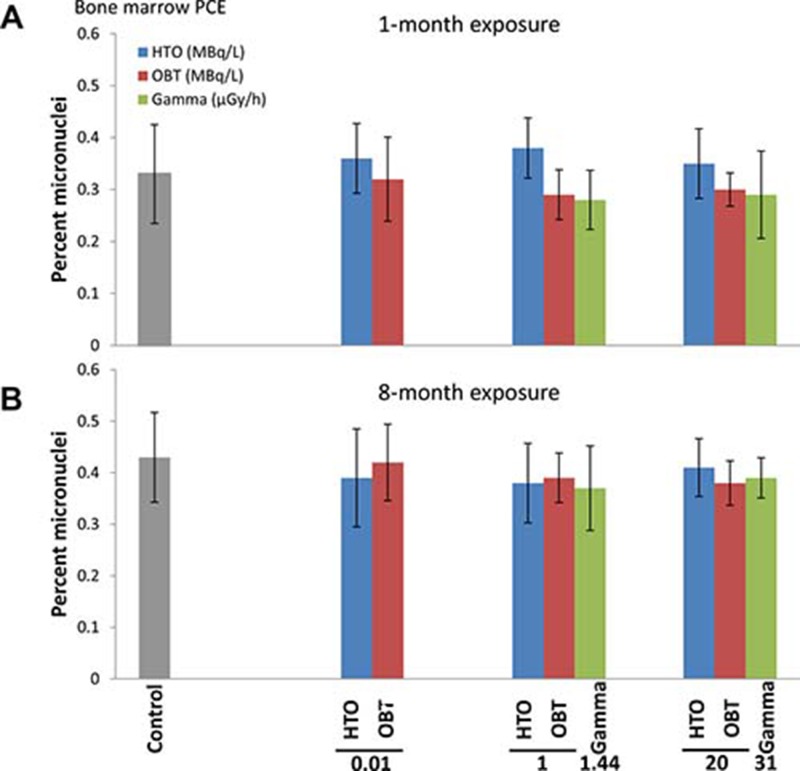
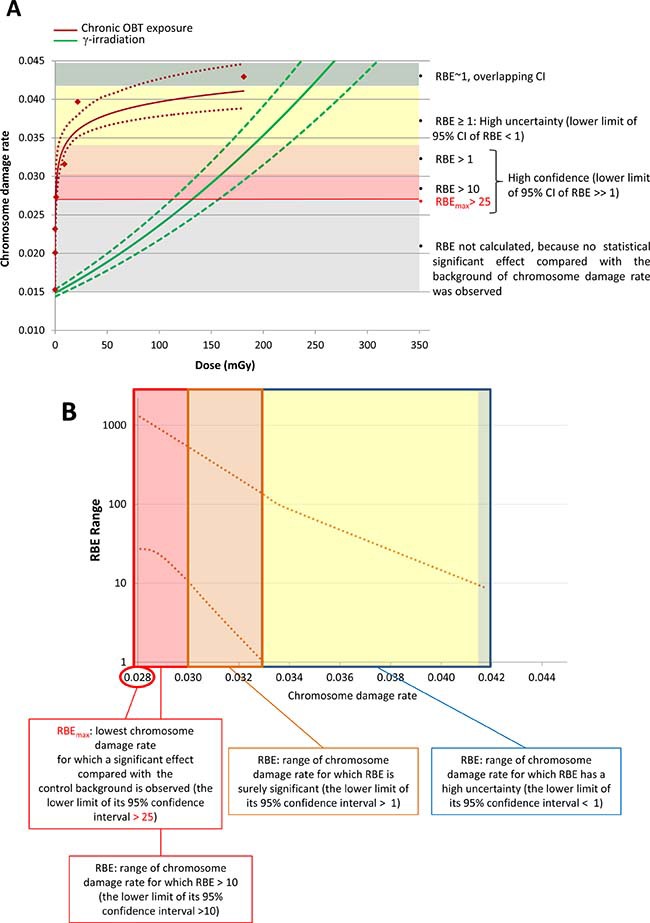
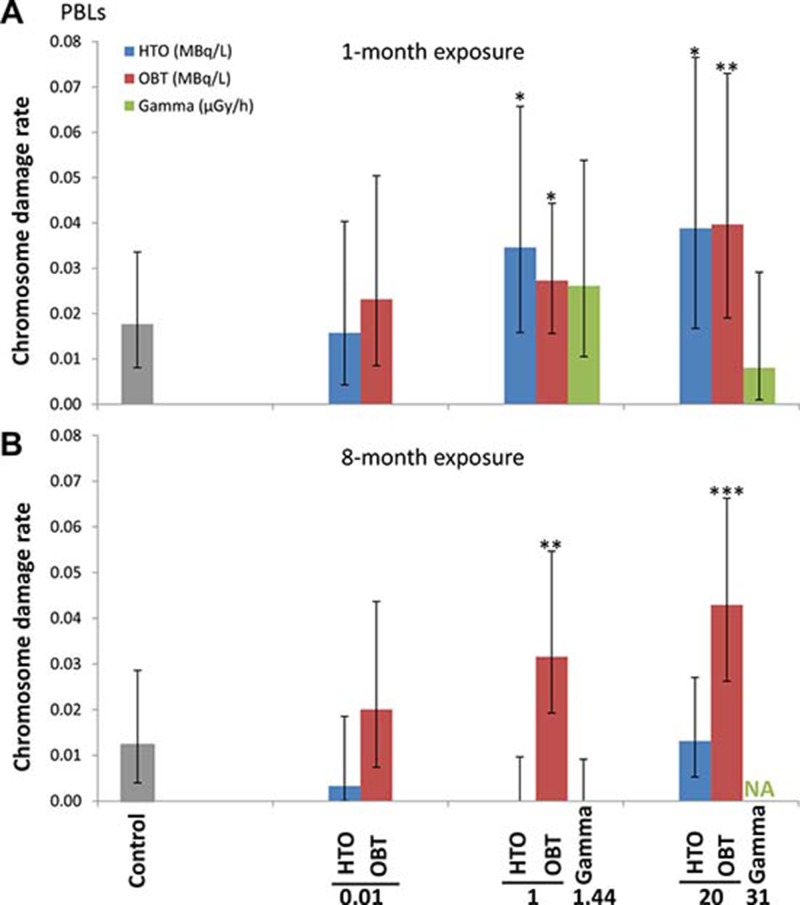
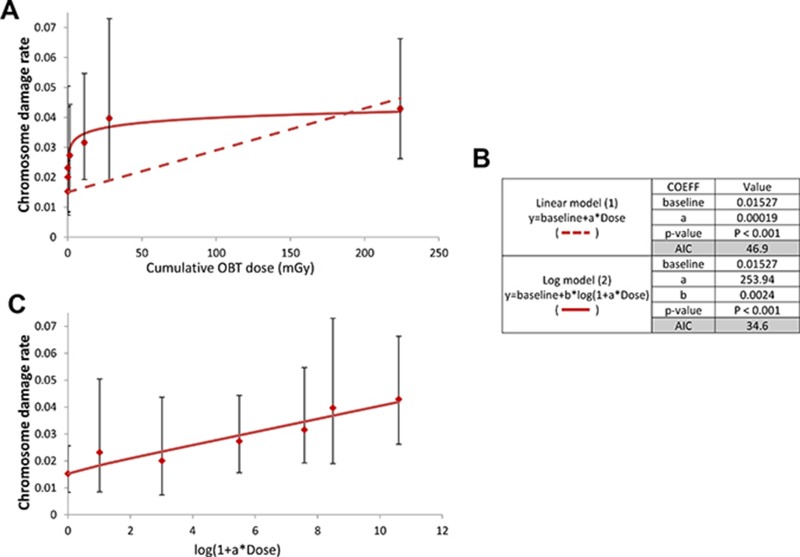
The aim of this study was to carry out a comprehensive examination of potential genotoxic effects of low doses of tritium delivered chronically to mice and to compare these effects to the ones resulting from equivalent doses of gamma-irradiation. Mice were chronically exposed for one or eight months to either tritiated water (HTO) or organically bound tritium (OBT) in drinking water at concentrations of 10 kBq/L, 1 MBq/L or 20 MBq/L. Dose rates of internal β-particle resulting from such tritium treatments were calculated and matching external gamma-exposures were carried out. We measured cytogenetic damage in bone marrow and in peripheral blood lymphocytes (PBLs) and the cumulative tritium doses (0.009 - 181 mGy) were used to evaluate the dose-response of OBT in PBLs, as well as its relative biological effectiveness (RBE). Neither tritium, nor gamma exposures produced genotoxic effects in bone marrow. However, significant increases in chromosome damage rates in PBLs were found as a result of chronic OBT exposures at 1 and 20 M Bq/L, but not at 10 kBq/L. When compared to an external acute gamma-exposure , the RBE of OBT for chromosome aberrations induction was evaluated to be significantly higher than 1 at cumulative tritium doses below 10 mGy. Although found non-existent at 10 kBq/L (the WHO limit), the genotoxic potential of low doses of tritium (>10 kBq/L), mainly OBT, may be higher than currently assumed.
本研究的目的是全面检测长期给予小鼠低剂量氚的潜在遗传毒性效应,并将这些效应与同等剂量的γ射线照射所产生的效应进行比较。将小鼠长期暴露于饮用水中浓度为10 kBq/L、1 MBq/L或20 MBq/L的氚水(HTO)或有机结合氚(OBT)中,为期1个月或8个月。计算了此类氚处理产生的内源性β粒子剂量率,并进行了相应的外源性γ照射。我们测量了骨髓和外周血淋巴细胞(PBL)中的细胞遗传损伤,并使用累积氚剂量(0.009 - 181 mGy)来评估OBT在PBL中的剂量反应及其相对生物有效性(RBE)。氚照射和γ照射均未在骨髓中产生遗传毒性效应。然而,发现1和20 MBq/L的慢性OBT暴露导致PBL中的染色体损伤率显著增加,但10 kBq/L时未出现这种情况。与外源性急性γ照射相比,在累积氚剂量低于10 mGy时,OBT诱导染色体畸变的RBE被评估为显著高于1。尽管在10 kBq/L(世界卫生组织限值)时未发现,但低剂量氚(>10 kBq/L),主要是OBT的遗传毒性潜力可能高于目前的假设。