Martin D M, Mazzotta M
U.S. Environmental Protection Agency, Office of Research and Development, Atlantic Ecology Division, 27 Tarzwell Drive, Narragansett, RI 02882, USA.
Ecosyst Serv. 2018 Feb 1;29:13-22. doi: 10.1016/j.ecoser.2017.10.022.
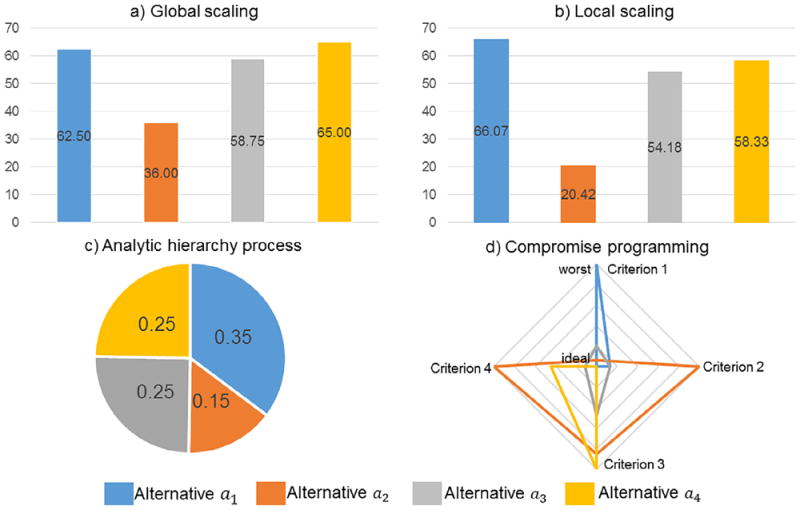
Analytical methods for Multi-Criteria Decision Analysis (MCDA) support the non-monetary valuation of ecosystem services for environmental decision making. Many published case studies transform ecosystem service outcomes into a common metric and aggregate the outcomes to set land use planning and environmental management priorities. Analysts and their stakeholder constituents should be cautioned that results may be sensitive to the methods that are chosen to perform the analysis. In this article, we investigate four common additive aggregation methods: global and local multi-attribute scaling, the analytic hierarchy process, and compromise programming. Using a hypothetical example, we explain scaling and compensation assumptions that distinguish the methods. We perform a case study application of the four methods to re-analyze a data set that was recently published in and demonstrate how results are sensitive to the methods.
多标准决策分析(MCDA)的分析方法为环境决策中生态系统服务的非货币估值提供支持。许多已发表的案例研究将生态系统服务成果转化为一个通用指标,并汇总这些成果以确定土地利用规划和环境管理的优先事项。应提醒分析师及其利益相关者,结果可能对用于执行分析的方法敏感。在本文中,我们研究了四种常见的加法聚合方法:全局和局部多属性缩放、层次分析法和折衷规划法。通过一个假设示例,我们解释了区分这些方法的缩放和补偿假设。我们对这四种方法进行了案例研究应用,以重新分析最近发表的一个数据集,并展示结果如何对这些方法敏感。