Department of Microbiology and Immunology, Weill Bugando School of Medicine, Catholic University of Health and Allied Sciences, Mwanza, Tanzania.
Pest Management Centre (SPMC), Sokoine University of Agriculture, Morogoro, Tanzania.
PLoS Negl Trop Dis. 2018 Jun 25;12(6):e0006600. doi: 10.1371/journal.pntd.0006600. eCollection 2018 Jun.
Brucellosis and leptospirosis are among neglected tropical zoonotic diseases particularly in the resource limited countries. Despite being endemic in these countries, there is paucity of information on its magnitude. This study investigated seropositivity of Brucella spp. and Leptospira spp., and associated factors among abattoir workers and meat vendors in the city of Mwanza, Tanzania.
A community based cross-sectional study was conducted in Mwanza city from May to July 2017. Socio-demographic and other relevant information were collected. Detection of Brucella spp. and Leptospira spp. antibodies were done using slide agglutination test and microscopic agglutination test, respectively. Data were analyzed using STATA version 13 Software.
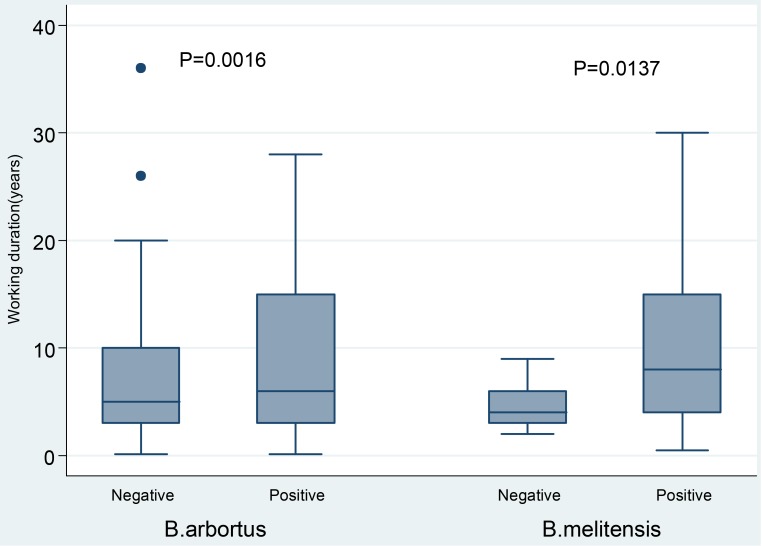
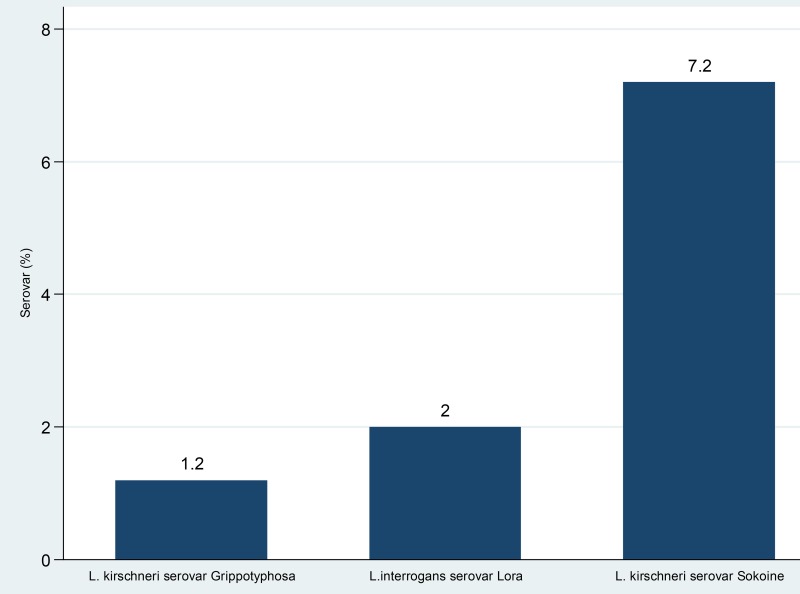
A total of 250 participants (146 abattoir workers and 104 meat vendors) were enrolled with median age of 31 (IQR: 25-38) years. The overall, seropositivity of Brucella spp. antibodies was 48.4% (95% Cl: 42-54). Seropositivity of B. abortus was significantly higher than that of B. melitensis (46.0%, 95%Cl: 39-52 vs. 23.6%, 95% Cl: 18-28, P<0.001) while seropositivity of both species was 21.2% (95%Cl: 16-26). The seropositivity of Leptospira spp. was 10.0% (95% CI: 6-13) with predominance of Leptospira kirschneri serovar Sokoine which was detected in 7.2% of the participants. Being abattoir worker (OR: 2.19, 95% CI 1.06-4.54, p = 0.035) and long work duration (OR: 1.06, 95%CI: 1.01-1.11, p = 0.014) predicted presence of both B.abortus and B. melitensis antibodies. Only being married (p = 0.041) was significantly associated with seropositivity of Leptospira spp. Primary education was the only factor independently predicted presence of Brucella spp. antibodies among abattoir workers on sub-analysis of occupational exposure. None of factors were found to be associated with presence of Brucella spp. antibodies among meat vendors on sub-analysis.
Seropositivity of B.abortus antibodies among abattoir workers and meat vendors is high and seem to be a function of being abattoir worker, having worked for long duration in the abattoir and having primary education. In addition, a significant proportion of abattoir workers and meat vendors in the city was seropositive for Leptospira kirschneri serovar Sokoine. There is a need to consider 'one health approach' in devising appropriate strategies to control these diseases in the developing countries.
布鲁氏菌病和钩端螺旋体病是被忽视的热带人畜共患病,在资源有限的国家尤其如此。尽管这些国家存在地方性流行,但对其严重程度的了解却很少。本研究调查了坦桑尼亚姆万扎市屠宰场工人和肉类销售商中布鲁氏菌 spp. 和钩端螺旋体 spp. 的血清阳性率及其相关因素。
2017 年 5 月至 7 月在姆万扎市进行了一项基于社区的横断面研究。收集了社会人口统计学和其他相关信息。使用玻片凝集试验和显微镜凝集试验分别检测布鲁氏菌 spp. 和钩端螺旋体 spp. 抗体。使用 STATA 版本 13 软件进行数据分析。
共纳入 250 名参与者(146 名屠宰场工人和 104 名肉类销售商),中位年龄为 31 岁(IQR:25-38)。总体而言,布鲁氏菌 spp. 抗体的血清阳性率为 48.4%(95%Cl:42-54)。B.abortus 的血清阳性率明显高于 B.melitensis(46.0%,95%Cl:39-52 vs. 23.6%,95% Cl:18-28,P<0.001),而两种血清阳性率均为 21.2%(95%Cl:16-26)。钩端螺旋体 spp. 的血清阳性率为 10.0%(95% CI:6-13),优势血清型为 Sokoine 血清型的钩端螺旋体 kirschneri,在 7.2%的参与者中检测到。作为屠宰场工人(OR:2.19,95% CI 1.06-4.54,p = 0.035)和工作时间长(OR:1.06,95%CI:1.01-1.11,p = 0.014)是同时存在 B.abortus 和 B.melitensis 抗体的预测因素。仅已婚(p = 0.041)与钩端螺旋体 spp. 的血清阳性率显著相关。在屠宰场工人的亚组分析中,只有小学教育是与布鲁氏菌 spp. 抗体存在相关的唯一因素。在肉类销售商的亚组分析中,没有发现任何因素与布鲁氏菌 spp. 抗体的存在相关。
屠宰场工人和肉类销售商的 B.abortus 抗体血清阳性率较高,似乎与屠宰场工人、在屠宰场工作时间长和接受小学教育有关。此外,该城市的很大一部分屠宰场工人和肉类销售商对 Sokoine 血清型的钩端螺旋体 kirschneri 呈血清阳性。在制定发展中国家控制这些疾病的适当策略时,需要考虑“同一健康方法”。