Colombo Leonardo, Montesano Giovanni, Sala Barbara, Patelli Fabio, Maltese Paolo, Abeshi Andi, Bertelli Matteo, Rossetti Luca
Department of Ophthalmology, San Paolo Hospital, University of Milan, Via A. Di Rudinì 8, 20142, Milan, Italy.
Optometry and Visual Science, School of Health Sciences, City University London, London, UK.
BMC Ophthalmol. 2018 Jun 26;18(1):153. doi: 10.1186/s12886-018-0817-z.
The aim of this study is to analyze and compare the progression of photoreceptor atrophy among siblings affected by retinitis pigmentosa by means of spectral SD-OCT.
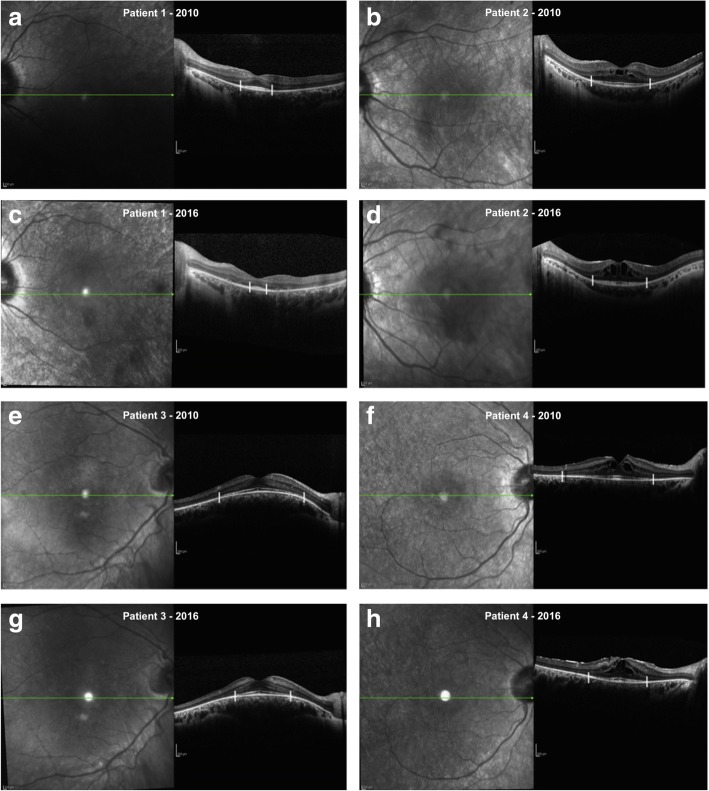
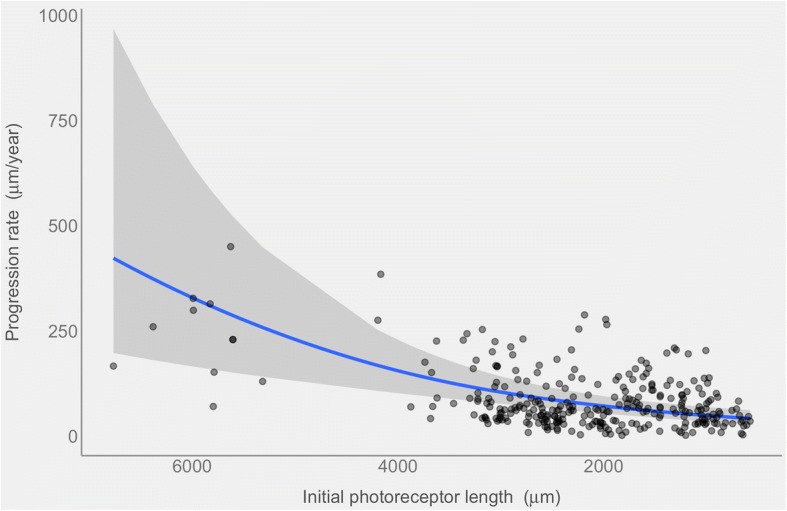
Fifty three eyes of 27 patients belonging to 12 family clusters were analyzed. To assess the annual progression rate of photoreceptor atrophy, the ellipsoid zone (EZ) line was measured in OCT sections through the fovea. We used multivariate generalized mixed effects to model the rate of progression and its relation to the initial ellipsoid zone line width.
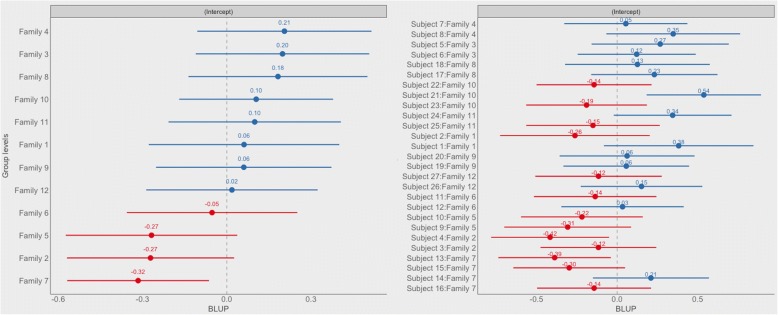
During our 4.84 years (± 1.44) mean follow up time (range 3-7) 53 eyes were examined. The ellipsoid zone line width declined with a yearly average rate of 76.4 μm (4.16% / year) (p-value < 0.0001). Progression rates were poorly correlated within family clusters (p-value = 0.23) and showed statistical difference between affected siblings (p-value = 0.007). There was no correlation between inter-familiar progression rate and mode of inheritance (p-value = 0.98) as well as between age and ellipsoid zone line width among siblings (p-value = 0.91).
RP could be extremely heterogeneous even among siblings: an accurate and sensitive method to follow the progression of the disease is fundamental for future development of clinical trials and therapy strategies.
本研究旨在通过光谱频域光学相干断层扫描(SD - OCT)分析和比较患有色素性视网膜炎的兄弟姐妹中光感受器萎缩的进展情况。
对来自12个家族群组的27例患者的53只眼睛进行了分析。为评估光感受器萎缩的年进展率,在通过黄斑中心凹的OCT切片中测量椭圆体带(EZ)线。我们使用多变量广义混合效应模型来模拟进展率及其与初始椭圆体带线宽度的关系。
在平均4.84年(±1.44)的随访时间(范围3 - 7年)内,对53只眼睛进行了检查。椭圆体带线宽度以每年平均76.4μm(4.16%/年)的速率下降(p值<0.0001)。家族群组内的进展率相关性较差(p值 = 0.23),且患病兄弟姐妹之间存在统计学差异(p值 = 0.007)。家族间进展率与遗传模式之间(p值 = 0.98)以及兄弟姐妹的年龄与椭圆体带线宽度之间(p值 = 0.91)均无相关性。
即使在兄弟姐妹之间,色素性视网膜炎也可能具有极大的异质性:一种准确且灵敏的跟踪疾病进展的方法对于未来临床试验和治疗策略的发展至关重要。