Health Promotion Service, Central Coast Local Health District, Level 1, 4-6 Watt Street, Gosford, NSW, 2250, Australia.
School of Medicine and Public Health, The University of Newcastle, Callaghan, NSW, 2308, Australia.
BMC Public Health. 2018 Jun 26;18(1):788. doi: 10.1186/s12889-018-5685-1.
Childhood overweight and obesity is a significant public health issue. A key contributing factor is sugar sweetened beverages (SSBs) consumption. Evidence suggests that secondary school students are frequent consumers of SSBs, with high daily consumption. The promotion of water consumption and provision of chilled water stations can reduce SSBs consumption. The Thirsty Choose Water! study will evaluate the effectiveness of two interventions, a behavioural intervention, Thirsty? Choose Water! behavioural intervention (TCW-BI), that target students through the domains of the health promoting high schools framework, and the second intervention is the installation and promotion of chilled water stations.
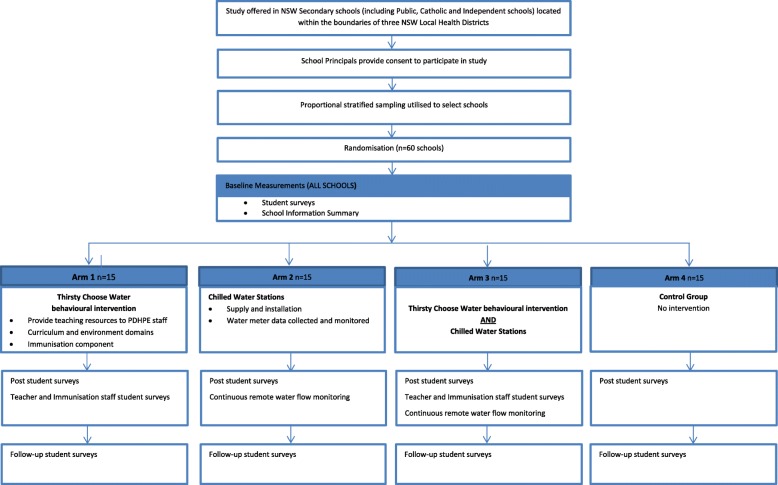
METHODS/DESIGN: This community trial will recruit 60 secondary schools from across three Local Health Districts (LHDs) within New South Wales (NSW). A two-by-two factorial study design will be used to determine the effect of the Thirsty? Choose Water! behavioural intervention (TCW-BI), and the installation of chilled water stations. The recruited secondary schools will be randomised and non-blinded to one of four study arms receiving either the TCW-BI or chilled water stations, both interventions, or neither (control group). Baseline measures will be collected including student self-report surveys which will gather data regarding knowledge, attitudes and consumption of water and SSBs, a school profile and an environmental scan. Student surveys will be repeated post the intervention and at follow-up. Regular water meter readings will determine the water flow from the chilled water stations across the study period.
There is an increasing body of evidence which suggests that decreasing consumption of SSBs can impact positively on childhood overweight and obesity. However, in the Australian context there are limited studies on how this may occur in the secondary school setting. This study will add to this evidence base and establish the effectiveness of TCW-BI and chilled water stations, either alone or combination on increasing water consumption in adolescents. Information about barriers and facilitators to implementation will be documented. Packages to support the implementation of the TCW-BI as a state-wide initiative will be developed.
Australian and New Zealand Clinical Trials Register ACTRN12618000526279 April 2018.
儿童超重和肥胖是一个严重的公共卫生问题。一个主要的促成因素是含糖饮料(SSB)的消费。有证据表明,中学生是 SSB 的频繁消费者,日消耗量很高。推广水的消费和提供冷藏水站可以减少 SSB 的消费。口渴选择水!研究将评估两种干预措施的有效性,一种是行为干预,口渴?选择水!行为干预(TCW-BI),通过健康促进高中框架的领域针对学生,第二种干预措施是安装和推广冷藏水站。
方法/设计:这项社区试验将从新南威尔士州(NSW)三个地方卫生区(LHD)招募 60 所中学。采用两因素两因素设计来确定口渴?选择水!行为干预(TCW-BI)和安装冷藏水站的效果。招募的中学将随机分组,不设盲法,分为四个研究组,分别接受 TCW-BI 或冷藏水站、两种干预措施或两者都不接受(对照组)。将收集基线措施,包括学生自我报告调查,收集有关水和 SSB 的知识、态度和消费的数据、学校概况和环境扫描。学生调查将在干预后和随访时重复进行。定期读取水表读数将确定研究期间从冷藏水站流出的水量。
越来越多的证据表明,减少 SSB 的消费可以对儿童超重和肥胖产生积极影响。然而,在澳大利亚的背景下,关于这如何在中学环境中发生的研究有限。这项研究将为此提供更多的证据,并确定 TCW-BI 和冷藏水站的有效性,无论是单独使用还是组合使用,都可以增加青少年的水摄入量。还将记录实施的障碍和促进因素的信息。将制定支持将 TCW-BI 作为全州倡议实施的一揽子计划。
澳大利亚和新西兰临床试验注册 ACTRN12618000526279 2018 年 4 月。