Institute for Social and Economic Research (ISER), University of Essex. Wivenhoe Park, Colchester, Essex, CO4 3SQ, UK.
Present Address : Department of Global Community Health and Behavioral Sciences, School of Public Health and Tropical Medicine, Tulane University, 1440 Canal St., suite 2200-16, New Orleans, LA, 70112, USA.
BMC Public Health. 2018 Jun 27;18(1):801. doi: 10.1186/s12889-018-5667-3.
Neighborhood deprivation has been consistently linked to poor individual health outcomes; however, studies exploring the mechanisms involved in this association are scarce. The objective of this study was to investigate whether objective measures of the physical environment mediate the association between neighborhood socioeconomic deprivation and biomarkers of health in Britain.
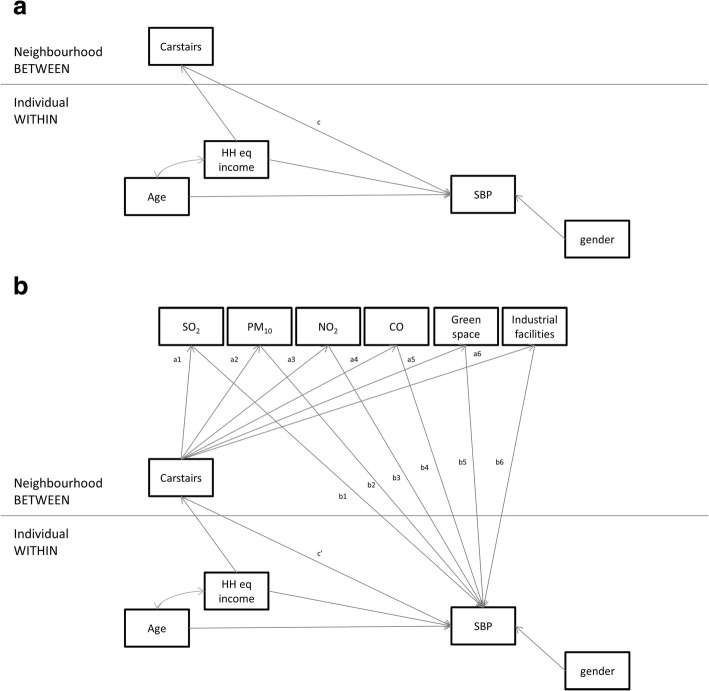
We linked individual-level biomarker data from Understanding Society: The UK Household Longitudinal Survey (2010-2012) to neighborhood-level data from different governmental sources. Our outcome variables were forced expiratory volume in 1 s (FEV%; n=16,347), systolic blood pressure (SBP; n=16,846), body mass index (BMI; n=19,417), and levels of C-reactive protein (CRP; n=11,825). Our measure of neighborhood socioeconomic deprivation was the Carstairs index, and the neighborhood-level mediators were levels of air pollutants (sulphur dioxide [SO], particulate matter [PM], nitrogen dioxide [NO], and carbon monoxide [CO]), green space, and proximity to waste and industrial facilities. We fitted a multilevel mediation model following a multilevel structural equation framework in MPlus v7.4, adjusting for age, gender, and income.
Residents of poor neighborhoods and those exposed to higher pollution and less green space had worse health outcomes. However, only SO exposure significantly and partially mediated the association between neighborhood socioeconomic deprivation and SBP, BMI, and CRP.
Reducing air pollution exposure and increasing access to green space may improve population health but may not decrease health inequalities in Britain.
邻里贫困与个体健康状况不佳密切相关;然而,探索这一关联所涉及机制的研究却很少。本研究旨在调查英国邻里社会经济剥夺与健康生物标志物之间的关联是否可由客观物理环境指标来解释。
我们将来自“社会认知:英国家庭纵向调查”(2010-2012 年)的个体生物标志物数据与来自不同政府来源的邻里数据进行了关联。我们的结局变量为 1 秒用力呼气容积(FEV%;n=16347)、收缩压(SBP;n=16846)、体重指数(BMI;n=19417)和 C 反应蛋白(CRP;n=11825)水平。我们衡量邻里社会经济剥夺的指标是卡尔斯塔斯指数,邻里水平的中介变量包括空气污染物(二氧化硫[SO]、颗粒物[PM]、二氧化氮[NO]和一氧化碳[CO])水平、绿地和靠近废物及工业设施的程度。我们使用 MPlus v7.4 中的多层次中介模型,根据多层次结构方程框架进行了拟合,调整了年龄、性别和收入。
居住在贫困社区的居民和暴露于更高污染和更少绿地的居民健康状况更差。然而,只有 SO 暴露显著部分地解释了邻里社会经济剥夺与 SBP、BMI 和 CRP 之间的关联。
减少空气污染暴露和增加获得绿地的机会可能会改善人群健康,但在英国可能不会减少健康不平等。