Exercise and Biochemical Nutritional Lab, Department of Health, Human Performance, and Recreation, Baylor University, Waco, TX, USA.
Department of Kinesiology, University of Louisiana Monroe, Monroe, LA, USA.
J Int Soc Sports Nutr. 2018 Jun 27;15(1):30. doi: 10.1186/s12970-018-0235-x.
Supplementation of combined glutathione (GSH) with L-citrulline in response to a single bout of resistance exercise has been shown to increase plasma nitric oxide metabolites, nitrite and nitrate and cyclic guanosine monophosphate (cGMP), which may play a role in muscle protein synthesis. As a result, in response to resistance training (RT) these responses may establish a role for GSH + L-citrulline to increase muscle mass. This study attempted to determine the effects of an 8-week RT program in conjunction with GSH (Setria®) + L-citrulline, L-citrulline-malate, or placebo supplementation on lean mass and its association with muscle strength. The secondary purpose was to assess the safety of such supplementation protocol by assessing clinical chemistry markers.
In a randomized, double-blind, placebo-controlled design, 75 resistance-trained males were randomly assigned to ingest GSH + L-citrulline (GSH + CIT), L-citrulline-malate, or cellulose placebo daily while also participating in 8 weeks of RT. The full dose of each supplement was delivered in capsules that were identical in weight, size, shape, and color. Participants completed testing sessions for body composition and muscle strength before and after 4 and 8 weeks of RT and supplementation. Venous blood samples were obtained before and after 8 weeks.
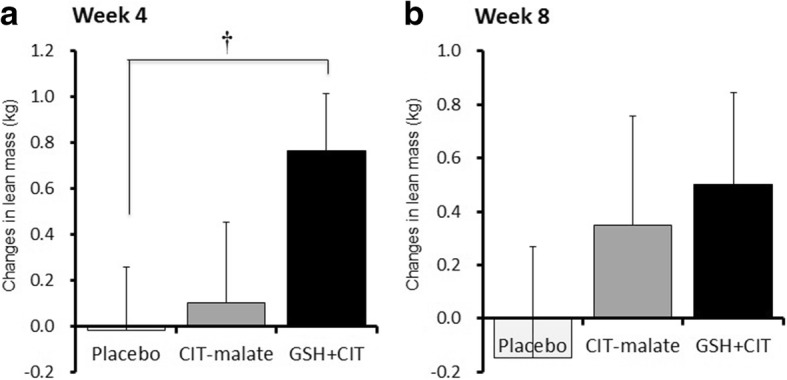
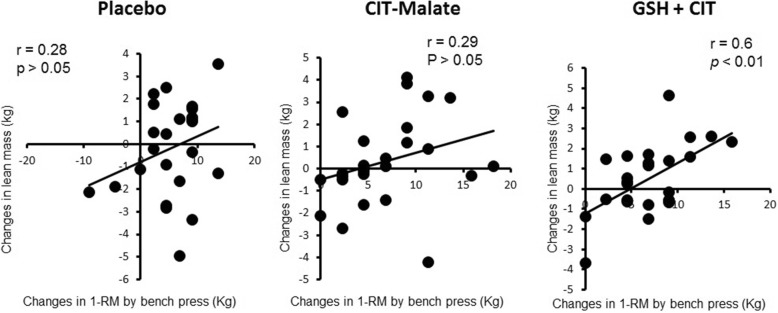
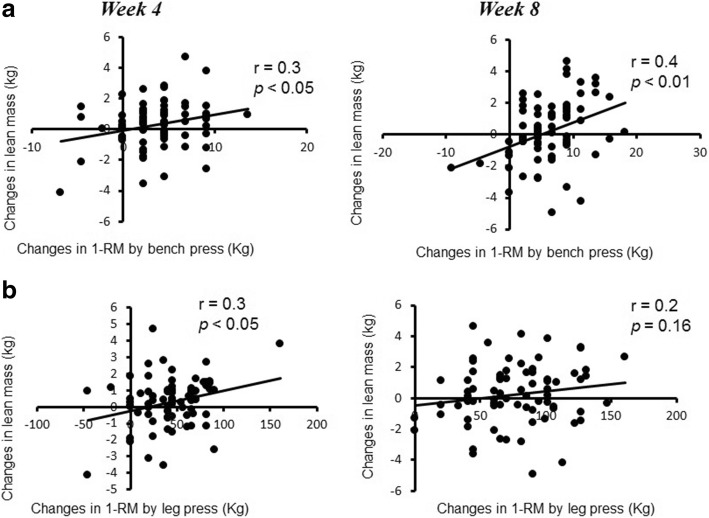
Leg press was increased with RT but was not significantly different between groups (p > 0.05); however, bench press strength was not increased with RT (p > 0.05). There were no significant changes in total body mass, fat mass, or total body water during 8 weeks of RT and supplementation. Lean mass increased in both GSH + CIT when compared to PLC; however, the increase was significant only after 4 weeks. Lean mass and strength were positively correlated (p < 0.05) in GSH + CIT, but not CIT-malate or PLC. Neither RT nor supplementation had any significant effects on blood clinical chemistry variables (p > 0.05).
Compared to PLC, supplementation of GSH + CIT during resistance training increased lean mass after 4 weeks of RT and was positively associated with muscle strength. However, after 8 weeks of RT there were no significant differences in any of the measured variables.
在单次抗阻运动后补充谷胱甘肽(GSH)与瓜氨酸可以增加血浆一氧化氮代谢物、亚硝酸盐和硝酸盐以及环鸟苷酸(cGMP),这可能在肌肉蛋白合成中发挥作用。因此,在抗阻训练(RT)后,这些反应可能为 GSH+瓜氨酸增加肌肉质量建立作用。本研究试图确定 8 周 RT 方案联合 GSH(Setria®)+瓜氨酸、瓜氨酸-苹果酸、或安慰剂补充对瘦体重的影响及其与肌肉力量的关系。次要目的是通过评估临床化学标志物来评估这种补充方案的安全性。
在一项随机、双盲、安慰剂对照设计中,75 名抗阻训练的男性被随机分配每天摄入 GSH+瓜氨酸(GSH+CIT)、瓜氨酸-苹果酸或纤维素安慰剂,同时参加 8 周的 RT。每种补充剂的全剂量均以胶囊形式提供,胶囊在重量、大小、形状和颜色上完全相同。参与者在 RT 和补充剂 4 周和 8 周后完成身体成分和肌肉力量测试。在 8 周后采集静脉血样。
腿举力量在 RT 后增加,但组间无显著差异(p>0.05);然而,卧推力量在 RT 后没有增加(p>0.05)。在 8 周 RT 和补充期间,总体体重、体脂和总体水没有显著变化。与 PLC 相比,GSH+CIT 组的瘦体重均增加;然而,仅在 4 周后增加具有显著性。GSH+CIT 组的瘦体重和力量呈正相关(p<0.05),但瓜氨酸-苹果酸或 PLC 组无相关性。RT 或补充均对血液临床化学变量无显著影响(p>0.05)。
与 PLC 相比,在抗阻训练期间补充 GSH+CIT 可在 4 周 RT 后增加瘦体重,并与肌肉力量呈正相关。然而,在 8 周 RT 后,任何测量变量均无显著差异。