Department of Psychiatry, Yale University School of Medicine, New Haven, CT, USA.
Olin Neuropsychiatry Research Center, Institute of Living, Hartford, CT, USA.
Mol Psychiatry. 2019 Apr;24(4):523-535. doi: 10.1038/s41380-018-0073-x. Epub 2018 Jun 28.
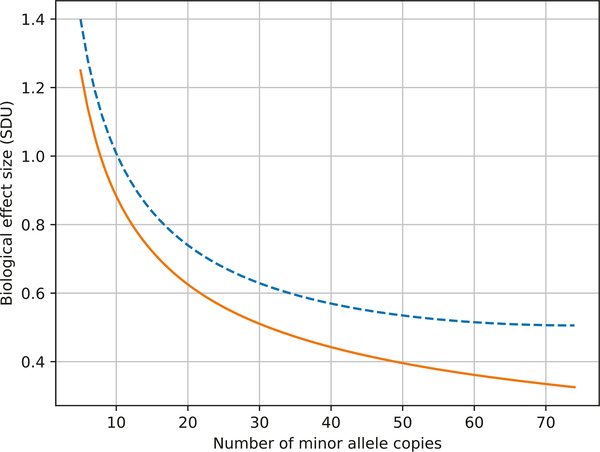
As it is likely that both common and rare genetic variation are important for complex disease risk, studies that examine the full range of the allelic frequency distribution should be utilized to dissect the genetic influences on mental illness. The rate limiting factor for inferring an association between a variant and a phenotype is inevitably the total number of copies of the minor allele captured in the studied sample. For rare variation, with minor allele frequencies of 0.5% or less, very large samples of unrelated individuals are necessary to unambiguously associate a locus with an illness. Unfortunately, such large samples are often cost prohibitive. However, by using alternative analytic strategies and studying related individuals, particularly those from large multiplex families, it is possible to reduce the required sample size while maintaining statistical power. We contend that using whole genome sequence (WGS) in extended pedigrees provides a cost-effective strategy for psychiatric gene mapping that complements common variant approaches and WGS in unrelated individuals. This was our impetus for forming the "Pedigree-Based Whole Genome Sequencing of Affective and Psychotic Disorders" consortium. In this review, we provide a rationale for the use of WGS with pedigrees in modern psychiatric genetics research. We begin with a focused review of the current literature, followed by a short history of family-based research in psychiatry. Next, we describe several advantages of pedigrees for WGS research, including power estimates, methods for studying the environment, and endophenotypes. We conclude with a brief description of our consortium and its goals.
由于常见和罕见的遗传变异都可能对复杂疾病的风险有重要影响,因此应该利用研究全等位基因频率分布的研究来解析遗传对精神疾病的影响。推断变异与表型之间的关联的限制因素不可避免地是在所研究样本中捕获的次要等位基因的总份数。对于频率为 0.5%或更低的罕见变异,需要大量无关个体的样本才能明确将基因座与疾病联系起来。不幸的是,这种大样本通常成本过高。但是,通过使用替代分析策略并研究相关个体,特别是来自大型多重家庭的个体,可以在保持统计效力的同时,减少所需的样本量。我们认为,在扩展的家系中使用全基因组序列 (WGS) 为精神疾病基因图谱提供了一种具有成本效益的策略,可补充常见变异方法和无关个体中的 WGS。这就是我们成立“情感和精神病谱系的基于家系的全基因组测序”联盟的动力。在这篇综述中,我们提供了在家系中使用 WGS 的理由,用于现代精神遗传学研究。我们首先重点回顾了当前的文献,然后简要回顾了精神病学中的家族研究历史。接下来,我们描述了家系对 WGS 研究的几个优势,包括效力估计、环境研究方法和表型。最后,我们简要介绍了我们的联盟及其目标。