Luo Wei, Katz David A, Hamilton Deven T, McKenney Jennie, Jenness Samuel M, Goodreau Steven M, Stekler Joanne D, Rosenberg Eli S, Sullivan Patrick S, Cassels Susan
Spatial Analysis Research Center, School of Geographical Sciences and Urban Planning, Arizona State University, Tempe, AZ, United States.
Department of Medicine, University of Washington, Seattle, WA, United States.
JMIR Public Health Surveill. 2018 Jun 29;4(2):e58. doi: 10.2196/publichealth.9357.
In the United States HIV epidemic, men who have sex with men (MSM) remain the most profoundly affected group. Prevention science is increasingly being organized around HIV testing as a launch point into an HIV prevention continuum for MSM who are not living with HIV and into an HIV care continuum for MSM who are living with HIV. An increasing HIV testing frequency among MSM might decrease future HIV infections by linking men who are living with HIV to antiretroviral care, resulting in viral suppression. Distributing HIV self-test (HIVST) kits is a strategy aimed at increasing HIV testing. Our previous modeling work suggests that the impact of HIV self-tests on transmission dynamics will depend not only on the frequency of tests and testers' behaviors but also on the epidemiological and testing characteristics of the population.
The objective of our study was to develop an agent-based model to inform public health strategies for promoting safe and effective HIV self-tests to decrease the HIV incidence among MSM in Atlanta, GA, and Seattle, WA, cities representing profoundly different epidemiological settings.
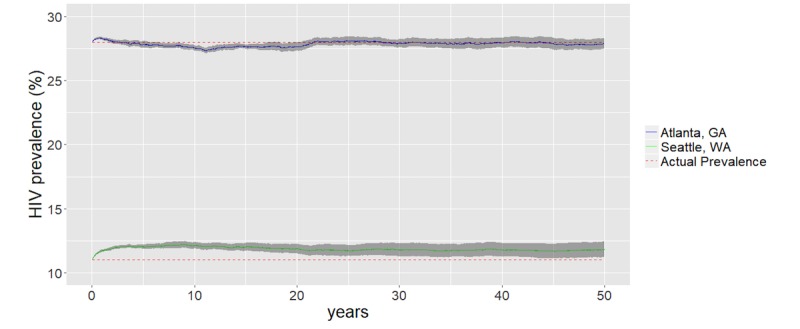
We adapted and extended a network- and agent-based stochastic simulation model of HIV transmission dynamics that was developed and parameterized to investigate racial disparities in HIV prevalence among MSM in Atlanta. The extension comprised several activities: adding a new set of model parameters for Seattle MSM; adding new parameters for tester types (ie, regular, risk-based, opportunistic-only, or never testers); adding parameters for simplified pre-exposure prophylaxis uptake following negative results for HIV tests; and developing a conceptual framework for the ways in which the provision of HIV self-tests might change testing behaviors. We derived city-specific parameters from previous cohort and cross-sectional studies on MSM in Atlanta and Seattle. Each simulated population comprised 10,000 MSM and targeted HIV prevalences are equivalent to 28% and 11% in Atlanta and Seattle, respectively.
Previous studies provided sufficient data to estimate the model parameters representing nuanced HIV testing patterns and HIV self-test distribution. We calibrated the models to simulate the epidemics representing Atlanta and Seattle, including matching the expected stable HIV prevalence. The revised model facilitated the estimation of changes in 10-year HIV incidence based on counterfactual scenarios of HIV self-test distribution strategies and their impact on testing behaviors.
We demonstrated that the extension of an existing agent-based HIV transmission model was sufficient to simulate the HIV epidemics among MSM in Atlanta and Seattle, to accommodate a more nuanced depiction of HIV testing behaviors than previous models, and to serve as a platform to investigate how HIV self-tests might impact testing and HIV transmission patterns among MSM in Atlanta and Seattle. In our future studies, we will use the model to test how different HIV self-test distribution strategies might affect HIV incidence among MSM.
在美国的艾滋病疫情中,男男性行为者(MSM)仍然是受影响最严重的群体。预防科学越来越围绕着艾滋病毒检测展开,以此作为切入点,为未感染艾滋病毒的男男性行为者构建艾滋病预防连续统一体,为感染艾滋病毒的男男性行为者构建艾滋病护理连续统一体。男男性行为者中艾滋病毒检测频率的增加可能会通过将感染艾滋病毒的男性与抗逆转录病毒治疗联系起来,从而降低未来的艾滋病毒感染率,实现病毒抑制。分发艾滋病毒自我检测(HIVST)试剂盒是一种旨在增加艾滋病毒检测的策略。我们之前的建模工作表明,艾滋病毒自我检测对传播动态的影响不仅取决于检测频率和检测者的行为,还取决于人群的流行病学和检测特征。
我们研究的目的是开发一种基于主体的模型,为公共卫生策略提供信息,以促进安全有效的艾滋病毒自我检测,从而降低佐治亚州亚特兰大市和华盛顿州西雅图市男男性行为者中的艾滋病毒发病率,这两个城市代表了截然不同的流行病学环境。
我们改编并扩展了一个基于网络和主体的艾滋病毒传播动态随机模拟模型,该模型是为研究亚特兰大市男男性行为者中艾滋病毒流行率的种族差异而开发并进行参数化的。扩展内容包括多项活动:为西雅图市的男男性行为者添加一组新的模型参数;为检测者类型(即定期检测者、基于风险的检测者、仅机会性检测者或从不检测者)添加新参数;为艾滋病毒检测结果为阴性后的简化暴露前预防措施的采用情况添加参数;并为提供艾滋病毒自我检测可能改变检测行为的方式制定一个概念框架。我们从之前关于亚特兰大市和西雅图市男男性行为者的队列研究和横断面研究中得出特定城市的参数。每个模拟人群包括10000名男男性行为者,目标艾滋病毒流行率在亚特兰大市和西雅图市分别相当于28%和11%。
先前的研究提供了足够的数据来估计代表细微艾滋病毒检测模式和艾滋病毒自我检测分布的模型参数。我们对模型进行校准,以模拟代表亚特兰大市和西雅图市的疫情,包括匹配预期的稳定艾滋病毒流行率。修订后的模型有助于根据艾滋病毒自我检测分布策略的反事实情景及其对检测行为的影响,估计10年艾滋病毒发病率的变化。
我们证明,扩展现有的基于主体的艾滋病毒传播模型足以模拟亚特兰大市和西雅图市男男性行为者中的艾滋病毒疫情,以比先前模型更细致地描绘艾滋病毒检测行为,并作为一个平台来研究艾滋病毒自我检测如何可能影响亚特兰大市和西雅图市男男性行为者中的检测和艾滋病毒传播模式。在我们未来的研究中,我们将使用该模型来测试不同的艾滋病毒自我检测分布策略可能如何影响男男性行为者中的艾滋病毒发病率。