Faculty of Physical Education, Health and Tourism, Kazimierz Wielki University in Bydgoszcz, Bydgoszcz, Poland.
Department of Medicine, Institute of Physiotherapy of University of Rzeszów, Rzeszów, Poland.
Med Sci Monit. 2018 Jun 30;24:4489-4500. doi: 10.12659/MSM.907134.
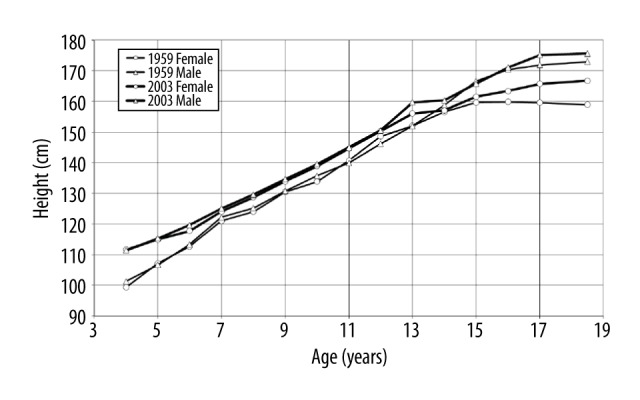
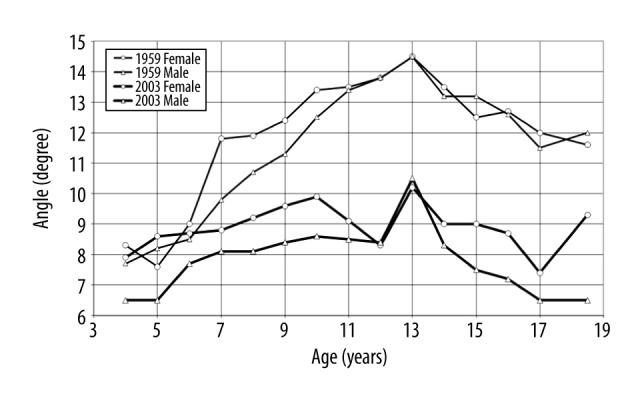
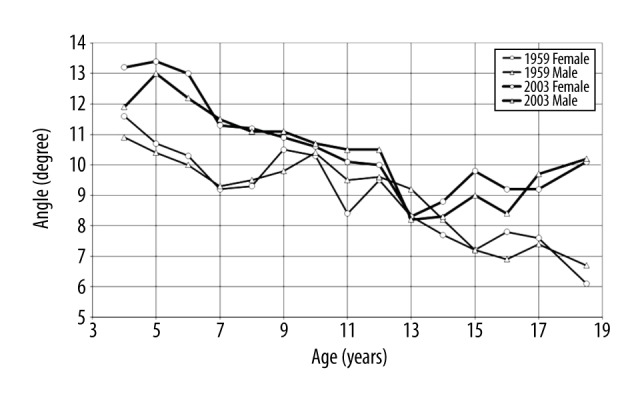
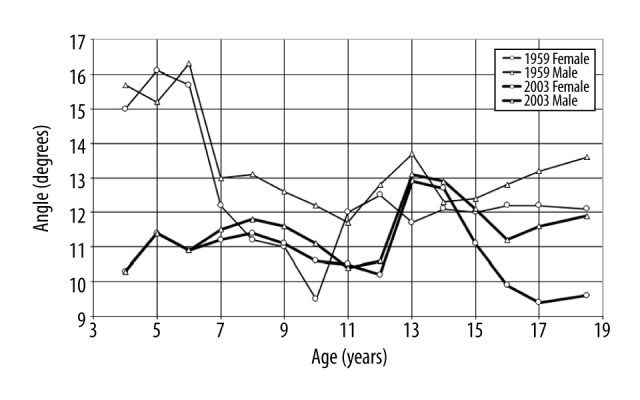
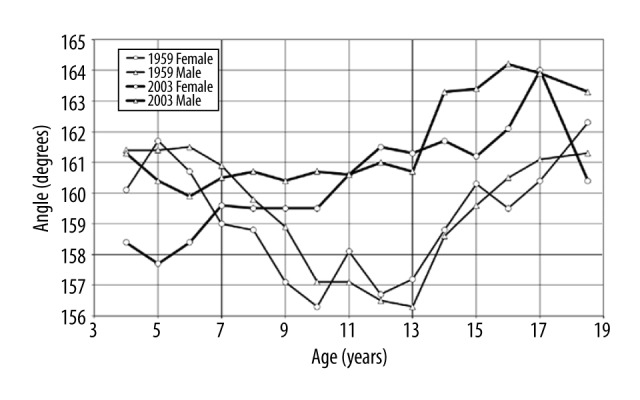
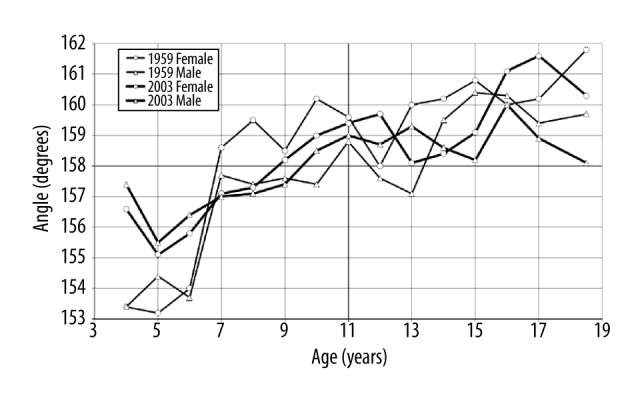
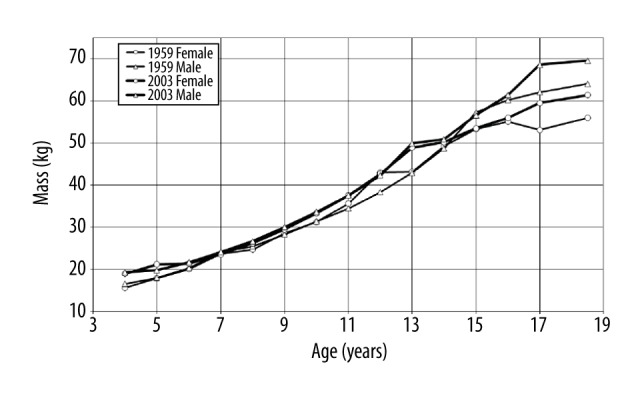
BACKGROUND Humans are exposed to various stimuli which lead to somatic modifications and changes in body posture, negatively affecting many of its characteristics. The purpose of this study was to assess significant alterations which occurred in selected morphological features and spinal curvatures in children and adolescents over a period of 40 years. MATERIAL AND METHODS The total of 7041 subjects, aged 4-18 years (mean age 11.3 years) were included in the study, which was designed to compare measurements performed in year 1959 (Group 1, n=3235 individuals) and in year 2003 (Group 2, n=3806 individuals). The children were examined for body height, body mass, as well as thoracic and lumbar curvatures. In 1959, the measurements were carried out using a spherodorsimeter, while in 2003, the CQ System photogrammetry was used, producing corresponding results. The Mann-Whitney U test and the Student's t-test were used for statistical analysis. RESULTS The findings showed a significant decrease in the angle of lumbar lordosis and in sacral inclination as well as an increase in body height and mass, particularly in prepubertal children. On the other hand, the angle of thoracic kyphosis and the partial angles of physiological spinal curvatures changed only to a small degree over the 40-year period. CONCLUSIONS This study provides evidence related to changes which occurred during the relevant period of over 40 years, namely a decrease in both the angle of lumbar lordosis and the sacral inclination angle, as well as an increase in body height and mass. These changes should be taken into consideration in selecting norms and standards applied in healthcare services, and the findings suggest it is necessary to regularly update such standards.
人类会受到各种刺激,这些刺激会导致躯体的改变和姿势的变化,从而对身体的许多特征产生负面影响。本研究的目的是评估在 40 年内,儿童和青少年的某些形态特征和脊柱弯曲度发生的显著变化。
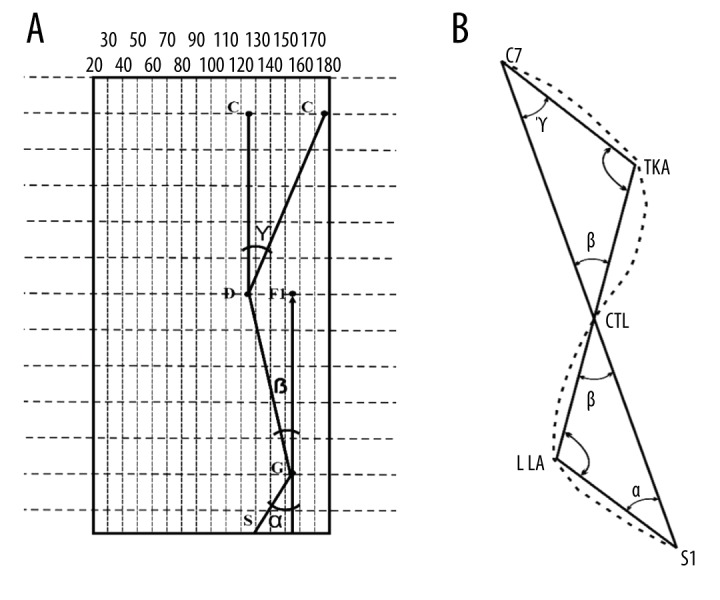
本研究共纳入 7041 名 4-18 岁(平均年龄 11.3 岁)的受试者,旨在比较 1959 年(第 1 组,n=3235 人)和 2003 年(第 2 组,n=3806 人)的测量结果。对儿童的身高、体重以及胸腰椎曲度进行了检查。1959 年使用球形测径器进行测量,2003 年使用 CQ 系统摄影测量法进行测量,产生相应的结果。采用 Mann-Whitney U 检验和 Student's t 检验进行统计学分析。
研究结果表明,腰椎前凸角和骶骨倾斜角显著减小,身高和体重显著增加,特别是在青春前期儿童中。另一方面,胸椎后凸角和生理脊柱曲度的部分角度在 40 年内仅发生了较小的变化。
本研究提供了相关时期(40 多年)内发生的变化的证据,即腰椎前凸角和骶骨倾斜角减小,身高和体重增加。在选择医疗保健服务中应用的规范和标准时,应考虑到这些变化,研究结果表明有必要定期更新这些标准。