Re Agnese, Colussi Claudia, Nanni Simona, Aiello Aurora, Bacci Lorenza, Grassi Claudio, Pontecorvi Alfredo, Farsetti Antonella
National Research Council (CNR), Institute of Cell Biology and Neurobiology (IBCN), Rome, Italy.
Università Cattolica, Institute of Medical Pathology, Rome, Italy.
Oncotarget. 2018 Jun 15;9(46):27985-27997. doi: 10.18632/oncotarget.25462.
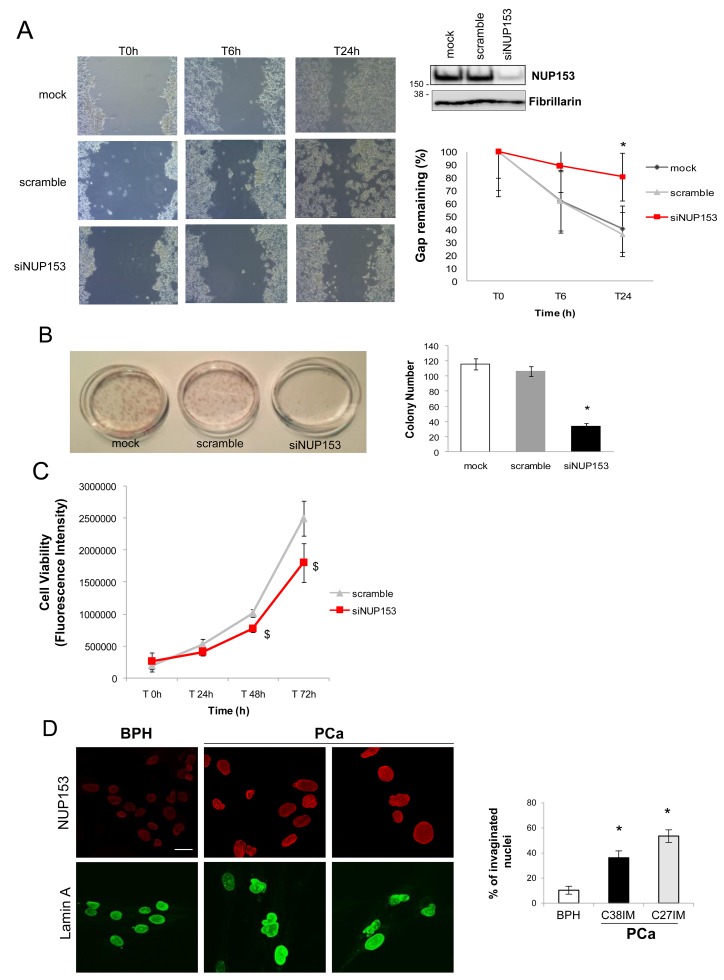
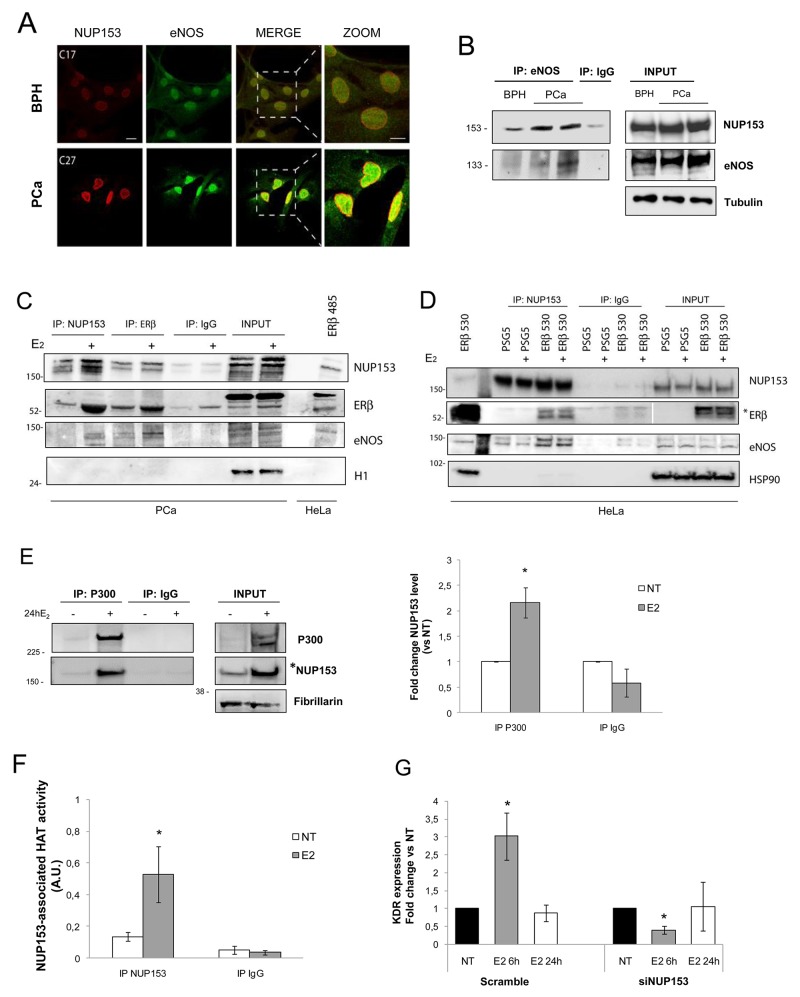
Nucleoporin 153 (Nup153), key regulator of nuclear import/export, has been recently associated to oncogenic properties in pancreatic and breast tumour cells modulating either cell motility and migration or gene expression by chromatin association. In the present work, we have characterized the role of Nup153 in a cellular model of prostate cancer (PCa). The analysis of several immortalized cell lines derived from freshly explants of prostate cancer specimens showed that Nup153 protein was higher and present in multimeric complexes with eNOS and ERβ as compared to normal/hyperplastic prostate epithelial cells. This phenomenon was enhanced in the presence of 17β-estradiol (E, 10M). Further experiments revealed that eNOS and ERβ were present in a DNA binding complexes associated with Nup153 promoter as demonstrated by ChIPs. Notably, after Nup153 depletion (siNup153), a reduction of migration capacity and colony formation in primary tumor-derived and metastatic PCa cells was observed. In addition, eNOS and ERβ nuclear localization was lost upon siNup 153 regardless of E treatment, suggesting that Nup153 is a key regulator of prostate cancer cell function and of the nuclear translocation of these proteins in response to hormone stimulus. Taken altogether our findings indicate that in PCa cells: the expression and function of Nup153 is modulated by estrogen signaling; Nup153 contributes to cell migration and proliferation; Nup153 regulates the nuclear translocation of eNOS and ERβ by forming a multimeric complex. Our findings unveil Nup153 as a novel component of the estrogen-dependent multimeric complex, thus representing a potential therapeutic candidate in prostate cancer.
核孔蛋白153(Nup153)是核输入/输出的关键调节因子,最近被发现与胰腺和乳腺肿瘤细胞的致癌特性有关,它通过与染色质结合来调节细胞运动和迁移或基因表达。在本研究中,我们已经阐明了Nup153在前列腺癌(PCa)细胞模型中的作用。对源自前列腺癌标本新鲜外植体的几种永生化细胞系的分析表明,与正常/增生性前列腺上皮细胞相比,Nup153蛋白水平更高,并且与eNOS和ERβ形成多聚体复合物。在17β-雌二醇(E,10M)存在的情况下,这种现象更加明显。进一步的实验表明,ChIP实验证明eNOS和ERβ存在于与Nup153启动子相关的DNA结合复合物中。值得注意的是,在Nup153缺失(siNup153)后,原发性肿瘤来源和转移性PCa细胞的迁移能力和集落形成减少。此外,无论是否进行E处理,siNup153后eNOS和ERβ的核定位都会丧失,这表明Nup153是前列腺癌细胞功能以及这些蛋白质在激素刺激下核转位的关键调节因子。综上所述,我们的研究结果表明,在PCa细胞中:Nup153的表达和功能受雌激素信号调节;Nup153促进细胞迁移和增殖;Nup153通过形成多聚体复合物调节eNOS和ERβ的核转位。我们的研究结果揭示了Nup153是雌激素依赖性多聚体复合物的新成分,因此是前列腺癌潜在的治疗靶点。