Tong Christy W S, Wu Mingxia, Cho William C S, To Kenneth K W
Faculty of Medicine, School of Pharmacy, The Chinese University of Hong Kong, Hong Kong, Hong Kong.
Department of Clinical Oncology, Queen Elizabeth Hospital, Hong Kong, Hong Kong.
Front Oncol. 2018 Jun 14;8:227. doi: 10.3389/fonc.2018.00227. eCollection 2018.
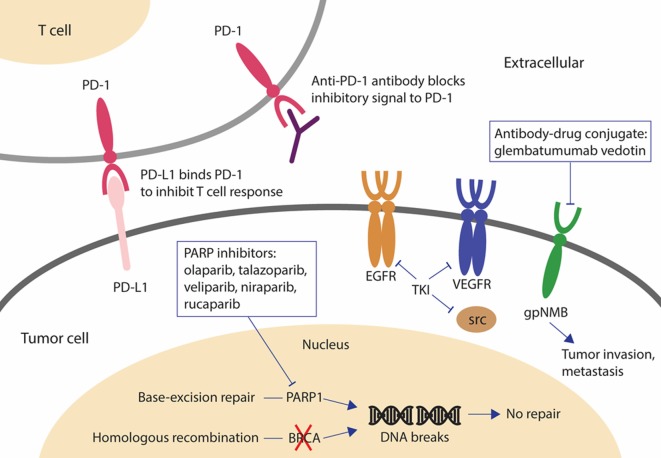
Breast cancer (BC) is the most common malignancy in women. It is classified into a few major molecular subtypes according to hormone and growth factor receptor expression. Over the past few years, substantial advances have been made in the discovery of new drugs for treating BC. Improved understanding of the biologic heterogeneity of BC has allowed the development of more effective and individualized approach to treatment. In this review, we provide an update about the current treatment strategy and discuss the various emerging novel therapies for the major molecular subtypes of BC. A brief account of the clinical development of inhibitors of poly(ADP-ribose) polymerase, cyclin-dependent kinases 4 and 6, phosphatidylinositol 3-kinase/protein kinase B/mammalian target of rapamycin pathway, histone deacetylation, multi-targeting tyrosine kinases, and immune checkpoints for personalized treatment of BC is included. However, no targeted drug has been approved for the most aggressive subtype-triple negative breast cancer (TNBC). Thus, we discuss the heterogeneity of TNBC and how molecular subtyping of TNBC may help drug discovery for this deadly disease. The emergence of drug resistance also poses threat to the successful development of targeted therapy in various molecular subtypes of BC. New clinical trials should incorporate advanced methods to identify changes induced by drug treatment, which may be associated with the upregulation of compensatory signaling pathways in drug resistant cancer cells.
乳腺癌(BC)是女性中最常见的恶性肿瘤。根据激素和生长因子受体表达情况,它被分为几种主要的分子亚型。在过去几年中,治疗乳腺癌的新药研发取得了重大进展。对乳腺癌生物学异质性的深入了解使得开发出更有效、更个性化的治疗方法成为可能。在本综述中,我们提供了当前治疗策略的最新情况,并讨论了针对乳腺癌主要分子亚型的各种新兴的新型疗法。简要介绍了聚(ADP-核糖)聚合酶抑制剂、细胞周期蛋白依赖性激酶4和6抑制剂、磷脂酰肌醇3-激酶/蛋白激酶B/雷帕霉素哺乳动物靶点通路抑制剂、组蛋白去乙酰化抑制剂、多靶点酪氨酸激酶抑制剂以及免疫检查点抑制剂在乳腺癌个性化治疗中的临床进展。然而,对于最具侵袭性的亚型——三阴性乳腺癌(TNBC),尚无靶向药物获批。因此,我们讨论了TNBC的异质性以及TNBC的分子分型如何有助于针对这种致命疾病的药物研发。耐药性的出现也对乳腺癌各种分子亚型靶向治疗的成功开展构成威胁。新的临床试验应采用先进方法来识别药物治疗引起的变化,这些变化可能与耐药癌细胞中补偿性信号通路的上调有关。