Division of Diabetes, Endocrinology, and Gastroenterology, School of Medical Sciences, University of Manchester, Manchester, United Kingdom.
FASEB J. 2019 Jan;33(1):126-139. doi: 10.1096/fj.201800026RR. Epub 2018 Jul 2.
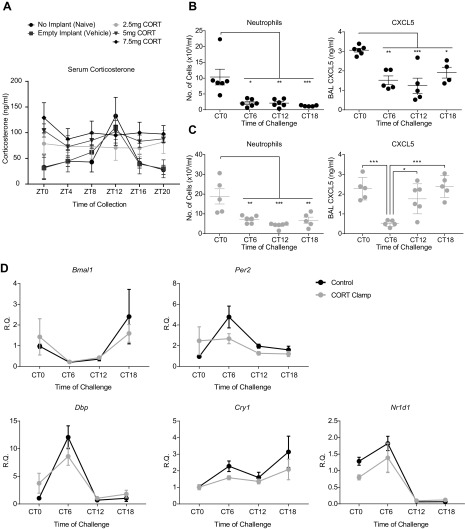
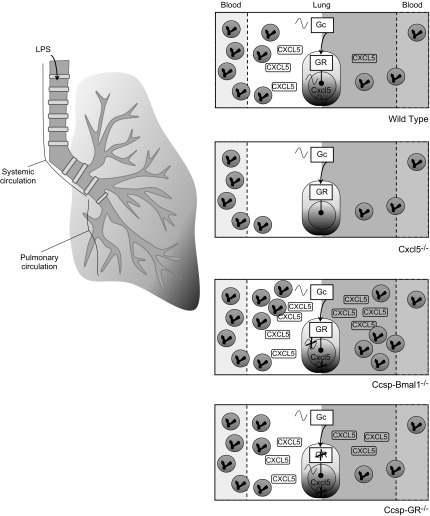
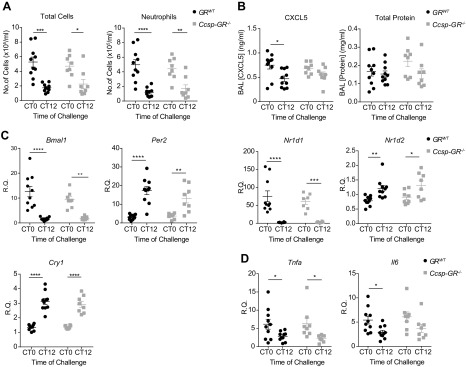
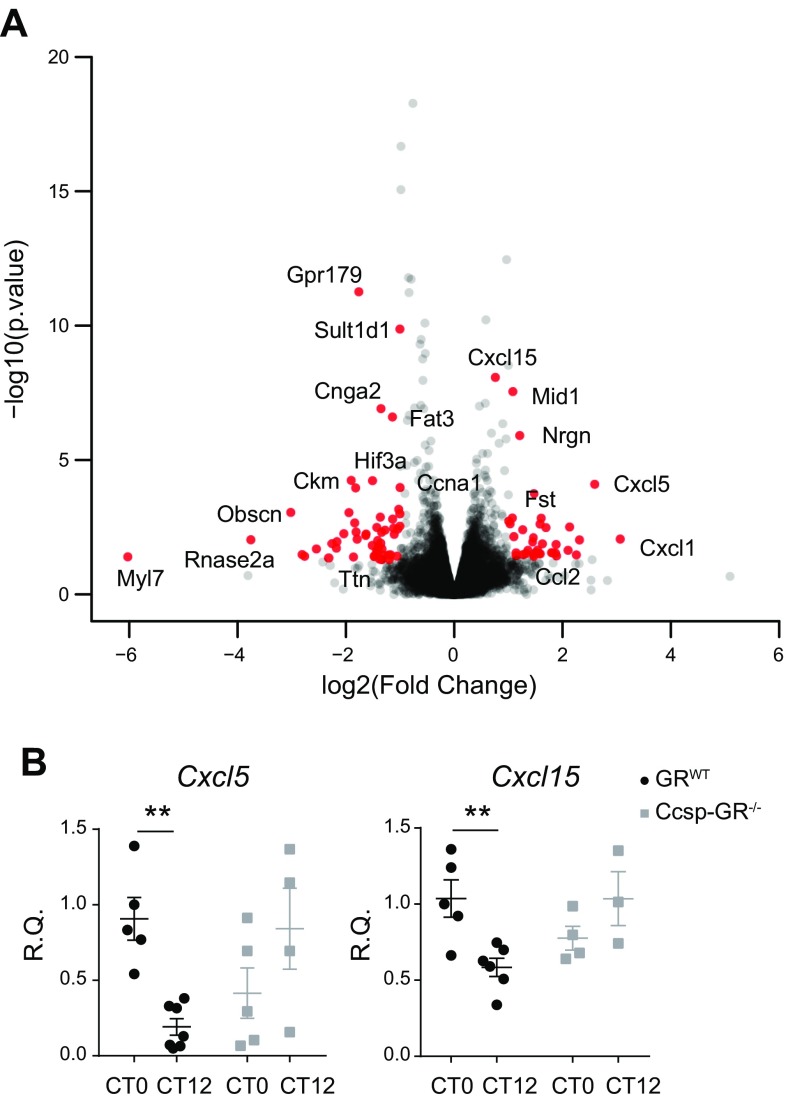
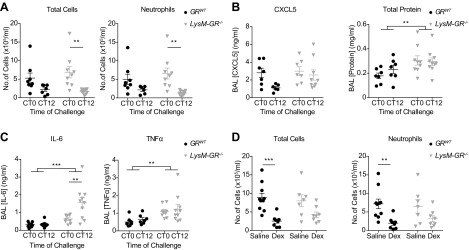
The circadian clock is a critical regulator of immune function. We recently highlighted a role for the circadian clock in a mouse model of pulmonary inflammation. The epithelial clock protein Bmal1 was required to regulate neutrophil recruitment in response to inflammatory challenge. Bmal1 regulated glucocorticoid receptor (GR) recruitment to the neutrophil chemokine, CXC chemokine ligand 5 (CXCL5), providing a candidate mechanism. We now show that clock control of pulmonary neutrophilia persists without rhythmic glucocorticoid availability. Epithelial GR-null mice had elevated expression of proinflammatory chemokines in the lung under homeostatic conditions. However, deletion of GR in the bronchial epithelium blocked rhythmic CXCL5 production, identifying GR as required to confer circadian control to CXCL5. Surprisingly, rhythmic pulmonary neutrophilia persisted, despite nonrhythmic CXCL5 responses, indicating additional circadian control mechanisms. Deletion of GR in myeloid cells alone did not prevent circadian variation in pulmonary neutrophilia and showed reduced neutrophilic inflammation in response to dexamethasone treatment. These new data show GR is required to confer circadian control to some inflammatory chemokines, but that this alone is insufficient to prevent circadian control of neutrophilic inflammation in response to inhaled LPS, with additional control mechanisms arising in the myeloid cell lineage.-Ince, L. M., Zhang, Z., Beesley, S., Vonslow, R. M., Saer, B. R., Matthews, L. C., Begley, N., Gibbs, J. E., Ray, D. W., Loudon, A. S. I. Circadian variation in pulmonary inflammatory responses is independent of rhythmic glucocorticoid signaling in airway epithelial cells.
生物钟是免疫功能的关键调节因子。我们最近强调了生物钟在肺部炎症的小鼠模型中的作用。上皮钟蛋白 Bmal1 被要求调节中性粒细胞对炎症挑战的募集。Bmal1 调节糖皮质激素受体 (GR) 募集到中性粒细胞趋化因子 CXC 趋化因子配体 5 (CXCL5),提供了一个候选机制。我们现在表明,时钟对肺部中性粒细胞增多的控制在没有节律性糖皮质激素可用性的情况下仍然存在。在稳态条件下,上皮细胞 GR 缺失小鼠的肺部促炎趋化因子表达升高。然而,支气管上皮细胞中 GR 的缺失阻断了 CXCL5 的节律性产生,这表明 GR 是赋予 CXCL5 节律性控制所必需的。令人惊讶的是,尽管 CXCL5 反应没有节律性,但节律性肺中性粒细胞增多仍然持续存在,表明存在其他节律性控制机制。髓样细胞中单独缺失 GR 并不能阻止肺部中性粒细胞的节律性变化,并且在接受地塞米松治疗时显示出中性粒细胞炎症减少。这些新数据表明,GR 是赋予某些炎症趋化因子节律性控制所必需的,但这不足以防止吸入 LPS 引起的中性粒细胞炎症的节律性控制,在髓样细胞谱系中出现了其他控制机制。-Ince, L. M., Zhang, Z., Beesley, S., Vonslow, R. M., Saer, B. R., Matthews, L. C., Begley, N., Gibbs, J. E., Ray, D. W., Loudon, A. S. I. 生物钟对肺部炎症反应的变化是独立于气道上皮细胞中节律性糖皮质激素信号的。