Department of Population Medicine, Harvard Medical School and Harvard Pilgrim Health Care Institute, Boston, MA 02215, United States.
Oregon State University, College of Public Health and Human Sciences, 101 Milam Hall, Corvallis, OR 97331, United States.
Environ Res. 2018 Oct;166:570-576. doi: 10.1016/j.envres.2018.06.023. Epub 2018 Jun 28.
Arsenic alters immunological parameters including antibody formation and antigen-driven T-cell proliferation.
We evaluated the cross-sectional relationship between urinary arsenic and the seroprevalence of hepatitis B (HBV) infection in the United States using data from six pooled cycles of the National Health and Nutrition Examination Survey (2003-2014, N = 12,447).
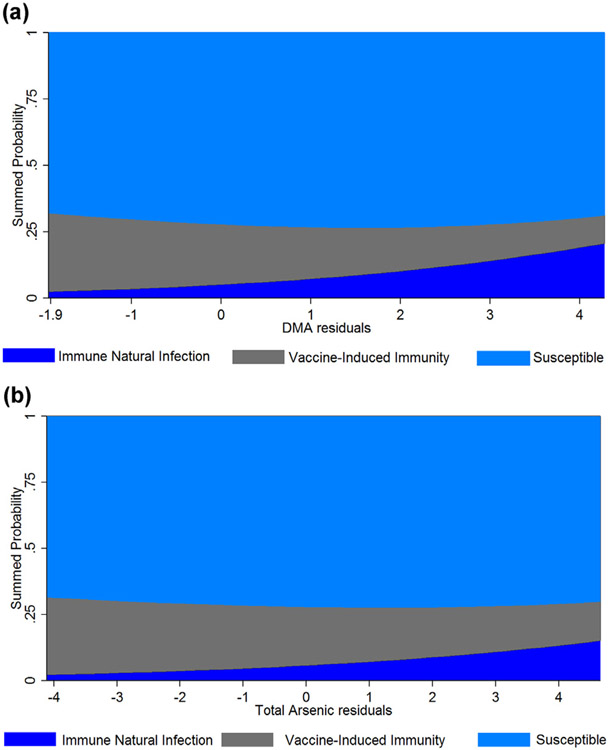
Using serological data, participants were classified as susceptible, immune due to vaccination, or immune due to past natural infection. We used multinomial logistic regression to evaluate the association between urinary DMA and HBV classification. A sensitivity analysis using total urinary arsenic (TUA) was also conducted. Both DMA and TUA were adjusted for arsenobetaine using a residual regression method RESULTS: A 1-unit increase in the natural logarithm (ln) of DMA was associated with 40% greater adjusted odds of having immunity due to natural infection compared to being susceptible (Odds Ratio [aOR]: 1.40, 95% Confidence Intervals [CI] 1.15, 1.69), 65% greater odds of having immunity due to a natural infection (aOR: 1.65, 95% CI: 1.34, 2.04) and 18% greater odds of being susceptible (aOR: 1.18, 95% CI: 1.05, 1.33) compared to being immune due to vaccination after adjusting for creatinine, age, sex, race, income, country of birth, BMI, survey cycle, serum cotinine, recent seafood intake, and self-reported HBV immunization status.
In the U.S. general public, higher urinary arsenic levels were associated with a greater odds of having a serological classification consistent with a past natural hepatitis B infection after adjusting for other risk factors. Additionally, higher urinary arsenic levels were linked to a greater odds of not receiving hepatitis B vaccinations. Given the cross-sectional nature of this analysis, more research is needed to test the hypothesis that environmentally relevant exposure to arsenic modulates host susceptibility to hepatitis B virus.
砷会改变免疫参数,包括抗体形成和抗原驱动的 T 细胞增殖。
我们利用美国国家健康和营养检查调查(2003-2014 年,共 6 个周期,N=12447)的六组汇总数据,评估了尿液中砷与乙型肝炎(HBV)感染血清阳性率之间的横断面关系。
使用血清学数据,将参与者分为易感、因疫苗接种而具有免疫力或因过去自然感染而具有免疫力。我们使用多变量逻辑回归评估了尿液中 DMA 与 HBV 分类之间的关联。还进行了使用总尿砷(TUA)的敏感性分析。DMA 和 TUA 均使用残差回归方法进行了用砷甜菜碱调整。
DMA 的自然对数(ln)增加 1 个单位,与易感相比,自然感染引起的免疫的调整后比值比(OR)增加 40%(优势比 [aOR]:1.40,95%置信区间 [CI]:1.15,1.69),自然感染引起的免疫的 OR 增加 65%(aOR:1.65,95% CI:1.34,2.04),易感的 OR 增加 18%(aOR:1.18,95% CI:1.05,1.33),调整肌酐、年龄、性别、种族、收入、出生地、BMI、调查周期、血清可替宁、近期海鲜摄入量和自我报告的 HBV 免疫状况后。
在美国普通人群中,在调整其他危险因素后,尿液中砷水平较高与血清学分类更符合过去自然感染乙型肝炎的可能性更大相关。此外,尿液中砷水平较高与未接种乙型肝炎疫苗的可能性更大相关。鉴于此分析的横断面性质,需要进行更多研究来检验环境相关的砷暴露会改变宿主对乙型肝炎病毒易感性的假设。