Ding Shibin, Jiang Jinjin, Wang Zhe, Zhang Guofu, Yin Jianli, Wang Xiaoya, Wang Sui, Yu Zengli
School of Public Health, Xinxiang Medical University, Xinxiang, Henan, PR China.
Henan Collaborative Innovation Center of Molecular Diagnosis and Laboratory Medicine, Xinxiang Medical University, Xinxiang, Henan, PR China.
PeerJ. 2018 Jun 29;6:e5173. doi: 10.7717/peerj.5173. eCollection 2018.
Obesity-induced glucose metabolism disorder is associated with chronic, low-grade, systemic inflammation and is considered a risk factor for diabetes and metabolic syndrome. Resveratrol (RES), a natural anti-inflammatory compound, is observed to improve glucose tolerance and insulin sensitivity in obese rodents and humans. This study aimed to test the effects of RES administration on insulin signaling and the inflammatory response in visceral white adipose tissue (WAT) caused by a high-fat diet (HFD) in mice.
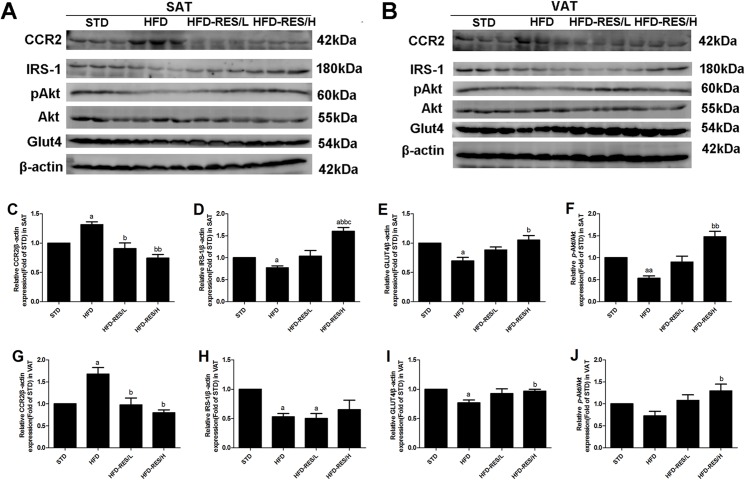
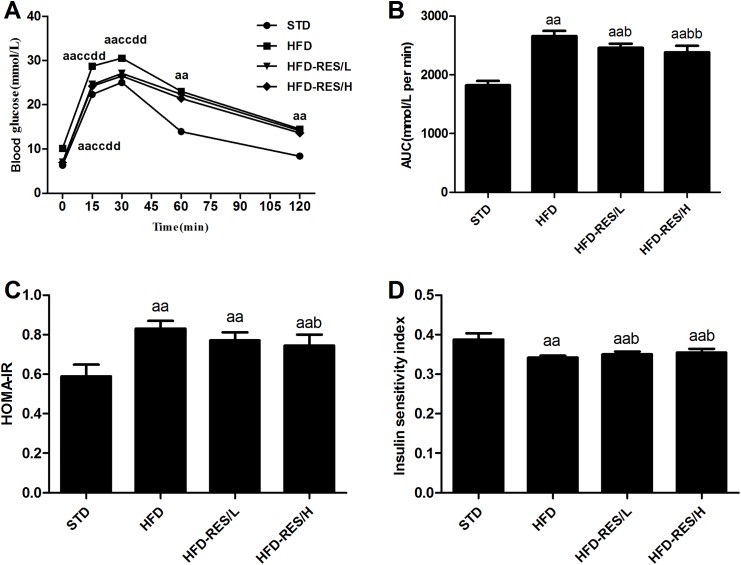
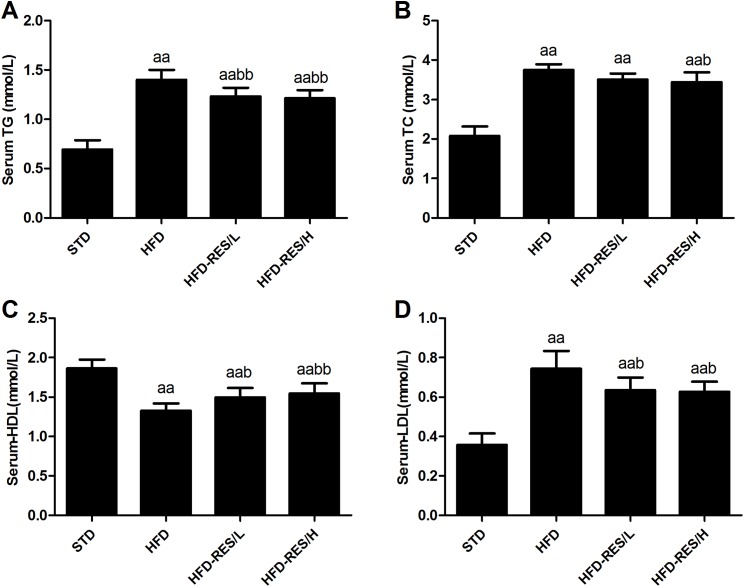
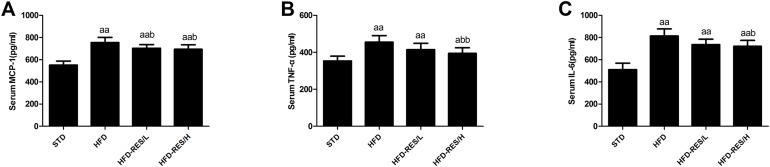
A total of 40 wild-type C57BL/6 male mice were divided into four groups (10 in each group): the standard chow diet (STD) group was fed a STD; the HFD group was fed a HFD; and the HFD-RES/L and HFD-RES/H groups were fed a HFD plus RES (200 and 400 mg/kg/day, respectively). The L and H in RES/L and RES/H stand for low and high, respectively. Glucose tolerance, insulin sensitivity, circulating inflammatory biomarkers and lipid profile were determined. Quantitative PCR and Western blot were used to determine the expression of CC-chemokine receptor 2 (CCR2), other inflammation markers, glucose transporter 4 (GLUT4), insulin receptor substrate 1 (IRS-1) and pAkt/Akt and to assess targets of interest involving glucose metabolism and inflammation in visceral WAT.
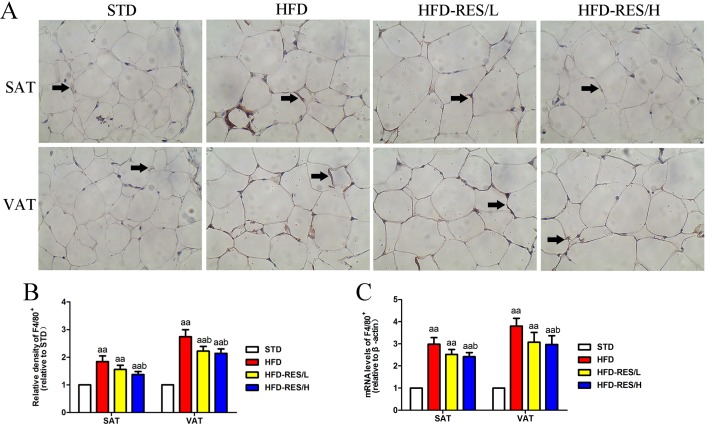
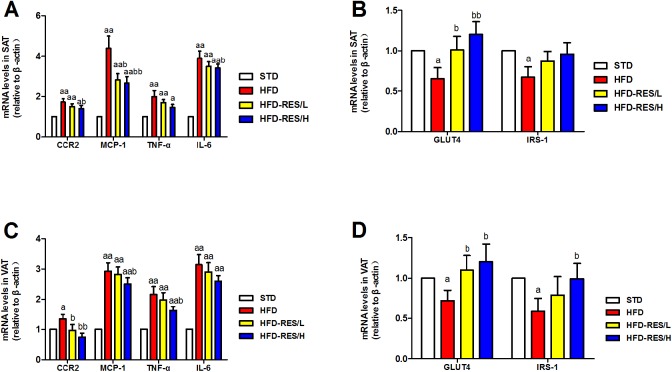
HFD increased the levels of total cholesterol, triglycerides, low-density lipoprotein cholesterol and proinflammatory cytokines in serum, decreased the high-density lipoprotein cholesterol level in serum, and induced insulin resistance and WAT inflammation in mice. However, RES treatment alleviated insulin resistance, increased the expressions of pAkt, GLUT4 and IRS-1 in WAT, and decreased serum proinflammatory cytokine levels, macrophage infiltration and CCR2 expression in WAT.
Our results indicated that WAT CCR2 may play a vital role in macrophage infiltration and the inflammatory response during the development of insulin resistance in HFD-induced obesity. These data suggested that administration of RES offers protection against abnormal glucose metabolism and inflammatory adaptations in visceral WAT in mice with HFD-induced obesity.
肥胖诱导的葡萄糖代谢紊乱与慢性、低度全身性炎症相关,被认为是糖尿病和代谢综合征的一个危险因素。白藜芦醇(RES)是一种天然抗炎化合物,在肥胖啮齿动物和人类中可改善糖耐量和胰岛素敏感性。本研究旨在测试RES给药对高脂饮食(HFD)诱导的小鼠内脏白色脂肪组织(WAT)中胰岛素信号传导和炎症反应的影响。
总共40只野生型C57BL/6雄性小鼠被分为四组(每组10只):标准饲料组喂食标准饲料;高脂饮食组喂食高脂饮食;高脂饮食-RES/L组和高脂饮食-RES/H组喂食高脂饮食加RES(分别为200和400mg/kg/天)。RES/L和RES/H中的L和H分别代表低和高。测定糖耐量、胰岛素敏感性、循环炎症生物标志物和血脂谱。采用定量PCR和蛋白质印迹法测定CC趋化因子受体2(CCR2)、其他炎症标志物、葡萄糖转运蛋白4(GLUT4)、胰岛素受体底物1(IRS-1)以及pAkt/Akt的表达,并评估内脏WAT中涉及葡萄糖代谢和炎症的相关靶点。
高脂饮食增加了血清中总胆固醇、甘油三酯、低密度脂蛋白胆固醇和促炎细胞因子的水平,降低了血清中高密度脂蛋白胆固醇水平,并诱导了小鼠的胰岛素抵抗和白色脂肪组织炎症。然而,RES治疗减轻了胰岛素抵抗,增加了白色脂肪组织中pAkt、GLUT4和IRS-1的表达,并降低了血清促炎细胞因子水平、巨噬细胞浸润以及白色脂肪组织中CCR2的表达。
我们的数据表明,白色脂肪组织CCR2可能在高脂饮食诱导的肥胖中胰岛素抵抗发生发展过程中的巨噬细胞浸润和炎症反应中起关键作用。这些数据表明,RES给药可保护高脂饮食诱导的肥胖小鼠内脏白色脂肪组织免受异常葡萄糖代谢和炎症适应的影响。