Department of Family Medicine, Mie University Graduate School of Medicine, Mie, Japan.
Department of Internal Medicine, Minami-Ise Municipal Hospital, Mie, Japan.
Am J Trop Med Hyg. 2018 Aug;99(2):466-469. doi: 10.4269/ajtmh.17-0576. Epub 2018 Jun 28.
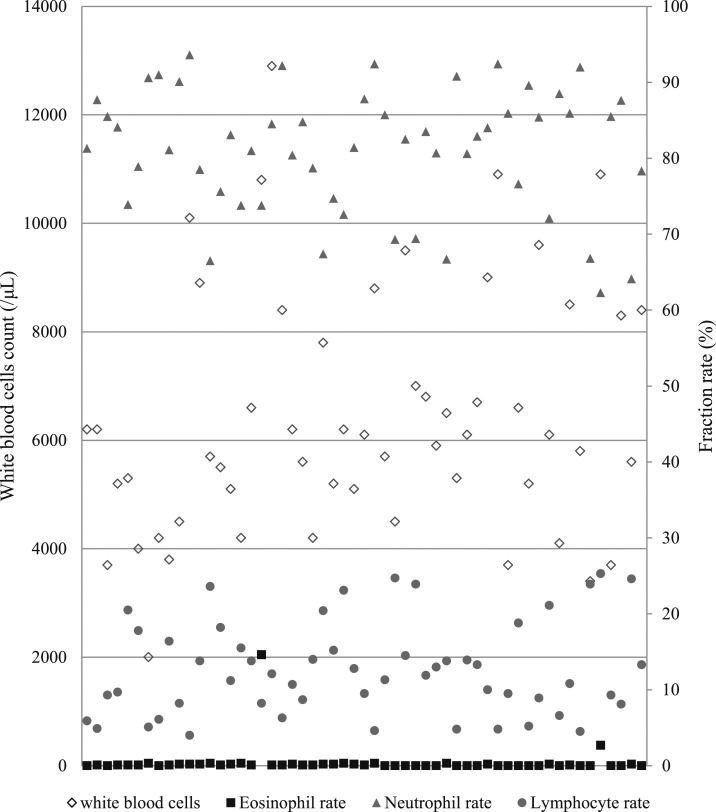
Japanese spotted fever (JSF) is a zoonosis transmitted by ticks carrying the pathogen . The classic triad of JSF symptoms is high fever, erythema, and tick bite eschar. About 200 people in Japan develop the disease every year. Japanese spotted fever is also a potentially fatal disease. At Minami-Ise Municipal Hospital in Japan, 55 patients were diagnosed with JSF from 2007 to 2015, which was equivalent to 4.3% of the total JSF cases in Japan. In this retrospective study, we examined the medical records of these 55 JSF cases. Fever, erythema, eschar, and elevated C-reactive protein (CRP) are characteristic clinical features of the disease. We confirmed four of these in the reviewed cases; however, eschar was not present in occasional cases. We confirmed that eosinopenia appeared in nearly all cases. Using fever, erythema, elevated CRP, and eosinopenia in diagnostic screening, our positivity rate was 90.9%. In our clinical practice, including eosinopenia improves the initial diagnosis of JSF.
日本斑疹热(JSF)是一种由携带病原体的蜱传播的人畜共患病。JSF 的典型三联征是高热、红斑和蜱咬焦痂。日本每年约有 200 人发病。日本斑疹热也是一种潜在致命的疾病。在日本的南伊势市立医院,2007 年至 2015 年期间诊断出 55 例 JSF,相当于日本 JSF 总病例数的 4.3%。在这项回顾性研究中,我们检查了这 55 例 JSF 病例的病历。发热、红斑、焦痂和 C 反应蛋白(CRP)升高是该病的特征性临床特征。在回顾的病例中,我们确认了其中的四个,但偶尔也会出现没有焦痂的病例。我们证实几乎所有病例都出现了嗜酸性粒细胞减少。在诊断性筛查中使用发热、红斑、CRP 升高和嗜酸性粒细胞减少,我们的阳性率为 90.9%。在我们的临床实践中,包括嗜酸性粒细胞减少在内,可提高 JSF 的初始诊断率。