Ding Rongrong, Yang Ming, Wang Xingwang, Quan Jianping, Zhuang Zhanwei, Zhou Shenping, Li Shaoyun, Xu Zheng, Zheng Enqin, Cai Gengyuan, Liu Dewu, Huang Wen, Yang Jie, Wu Zhenfang
College of Animal Science and National Engineering Research Center for Breeding Swine Industry, South China Agricultural University, Guangdong, China.
National Engineering Research Center for Breeding Swine Industry, Guangdong Wens Foodstuffs Group, Co., Ltd., Guangdong, China.
Front Genet. 2018 Jun 19;9:220. doi: 10.3389/fgene.2018.00220. eCollection 2018.
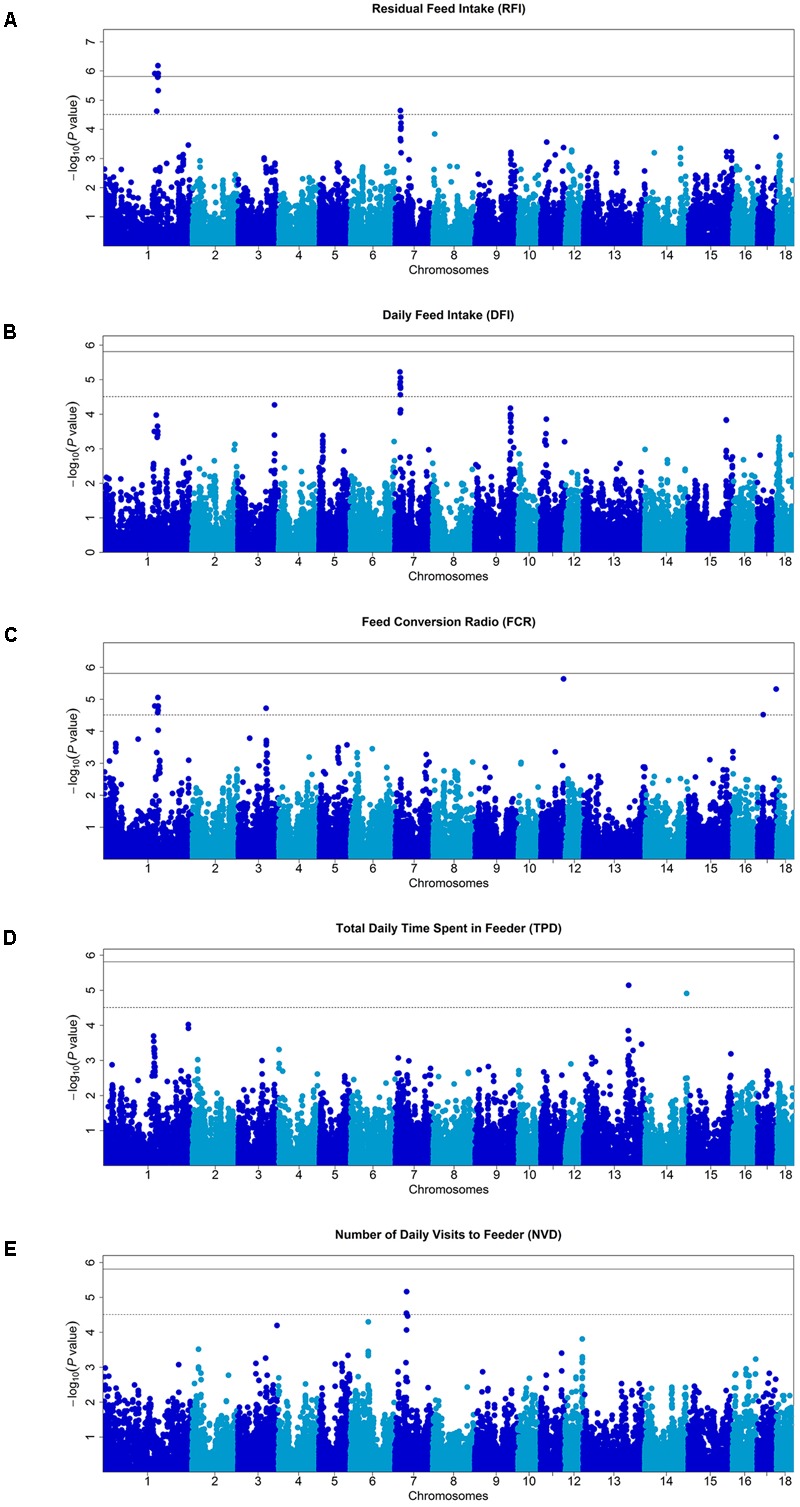
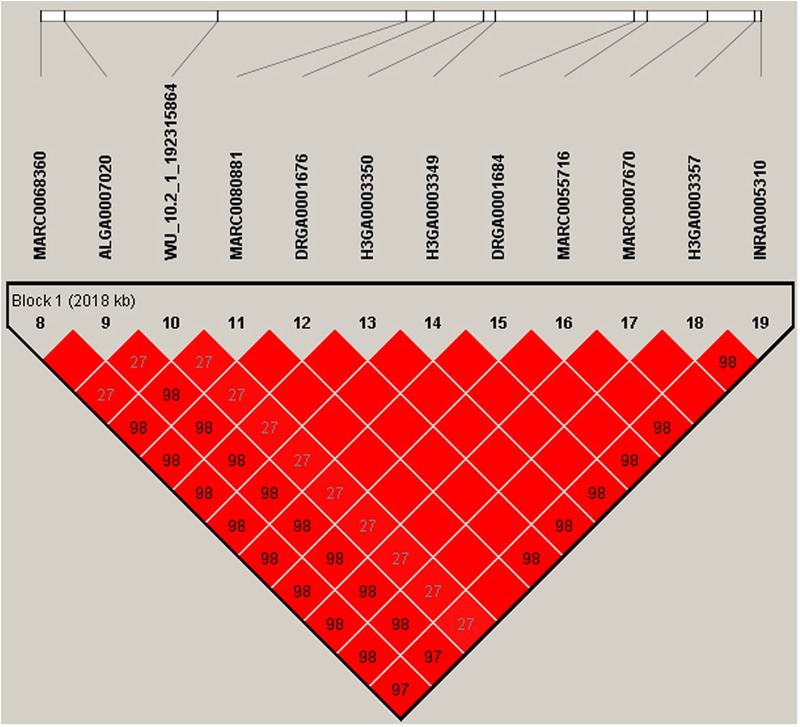
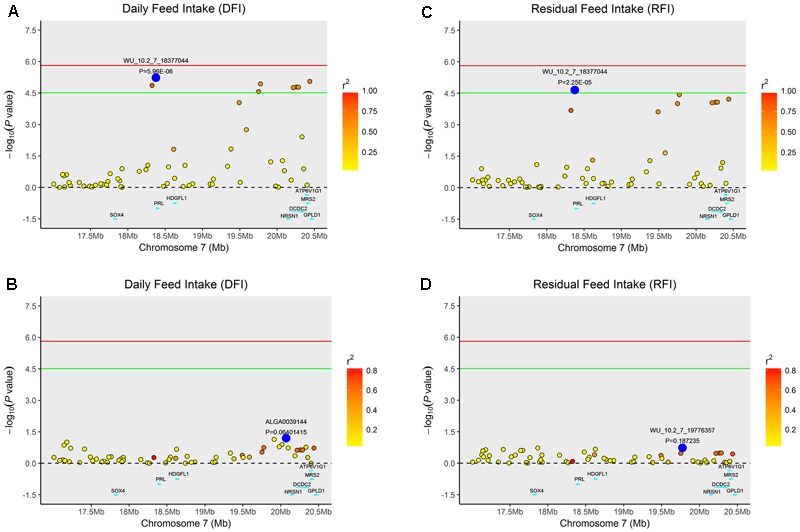
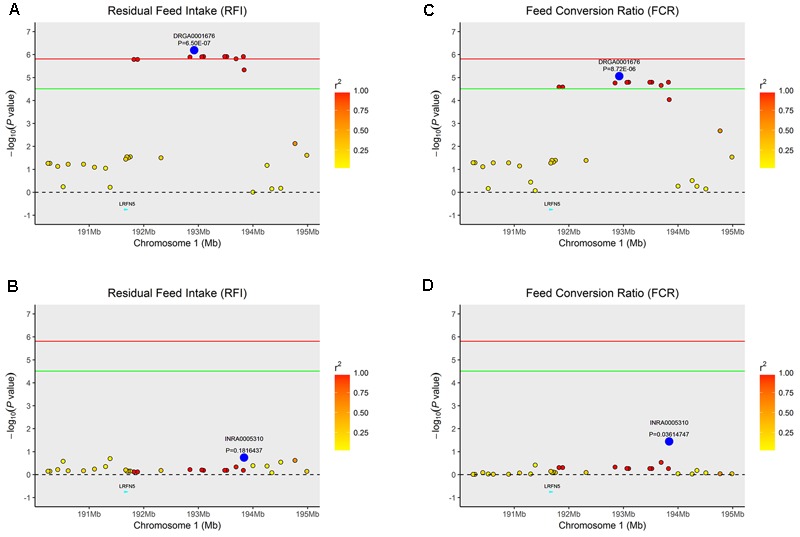
Increasing feed efficiency is a major goal of breeders as it can reduce production cost and energy consumption. However, the genetic architecture of feeding behavior and feed efficiency traits remains elusive. To investigate the genetic architecture of feed efficiency in pigs, three feeding behavior traits (daily feed intake, number of daily visits to feeder, and duration of each visit) and two feed efficiency traits (feed conversion ratio and residual feed intake) were considered. We performed genome-wide association studies (GWASs) of the five traits using a population of 1,008 Duroc pigs genotyped with an Illumina Porcine SNP50K BeadChip. A total of 9 genome-wide ( < 1.54E-06) and 35 suggestive ( < 3.08E-05) single nucleotide polymorphisms (SNPs) were detected. Two pleiotropic quantitative trait loci (QTLs) on SSC 1 and SSC 7 were found to affect more than one trait. Markers WU_10.2_7_18377044 and DRGA0001676 are two key SNPs for these two pleiotropic QTLs. Marker WU_10.2_7_18377044 on SSC 7 contributed 2.16 and 2.37% of the observed phenotypic variance for DFI and RFI, respectively. The other SNP DRGA0001676 on SSC 1 explained 3.22 and 5.46% of the observed phenotypic variance for FCR and RFI, respectively. Finally, functions of candidate genes and gene set enrichment analysis indicate that most of the significant pathways are associated with hormonal and digestive gland secretion during feeding. This study advances our understanding of the genetic mechanisms of feeding behavior and feed efficiency traits and provide an opportunity for increasing feeding efficiency using marker-assisted selection or genomic selection in pigs.
提高饲料效率是育种者的一个主要目标,因为它可以降低生产成本和能源消耗。然而,采食行为和饲料效率性状的遗传结构仍然不清楚。为了研究猪饲料效率的遗传结构,我们考虑了三个采食行为性状(日采食量、每日访问饲槽次数和每次访问的持续时间)和两个饲料效率性状(饲料转化率和剩余采食量)。我们使用1008头杜洛克猪群体,通过Illumina猪SNP50K芯片进行基因分型,对这五个性状进行了全基因组关联研究(GWAS)。共检测到9个全基因组显著(<1.54E-06)和35个提示性(<3.08E-05)单核苷酸多态性(SNP)。发现位于1号和7号染色体上的两个多效性数量性状位点(QTL)影响多个性状。标记WU_10.2_7_18377044和DRGA0001676是这两个多效性QTL的两个关键SNP。7号染色体上的标记WU_10.2_7_18377044分别解释了日采食量和剩余采食量观测表型变异的2.16%和2.37%。1号染色体上的另一个SNP DRGA0001676分别解释了饲料转化率和剩余采食量观测表型变异的3.22%和5.46%。最后,候选基因功能和基因集富集分析表明,大多数显著通路与采食期间的激素和消化腺分泌有关。本研究增进了我们对采食行为和饲料效率性状遗传机制的理解,并为在猪中使用标记辅助选择或基因组选择提高饲料效率提供了机会。