Jiang Wenhan, Ma Zifeng, Zhang Huiyong, Lynn Henry S, Xu Beiqi, Zhang Xiao, Bi Rongrong, Fu Jiyou, Chen Yue, Xiao Zhen, Zhang Zhijie, Lu Zhenhui
Department of Biostatistics, School of Public Health, Fudan University, Shanghai, People's Republic of China.
Department of Respiratory, Longhua Hospital Shanghai University of Traditional Chinese Medicine, No.725 South Wanping Road, No.1 building, Xuhui District, Shanghai, People's Republic of China.
Trials. 2018 Jul 4;19(1):355. doi: 10.1186/s13063-018-2739-8.
Over the past two or three decades, the prevalence of asthma has significantly increased worldwide; therefore, effective treatment without side effects is of utmost importance. Traditional Chinese medicine (TCM) plays a vital role in reducing symptoms and improving the quality of life in persistent-asthma patients. The aim of this study is to evaluate the efficacy of the Jia Wei Yang He (JWYH) formula in the treatment of asthma and to explore the relationship between the airway microbiome and TCM treatment in asthma patients.
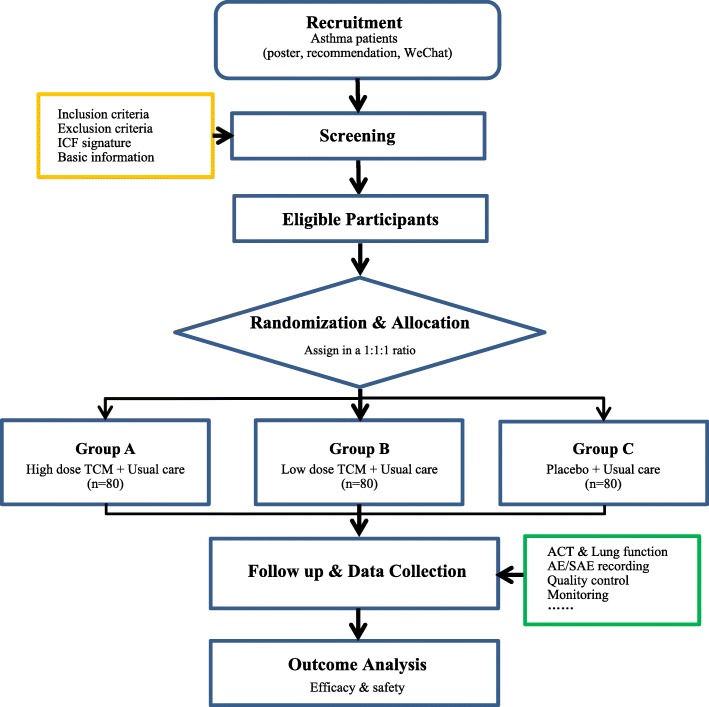
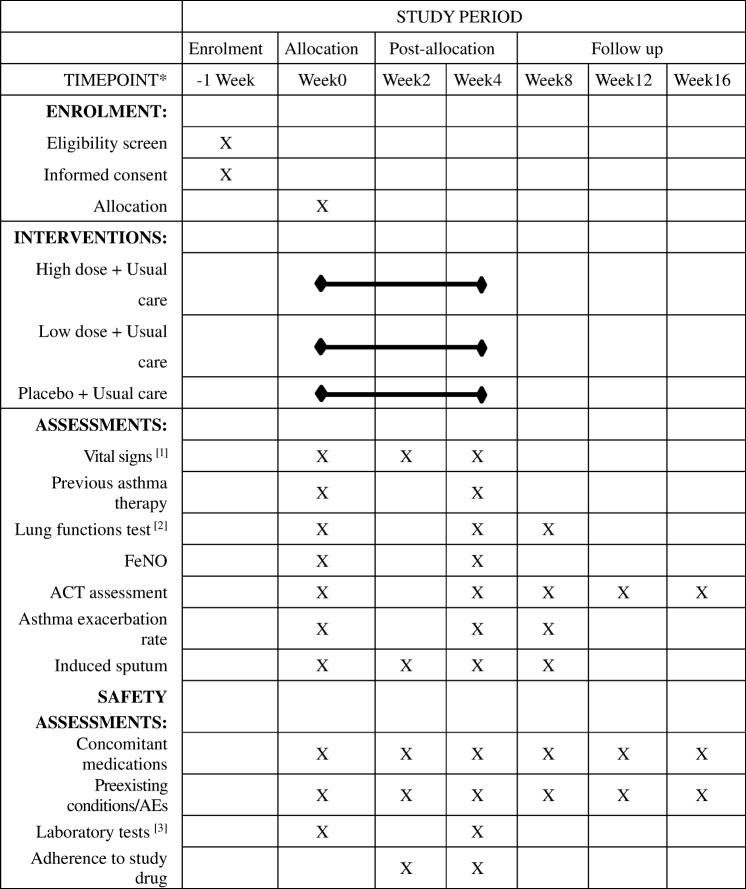
METHODS/DESIGN: This multicenter, parallel-arm, randomized, double-blinded, placebo-controlled trial will assess the efficacy of JWYH in asthma patients with usual care. Persistent-asthma patients without life-threatening disease will be enrolled on a random basis and are equally assigned to a high- or a low-dose JWYH plus usual care group, or a placebo plus usual care group. Patients are followed up for 4 months. Accordingly, 240 patients will yield sufficient statistical power to determine a difference between groups. Based on modified intent-to-treat (mITT) analyses, the three groups will be compared at 4 weeks after the beginning of treatment. The primary efficacy measurement is the mean change in the Asthma Control Test (ACT) score from baseline to 4 weeks post treatment. Secondary outcomes include forced expiratory volume in 1 s (FEV), forced vital capacity (FVC), peak expiratory flow (PEF), and asthma exacerbations. This trial also includes analyses of the associations between airway microbiome and asthma treatment.
In this study, a randomized clinical trial design is described. The results are based on several outcomes that estimate the efficacy of the JWYH formula and prospective links between the airway microbiome and asthma treatment.
ClinicalTrials.gov, ID: NCT03299322 . Registered on 3 October 2017.
在过去二三十年里,哮喘的患病率在全球范围内显著上升;因此,无副作用的有效治疗至关重要。中医在减轻持续性哮喘患者症状和提高生活质量方面发挥着重要作用。本研究的目的是评估加味阳和方(JWYH)治疗哮喘的疗效,并探讨哮喘患者气道微生物群与中医治疗之间的关系。
方法/设计:本多中心、平行组、随机、双盲、安慰剂对照试验将评估JWYH联合常规治疗对哮喘患者的疗效。无危及生命疾病的持续性哮喘患者将被随机纳入,并平均分配至高剂量或低剂量JWYH联合常规治疗组,或安慰剂联合常规治疗组。对患者进行4个月的随访。因此,240名患者将产生足够的统计效力以确定组间差异。基于改良意向性分析(mITT),在治疗开始后4周对三组进行比较。主要疗效指标是哮喘控制测试(ACT)评分从基线到治疗后4周的平均变化。次要结局包括一秒用力呼气容积(FEV)、用力肺活量(FVC)、呼气峰值流速(PEF)和哮喘急性发作。本试验还包括对气道微生物群与哮喘治疗之间关联的分析。
在本研究中,描述了一种随机临床试验设计。结果基于几个评估JWYH配方疗效以及气道微生物群与哮喘治疗之间前瞻性联系的结局指标。
ClinicalTrials.gov,标识符:NCT03299322。于2017年10月3日注册。