Zhang Qingling, Cox Michael, Liang Zhike, Brinkmann Folke, Cardenas Paul A, Duff Rachael, Bhavsar Pankaj, Cookson William, Moffatt Miriam, Chung Kian Fan
National Heart & Lung Institute, Imperial College, London, United Kingdom.
Respiratory Biomedical Research Unit, Royal Brompton & Harefield NHS Trust and Imperial College London, United Kingdom.
PLoS One. 2016 Apr 14;11(4):e0152724. doi: 10.1371/journal.pone.0152724. eCollection 2016.
The lower airways harbor a community of bacterial species which is altered in asthma.
We examined whether the lower airway microbiota were related to measures of asthma severity.
We prospectively recruited 26 severe asthma, 18 non-severe asthma and 12 healthy subjects. DNA was extracted from induced sputum and PCR amplification of the V3-V5 region of bacterial 16S rRNA gene was performed.
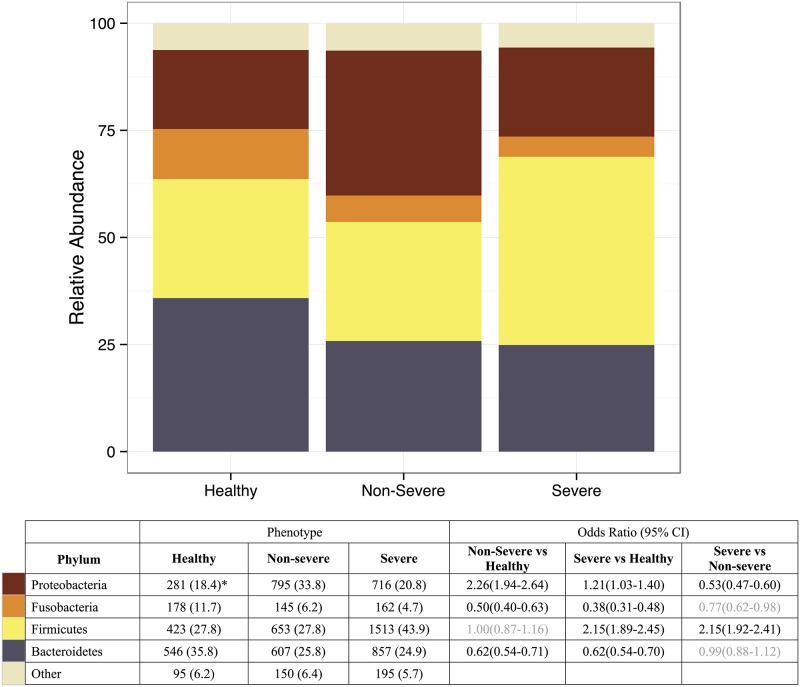
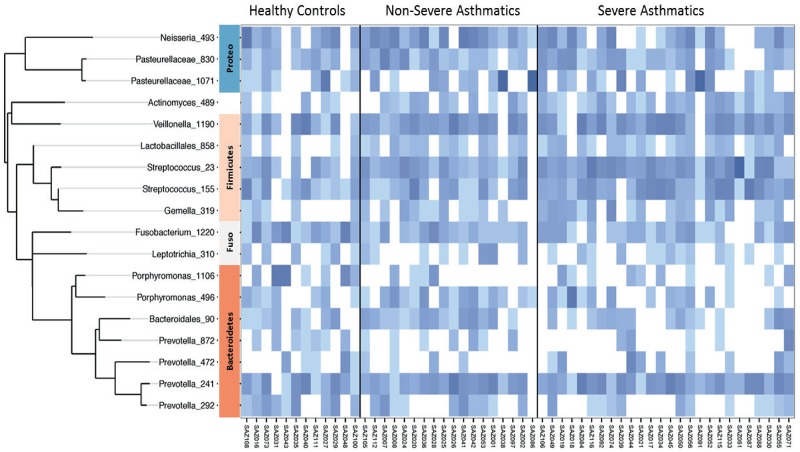
We obtained 138,218 high quality sequences which were rarefied at 133 sequences/sample. Twenty OTUs had sequences ≥1% of total. There were marked differences in the distribution of Phyla between groups (P = 2.8x10-118). Bacteroidetes and Fusobacteria were reduced in non-severe and severe asthmatic groups. Proteobacteria were more common in non-severe asthmatics compared to controls (OR = 2.26; 95% CI = 1.94-2.64) and Firmicutes were increased in severe asthmatics compared to controls (OR = 2.15; 95%CI = 1.89-2.45). Streptococcal OTUs amongst the Firmicutes were associated with recent onset asthma, rhinosinusitis and sputum eosinophilia.
Sputum microbiota in severe asthma differs from healthy controls and non-severe asthmatics, and is characterized by the presence of Streptococcus spp with eosinophilia. Whether these organisms are causative for the pathophysiology of asthma remains to be determined.
下呼吸道存在一个细菌群落,其在哮喘中会发生改变。
我们研究了下呼吸道微生物群是否与哮喘严重程度的指标相关。
我们前瞻性招募了26名重度哮喘患者、18名非重度哮喘患者和12名健康受试者。从诱导痰中提取DNA,并对细菌16S rRNA基因的V3-V5区域进行PCR扩增。
我们获得了138,218条高质量序列,以133条序列/样本进行了稀疏化处理。20个操作分类单元(OTU)的序列占总数的≥1%。各组之间门的分布存在显著差异(P = 2.8×10-118)。在非重度和重度哮喘组中,拟杆菌门和梭杆菌门减少。与对照组相比,变形菌门在非重度哮喘患者中更常见(比值比[OR]=2.26;95%置信区间[CI]=1.94-2.64),与对照组相比,厚壁菌门在重度哮喘患者中增加(OR = 2.15;95%CI = 1.89-2.45)。厚壁菌门中的链球菌OTU与近期发作的哮喘、鼻窦炎和痰嗜酸性粒细胞增多有关。
重度哮喘患者的痰液微生物群与健康对照组和非重度哮喘患者不同,其特征是存在伴有嗜酸性粒细胞增多的链球菌属。这些微生物是否是哮喘病理生理学的病因仍有待确定。