Department of Psychology, Ludwig-Maximilians-Universität München, Munich, 80802, Germany.
Graduate School of Systemic Neuroscience LMU Munich, Planegg, Martinsried, 82152, Germany.
Sci Rep. 2018 Jul 4;8(1):10110. doi: 10.1038/s41598-018-28241-z.
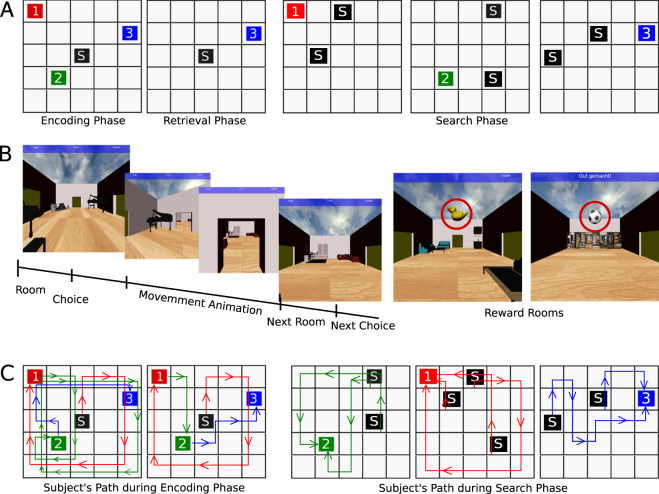
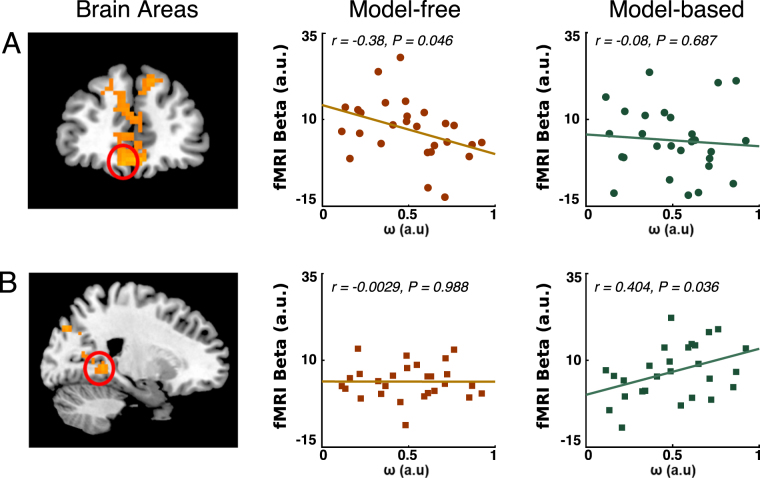
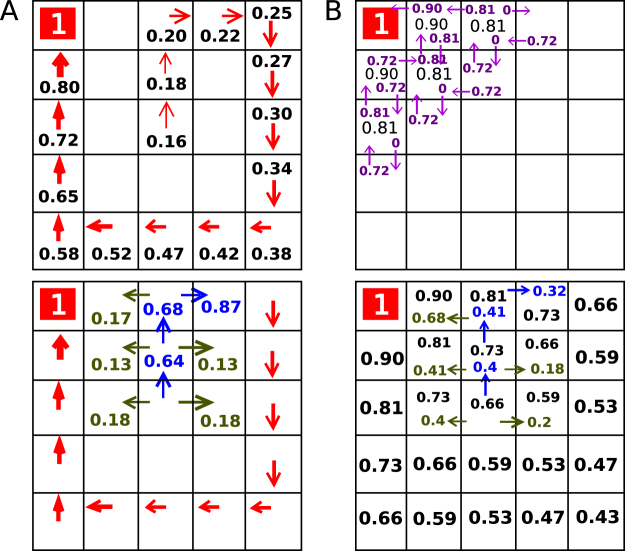
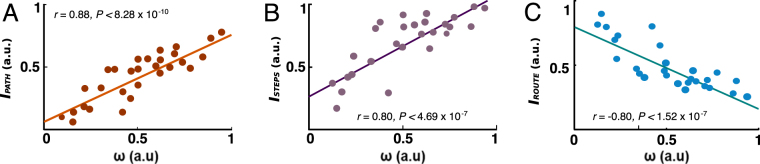
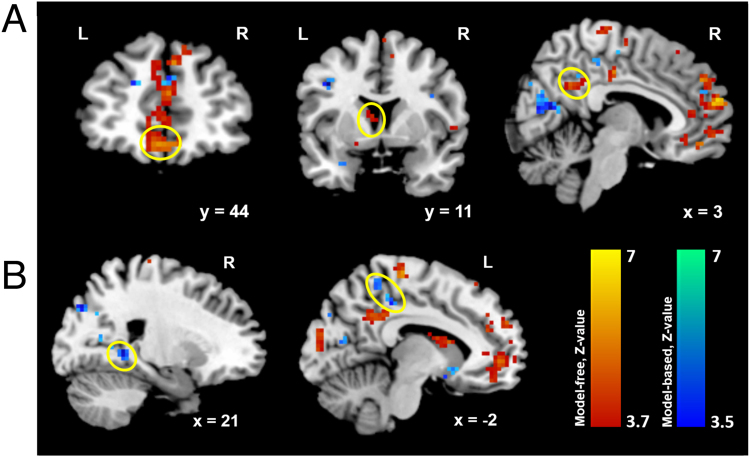
Human navigation is generally believed to rely on two types of strategy adoption, route-based and map-based strategies. Both types of navigation require making spatial decisions along the traversed way although formal computational and neural links between navigational strategies and mechanisms of value-based decision making have so far been underexplored in humans. Here we employed functional magnetic resonance imaging (fMRI) while subjects located different objects in a virtual environment. We then modelled their paths using reinforcement learning (RL) algorithms, which successfully explained decision behavior and its neural correlates. Our results show that subjects used a mixture of route and map-based navigation and their paths could be well explained by the model-free and model-based RL algorithms. Furthermore, the value signals of model-free choices during route-based navigation modulated the BOLD signals in the ventro-medial prefrontal cortex (vmPFC), whereas the BOLD signals in parahippocampal and hippocampal regions pertained to model-based value signals during map-based navigation. Our findings suggest that the brain might share computational mechanisms and neural substrates for navigation and value-based decisions such that model-free choice guides route-based navigation and model-based choice directs map-based navigation. These findings open new avenues for computational modelling of wayfinding by directing attention to value-based decision, differing from common direction and distances approaches.
人类导航通常被认为依赖于两种策略的采用,即基于路线的策略和基于地图的策略。这两种导航类型都需要在行进过程中做出空间决策,尽管在人类中,关于导航策略和基于价值的决策机制之间的正式计算和神经联系,到目前为止还没有得到充分的探索。在这里,我们在被试者在虚拟环境中定位不同物体时使用了功能磁共振成像(fMRI)。然后,我们使用强化学习(RL)算法对他们的路径进行建模,该算法成功地解释了决策行为及其神经关联。我们的研究结果表明,被试者使用了基于路线和基于地图的混合导航,他们的路径可以通过无模型和基于模型的 RL 算法得到很好的解释。此外,基于路线的导航中无模型选择的价值信号调节了腹内侧前额叶皮层(vmPFC)的 BOLD 信号,而基于地图的导航中基于模型的价值信号与海马和海马旁回区域的 BOLD 信号有关。我们的发现表明,大脑可能共享导航和基于价值的决策的计算机制和神经基质,使得无模型选择指导基于路线的导航,而基于模型的选择指导基于地图的导航。这些发现为通过关注基于价值的决策来指导寻路的计算建模开辟了新的途径,这与常见的方向和距离方法不同。