Department of Psychology, Binghamton University, Binghamton, New York, United States of America.
Metabolic Surgery, St. Joseph Hospital Health Center, Syracuse, New York, United States of America.
PLoS One. 2018 Jul 5;13(7):e0199508. doi: 10.1371/journal.pone.0199508. eCollection 2018.
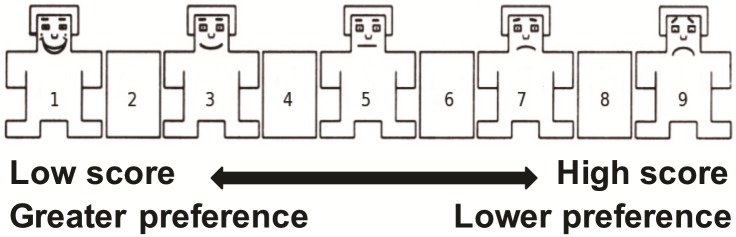
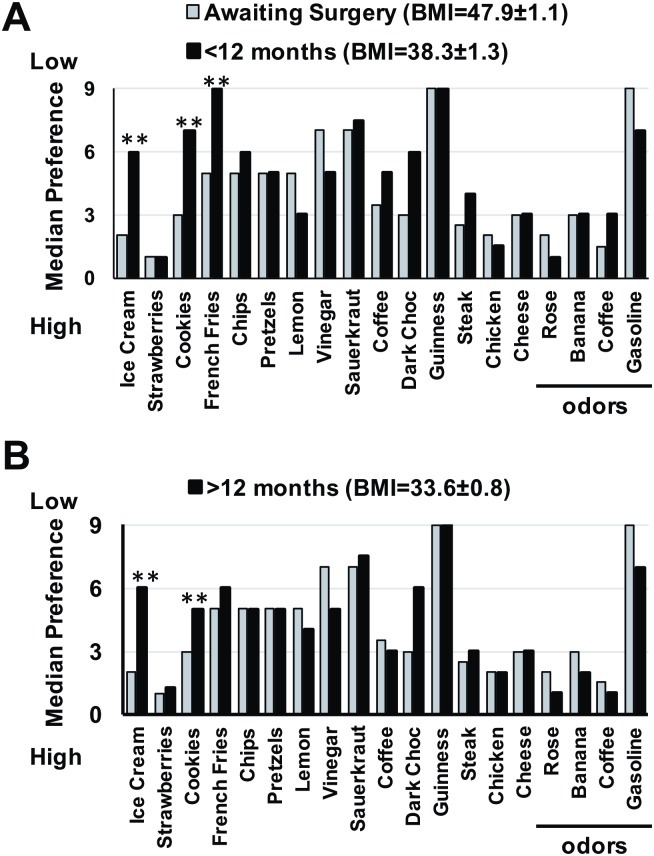
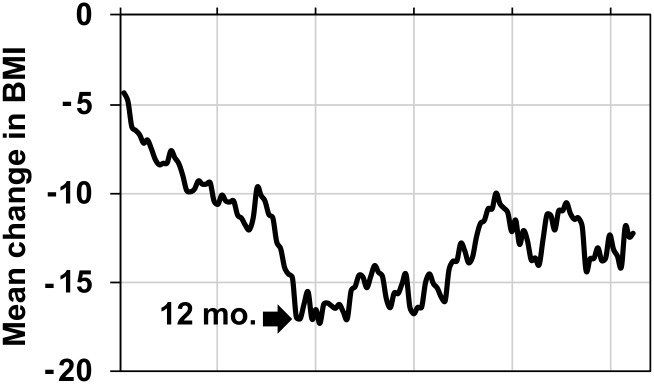
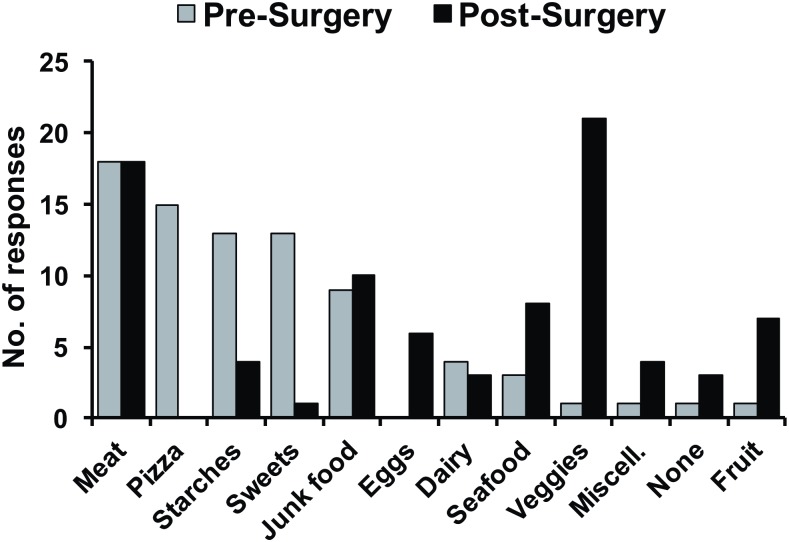
It is well established that bariatric surgery, the most effective method to achieve long-term weight loss in obese subjects, reverses enhanced preference and intake of sweet/fatty foods. Although taste and odor preference changes following bariatric surgery have been previously described, their time course and relationship to weight loss remains an issue. The aim of this study was to determine the relationship between taste and odor preference changes and successful weight loss following bariatric surgery. A cross-sectional study was performed on 195 human subjects with body mass index (BMI) above 30 (at least class I obesity), who were scheduled to receive (n = 54) or had previously received (n = 141) Roux-en-Y gastric bypass (RYGB). A Self-Assessment Manikin test was used to measure each participant's affective reaction (ranging from pleasure to displeasure) to a variety of food-related and odor-related pictures. Results confirmed earlier reports about changes in sweet/fatty foods preference after surgery and revealed a shift in preference toward less calorie-dense foods. Relatedly, endorsements of "favorite" foods were mostly sweet/fatty foods in subjects awaiting surgery but were shifted toward more healthy choices, particularly vegetables, in subjects post-RYGB surgery. However, food preference ratings trended toward pre-surgical levels as the time since surgery increased. Answers to open-ended questions about why their diet changed post-surgery revealed that changes in cravings, rather than changes in taste per se, were the major factor. Surprisingly, patients rating a coffee taste as more pleasing after surgery had a lower post-surgical BMI. No associations of odors with change in BMI were apparent. Results showed that following bariatric surgery taste preferences are significantly altered and that these changes correlate with lowered BMI. However, these changes fade as time since surgery lengthens. These results may suggest diagnostic criteria to identify people at risk for less than optimal changes in BMI following bariatric surgery.
已经证实,减重手术是肥胖患者实现长期减肥的最有效方法,可以逆转对甜/脂肪食物的增强偏好和摄入。尽管之前已经描述了减重手术后味觉和嗅觉偏好的变化,但它们的时间过程及其与体重减轻的关系仍然是一个问题。本研究旨在确定减重手术后味觉和嗅觉偏好变化与成功减肥之间的关系。对 195 名体重指数(BMI)超过 30(至少为 I 类肥胖)的人类受试者进行了横断面研究,这些受试者计划接受(n=54)或已经接受(n=141)Roux-en-Y 胃旁路手术(RYGB)。使用自我评估情绪图测试来衡量每个参与者对各种与食物相关和气味相关的图片的情感反应(范围从愉悦到不悦)。结果证实了先前关于手术后甜味/脂肪食物偏好变化的报告,并揭示了对热量密度较低的食物的偏好转变。相关地,在等待手术的受试者中,“最喜欢”的食物大多是甜/脂肪食物,但在 RYGB 手术后的受试者中,这些食物则更多地转向更健康的选择,尤其是蔬菜。然而,随着手术时间的增加,食物偏好评分呈趋势向术前水平。对手术后为什么饮食发生变化的开放式问题的回答表明,是食欲的变化而不是味觉本身的变化是主要因素。令人惊讶的是,手术后对咖啡味道评价更愉悦的患者术后 BMI 较低。嗅觉与 BMI 变化之间没有明显关联。结果表明,减重手术后味觉偏好显著改变,这些变化与 BMI 降低相关。然而,随着手术时间的延长,这些变化会逐渐消失。这些结果可能表明有诊断标准可以识别出在减重手术后 BMI 变化不理想的风险较高的人群。