Basic Sciences Division and Computational Biology Program, Fred Hutchinson Cancer Research Center, Seattle, Washington, United States of America.
Molecular and Cellular Biology PhD program, University of Washington, Seattle, Washington, United States of America.
PLoS Pathog. 2018 Jul 5;14(7):e1007159. doi: 10.1371/journal.ppat.1007159. eCollection 2018 Jul.
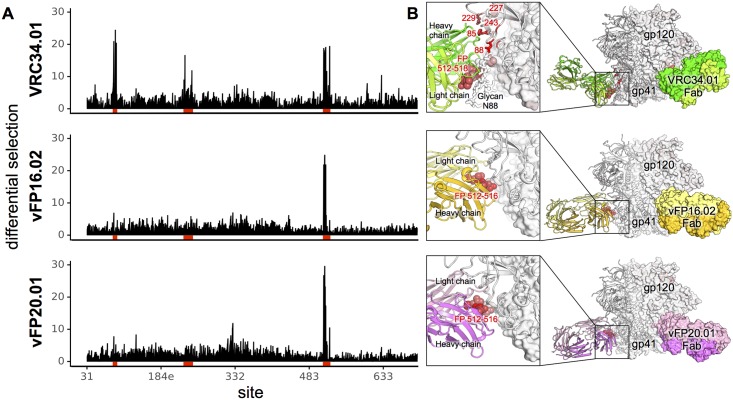
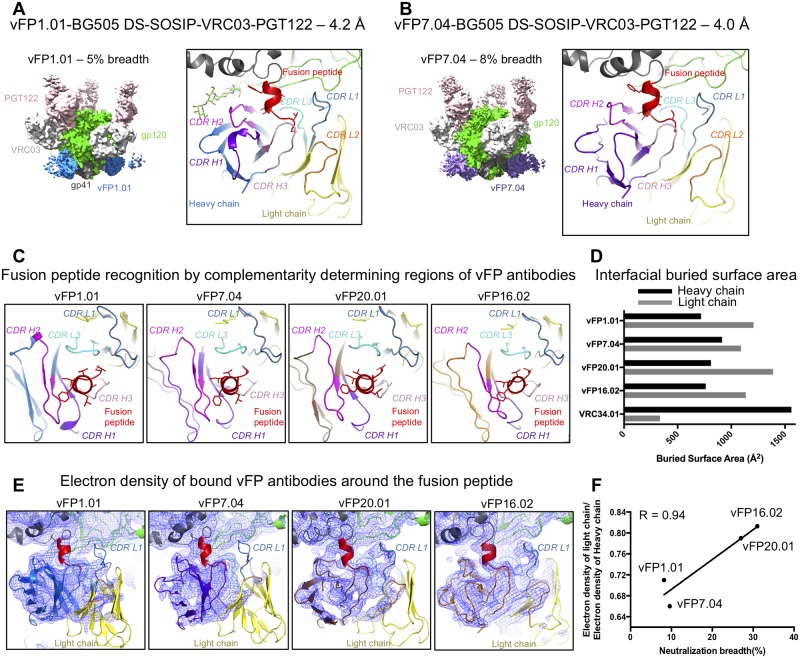
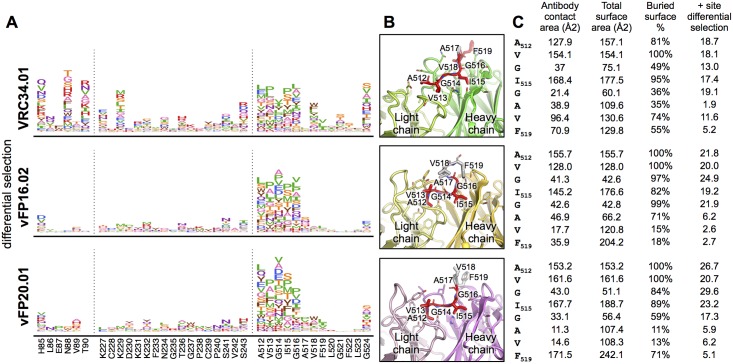
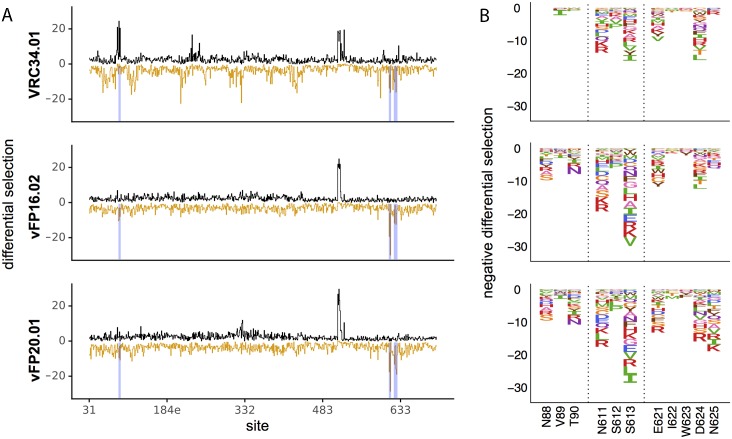
Eliciting broadly neutralizing antibodies (bnAbs) targeting envelope (Env) is a major goal of HIV vaccine development, but cross-clade breadth from immunization has only sporadically been observed. Recently, Xu et al (2018) elicited cross-reactive neutralizing antibody responses in a variety of animal models using immunogens based on the epitope of bnAb VRC34.01. The VRC34.01 antibody, which was elicited by natural human infection, targets the N terminus of the Env fusion peptide, a critical component of the virus entry machinery. Here we precisely characterize the functional epitopes of VRC34.01 and two vaccine-elicited murine antibodies by mapping all single amino-acid mutations to the BG505 Env that affect viral neutralization. While escape from VRC34.01 occurred via mutations in both fusion peptide and distal interacting sites of the Env trimer, escape from the vaccine-elicited antibodies was mediated predominantly by mutations in the fusion peptide. Cryo-electron microscopy of four vaccine-elicited antibodies in complex with Env trimer revealed focused recognition of the fusion peptide and provided a structural basis for development of neutralization breadth. Together, these functional and structural data suggest that the breadth of vaccine-elicited antibodies targeting the fusion peptide can be enhanced by specific interactions with additional portions of Env. Thus, our complete maps of viral escape both delineate pathways of resistance to these fusion peptide-directed antibodies and provide a strategy to improve the breadth or potency of future vaccine-induced antibodies against Env's fusion peptide.
诱导针对包膜 (Env) 的广泛中和抗体 (bnAbs) 是 HIV 疫苗开发的主要目标,但免疫接种产生的跨谱系广度仅偶尔观察到。最近,Xu 等人 (2018) 使用基于 bnAb VRC34.01 表位的免疫原在多种动物模型中诱导出交叉反应性中和抗体反应。VRC34.01 抗体是由自然人类感染引起的,针对 Env 融合肽的 N 端,这是病毒进入机制的关键组成部分。在这里,我们通过将所有单个氨基酸突变映射到影响病毒中和的 BG505 Env 上来精确表征 VRC34.01 和两种疫苗诱导的鼠抗体的功能表位。虽然 VRC34.01 的逃逸是通过融合肽和 Env 三聚体的远端相互作用位点的突变发生的,但疫苗诱导的抗体的逃逸主要是由融合肽中的突变介导的。四种疫苗诱导的抗体与 Env 三聚体复合物的低温电子显微镜揭示了融合肽的聚焦识别,并为中和广度的发展提供了结构基础。这些功能和结构数据表明,通过与 Env 的其他部分的特定相互作用,可以增强针对融合肽的疫苗诱导的抗体的广度。因此,我们对病毒逃逸的完整图谱不仅描绘了这些融合肽定向抗体的抗性途径,而且为提高针对 Env 融合肽的未来疫苗诱导抗体的广度或效力提供了策略。